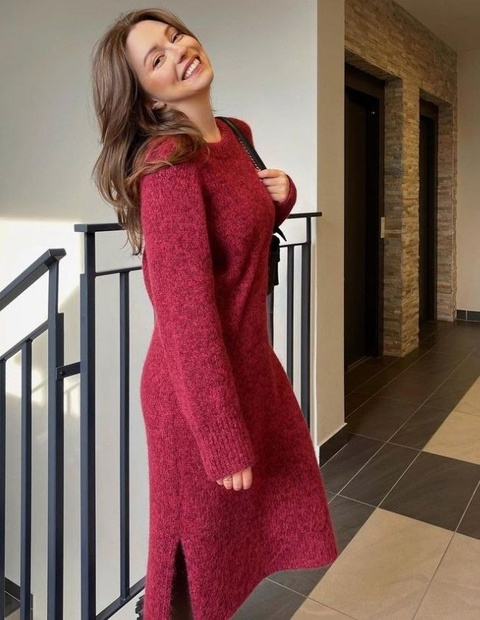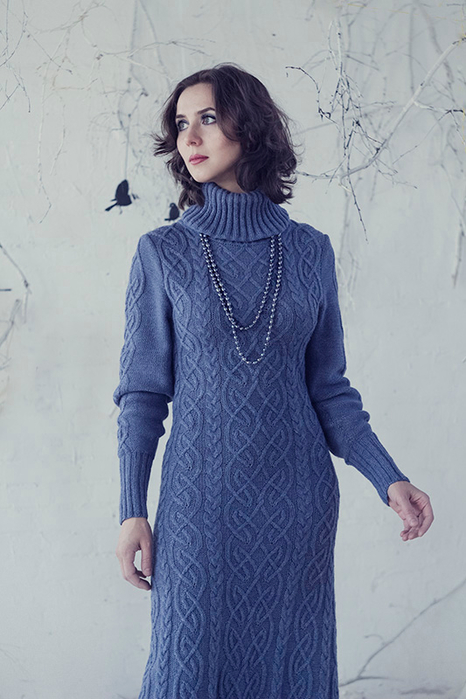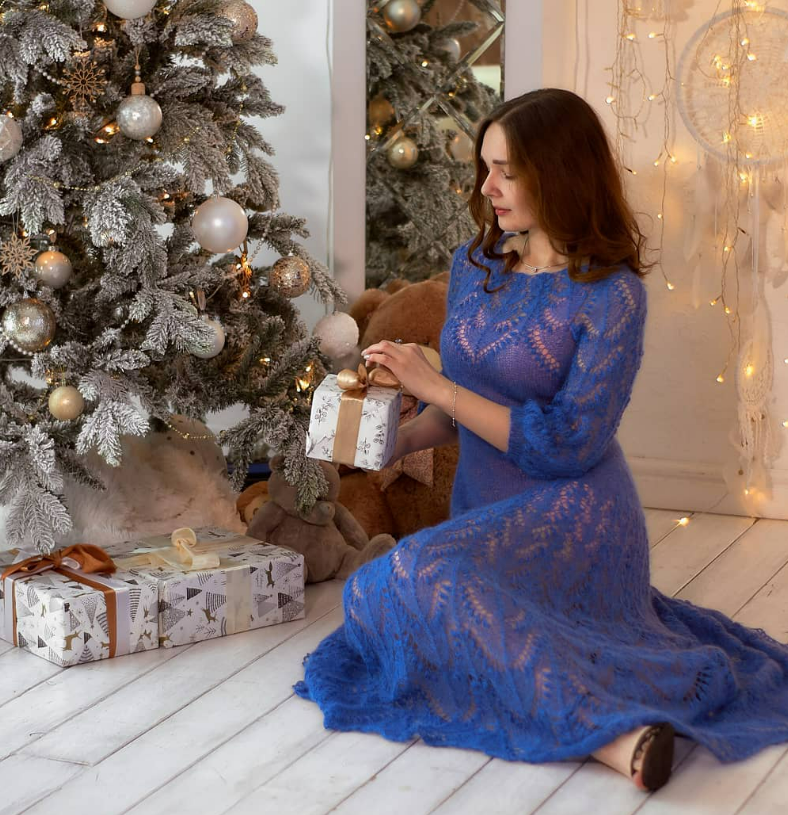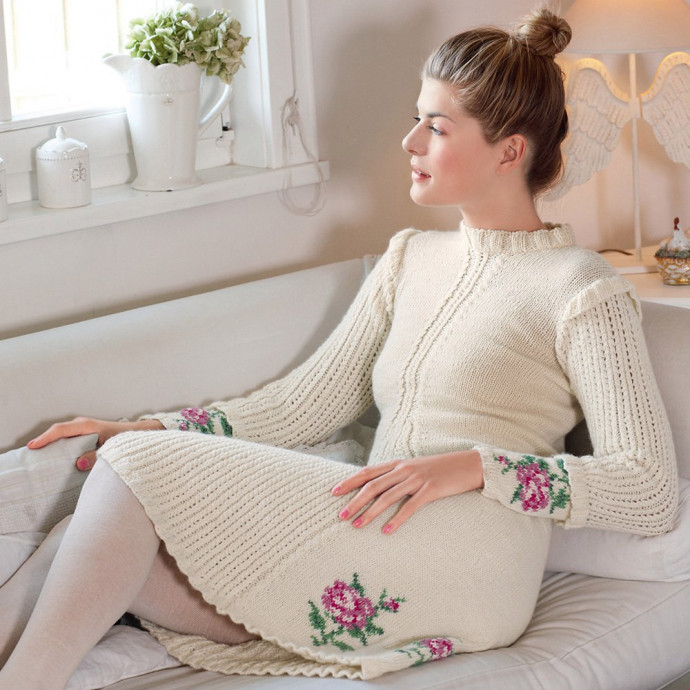




Dress knitted with a round yoke type
Added: 18.01.2020 в 01:18 Views: 26797
Dress knitted with a round yoke typeKlubokhttp://klubok.work/1/100/8341/Klubokhttps://klubok.work/css/image/top-logo-en.png
The height of the elastic is 6 rows.
I used braids: external 4*4, crossed every 6 rows
internal 3*3 crossed every 6 rows
I cast on 101 stitches.
I made increases 8 times every other row and 3 times in every 4th row. The length of the conditional raglan line is 17cm. The width of the product after separating the sleeves (that is, where the second row of internal braids begins) is 96cm. My bust circumference is 78cm. The length of the dress from the armhole is 65cm. The width at the bottom is 176cm.
I made increases to widen the fabric every 7th row by 2 stitches at the front and on the back
Many girls are already interested in the rhythm of increases in the yoke. I wanted to show it right away on mine, but I'll try to explain simply in words.
My gauge is 10cm - 16 stitches. I want the neck width to be 60cm. 60*1.6p (in 1cm) = 96 stitches. I cast on 101. Because 5 stitches won't change much for me (I will process the neck with a crochet at the end). In the burgundy dress, I knitted the first 8 rows of the elastic without increases, then started the fabric with a pattern and immediately added increases.
Here, I immediately started with patterns and increases after the cast-on row.
I have already written about the increases in the burgundy dress. I also want to say that it fits snugly, but it easily fits a size 48.
Now I am knitting a dress for a woman size 48, height 164 cm. And I will make increases every second row until the very end of the yoke. Because the customer is of short stature but with volume.
You measure the desired width of the neck and calculate the number of stitches you need. Then you do the neck calculations and start the increases.
If your body type is like mine, with a minus sign, then for the first 5-6 times, you add in every second row. Then a few more times in every third or fourth row. It depends on your height. If you are short, then in the third, if tall, then in the fourth. Measure, be sure to try it on!
If you have volume, then most likely you will be adding until the very end in every third row.
Don't forget that ease of fit should be there. When it seems to you that the length and width of the yoke are enough, divide the stitches as for the raglan (the total number by three, one of the parts is then divided by 2 for the sleeves). Try it on, pin it with markers, and transfer it to a cable. See if the result suits you? It may be necessary to leave less for the back if it is narrow, or more for the sleeves if the arms are thick. Symmetrically select stitches from the front and back - depending on where you need more or less.
I always divide evenly for myself, and it turns out well.
This is how I distributed the stitches for the braids in the burgundy dress. You can do it differently if the number of stitches is different.
Everything I knitted today, I unraveled and changed the needles to 4, to make it tighter. Because after the sample dried, it became very soft and too loose. I wanted it denser. The difference in gauge is only one stitch. But maybe in the overall fabric, it will be better.
Currently, I have knitted one skein of yarn. The line of increases is 17cm. Increases every other row. Another 3 centimeters, and I will start knitting the back neck (I will definitely show and tell)
So, I have completely finished the yoke. The total length of my conditional raglan line is 21cm.
After all the increases, I had 272 stitches on the needles. I distributed them as follows: 45 stitches for the sleeves and 91 stitches for the front and back. I started dividing the stitches from the central stitch of the front. From it, 45 to the left and right - marker (this is the front). Then from each of these markers, another 45 stitches (sleeves). The remaining ones are for the back. After that, I knitted 9 rows for the back (this is the back neck).
And only after I knitted the back neck did I separate the sleeves, adding 12 stitches for each side for the underarm. Then I knit in the round. I do not knit short rows. The knitting will be even, there will be no corners. This has been checked on all my sweaters knitted this way. And on the dress.
In every 7th row, I will make increases of 2 stitches in the front and 2 in the back to widen the fabric and create an A-silhouette.
Back neck. Height 9 rows
These are my stitches for the underarms. I didn’t cast on for the waste yarn, I cast on with crossed yarn overs.
Advice on knitting the back neck from Echudik:
"My advice for knitting the back neck. Divide it into four parts and place markers on the back and from it count 20 stitches in both directions (from the sleeves) and place markers. We knit the back neck with short rows. We knit to the marker on the sleeve and turn, knit to the marker. Turn again and knit to the marker without knitting 2 stitches and turn. Again knit to the marker without knitting 2 stitches. Thus, each time we do not knit 2 stitches until the number of stitches for the back neck remains. I also recommend making a small back neck in the front, for example, 4 rows. The transition will be smoother."
The weekend was absolutely unproductive. I knitted, not very much, and on another project) I know many girls are worried they won’t keep up - everyone will keep up, don’t worry. After this, I plan to knit another dress like this for a loved one) And I'm knitting this slowly - I took on several other projects.
I have knitted exactly two skeins.
The width of the body under the armhole is 104cm in a relaxed state. That is, not stretched.
I was asked about the distribution of patterns. I will explain
From the central stitch on both sides, two flat braids of 8 stitches each. On both sides, 2 purl stitches. After 6 stitches, cross two stitches, with one purl stitch on each side. After I reached 6 stitches again with increases on both sides, I made one more such cross.
Increases to widen the dress itself (not the yoke) I wanted to make every 7 rows. But the customer asked for a not very pronounced trapeze, so I made the first increases after 19 rows at the back near the two central lines on the back. At the front near the purl internal stitches by the small braids of two stitches. Next, I plan to make increases in the 14th or 15th row.
I show how I distributed the braids and from which side I will make the increases.
So, this is my final entry. In fact, the tunic has already been given away, I didn't even have time to take a photo - neither sleeves nor bottom, because I was knitting at night, and in the morning my friend grabbed it half wet.
What was knitted was ruthlessly unraveled. Firstly, somehow my gauge changed. I was shocked. I cast on the same number of stitches as in the striped seagull, knitted also 4, but it turned out to be a sheet, damn. The only difference is that the first seagull was knitted with Chinese needles, and now with Zing. Maybe that's the issue? I don't know. Plus, my friend wanted it to be light blue on top and have the same stripes. And I can't refuse her. In short, I played around. The top with 3.5 needles, the bottom with 4. Hence the flaring. 150 stitches, 37 for the front and another 15 for five parts and one central one (do I need to draw?). Increases 6 times every row and 8 times every two rows. The back neck is purely symbolic at 2 rows because the yarn stretches a lot. Underarm stitches of 15.