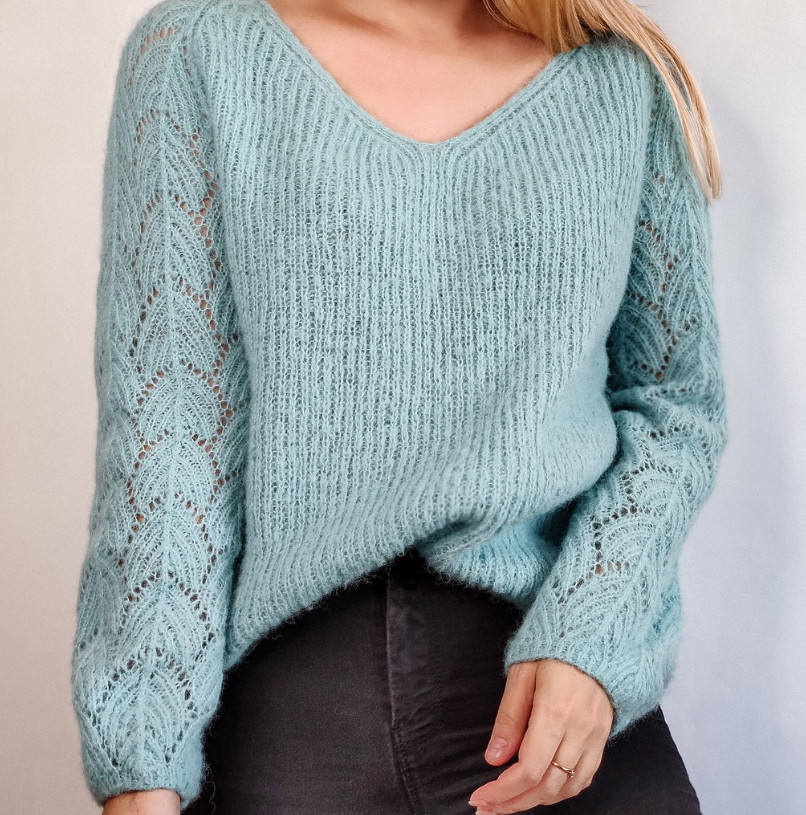




Turquoise Sweater Knitting
Added: 07.06.2020 в 13:08 Views: 19461
Turquoise Sweater KnittingKlubokhttp://klubok.work/1/3/8501/Klubokhttps://klubok.work/css/image/top-logo-en.png

Sizes: 36/38 (40/42 44/46)
You will find size recommendations on page A1. Explanations for performing patterns and knitting techniques are provided on pages A2 and A3.
You will need: yarn (72% alpaca wool, 16% polyamide, 12% sheep wool; 190 m / 50 g) — 300 (300–350) g light gray; needles No. 5; circular needles No. 4.5 and 5, 60 cm long.
Ribbing: alternate 1 knit, 1 purl.
“Braids” A and B: knit according to patterns A and B (General recommendations — see page A2). Distribute stitches according to the instructions. Repeat rows 1 to 20 in height.
Decorative decreases A (edge):
-
from the right edge: selvedge, 1 knit, 2 stitches knit together as knit;
-
from the left edge: knit 2 stitches together leaning left (= slip 1 stitch as if knitting, knit the next stitch, and pull the slipped stitch over the knitted stitch), 1 knit, selvedge.
Decorative decreases B (internal):
-
from the right: after the right “braid” knit 1 stitch, knit 2 stitches together as knit;
-
Decreases in “braids” (sleeves):
-
Before the “braid”: knit 2 stitches together leaning left, 1 knit.
-
After the “braid”: 1 knit, knit 2 stitches together as knit.
Knitting gauge: 16 stitches x 25 rows = 10 × 10 cm, knitted in stockinette stitch (see page A2) on needles No. 5.
Important: measurements were taken from the garment not on the figure, but laid flat on a table. Since knitted fabric has increased elasticity, special attention should be paid to matching your knitting density to the specified one.
Back:
On needles No. 5, cast on 89 (95–101) stitches, start with row 1 and 1 purl after the selvedge stitch, knit 5 rows = 2 cm in ribbing.
Then distribute the pattern stitches as follows:
-
selvedge, 12 (14–16) knit,
-
20 stitches of “braid” A,
-
25 (27–29) knit,
-
20 stitches of “braid” B,
-
12 (14–16) knit,
-
selvedge.
With this distribution, knit until the start of the neckline, performing decorative decreases A and B on both sides:
-
in the 19th row from the ribbing 1 time,
-
then in every 16th row — 2 times,
-
and in every 10th row — 2 times
= 45 (47–49) stitches.
Then knit 9 (5–7) more rows without decreases and close all stitches.
Front:
Knit as for the back, but after the last decrease, perform only 5 (1–3) rows and close all 45 (47–49) stitches.
Left sleeve:
On needles No. 4.5, cast on 41 (46–51) stitches and knit 20 rows = 8 cm in ribbing.
In the last row (between the selvedges) increase stitches to 80 (90–100) stitches.
Switch to needles No. 5 and knit, distributing the pattern stitches as follows:
-
selvedge, 31 (35–39) knit,
-
20 stitches of “braid” A,
-
31 (35–39) knit,
-
selvedge.
With this distribution, knit to the end of the sleeve, performing decorative decreases at the edges of the sleeve on both sides:
-
in the 21st row from the ribbing:
-
in every 8th row — 3 times by 1 stitch.
-
(in every 8th row 3 times and in every 6th row 3 times by 1 stitch.)
-
(in every 6th row 6 times by 1 stitch.) = 45 (51–57) stitches.
-
Then in every 2nd row:
-
1 time 8 stitches, 1 time 7 stitches, 1 time 6 stitches.
-
(1 time 9 stitches, 1 time 8 stitches.)
-
(1 time 11 stitches, 1 time 10 stitches.)
Right sleeve:
Knit symmetrically to the left sleeve and with “braid” B.
Assembly:
General recommendations — see page A3.
Sew the sleeves (long edge to the back).
For the turtleneck, cast on stitches along the edge of the neckline on circular needles No. 4.5:
-
along the edge of the back neckline — 38 (40–42) stitches,
-
along the lower edge of the left sleeve — 22 (24–26) stitches,
-
along the upper edge of the left sleeve — 22 (24–26) stitches,
-
along the upper edge of the right sleeve — 22 (24–26) stitches,
-
along the lower edge of the right sleeve — 22 (24–26) stitches.
Total: 126 (136) stitches.
Join in the round, knit in the round for 10 cm in ribbing.
Switch to needles No. 5 and knit another 14 cm in ribbing.
At a height of the collar of 24 cm — close stitches loosely according to the pattern.
Perform side seams and sleeve seams.
Legend: see also page A2
-
= 7 stitches crossed to the right:
leave 3 stitches on the 1st auxiliary needle behind the work, leave 1 stitch on the 2nd auxiliary needle in front of the work, knit the next 3 stitches, then knit the stitch from the 2nd auxiliary needle, and knit the 3 stitches from the 1st auxiliary needle. -
= 7 stitches crossed to the left:
leave 3 stitches on the 1st auxiliary needle in front of the work, leave 1 stitch on the 2nd auxiliary needle behind the work, knit the next 3 stitches, then purl the stitch from the 2nd auxiliary needle, and knit the 3 stitches from the 1st auxiliary needle.
-