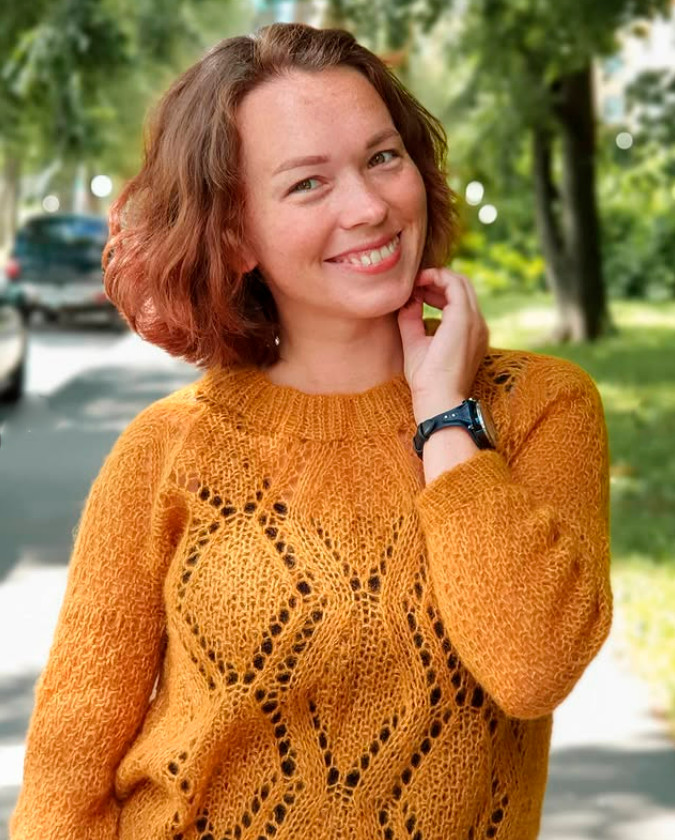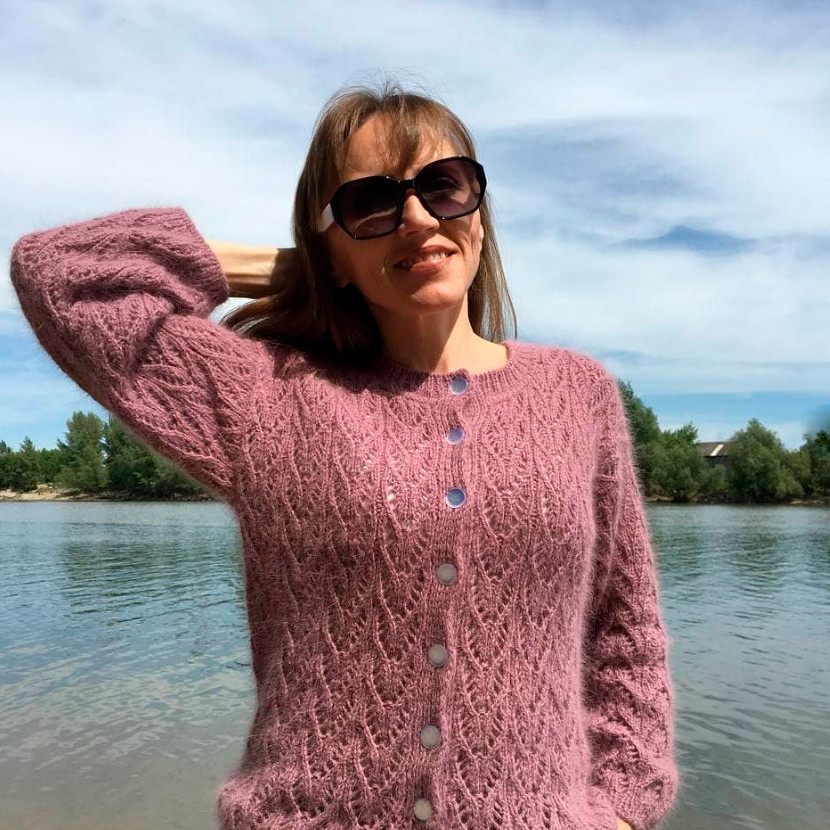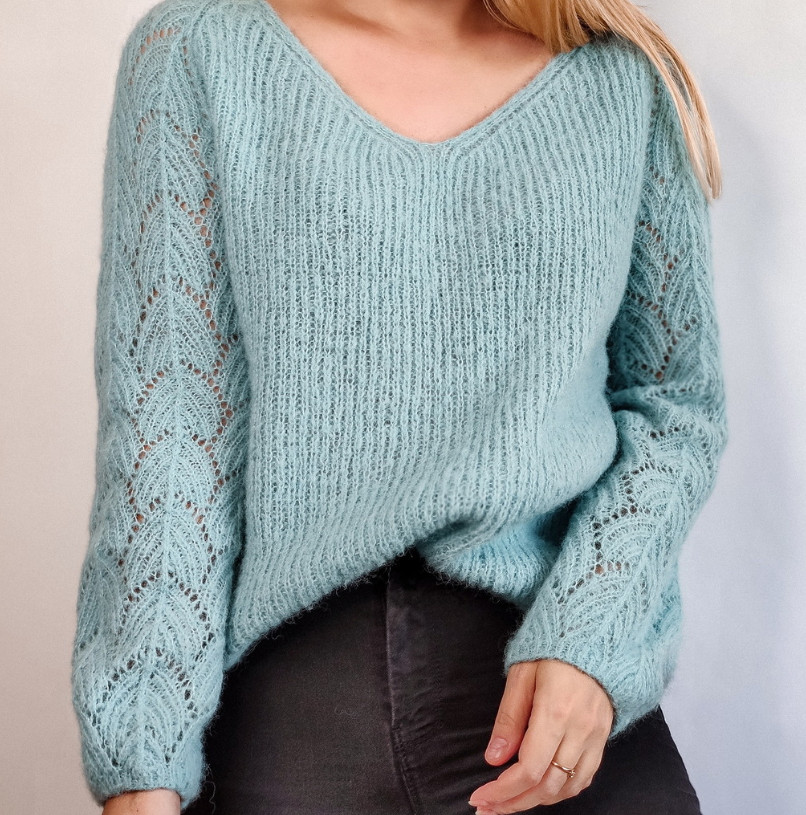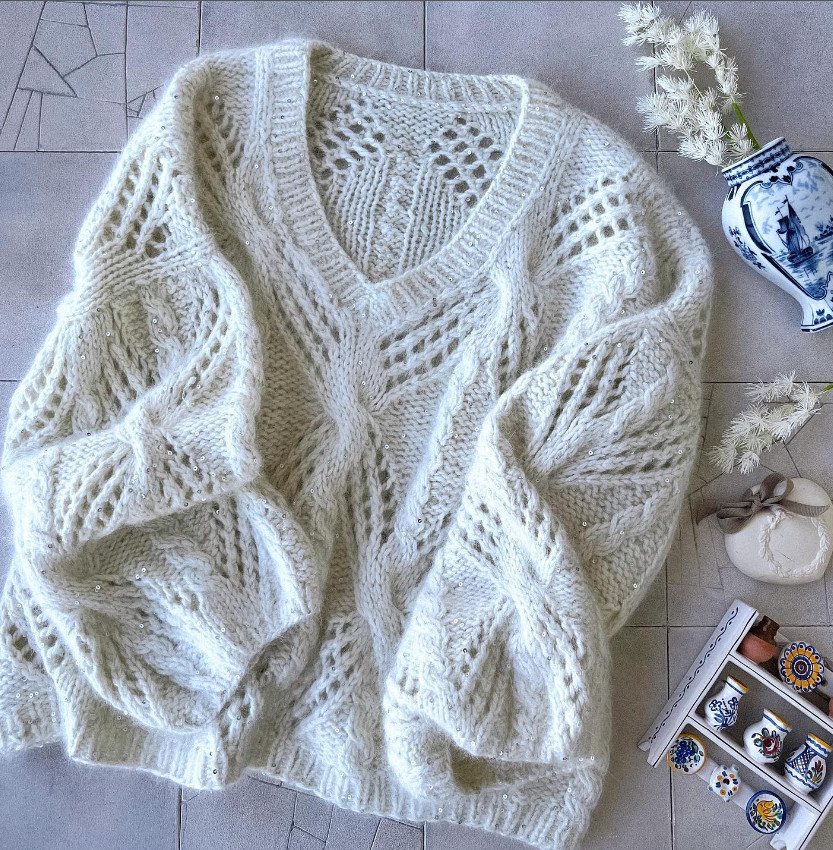




Knit Sweater
Added: 05.09.2025 в 21:14 Views: 1735
Knit SweaterKlubokhttp://klubok.work/1/3/9067/Klubokhttps://klubok.work/css/image/top-logo-en.png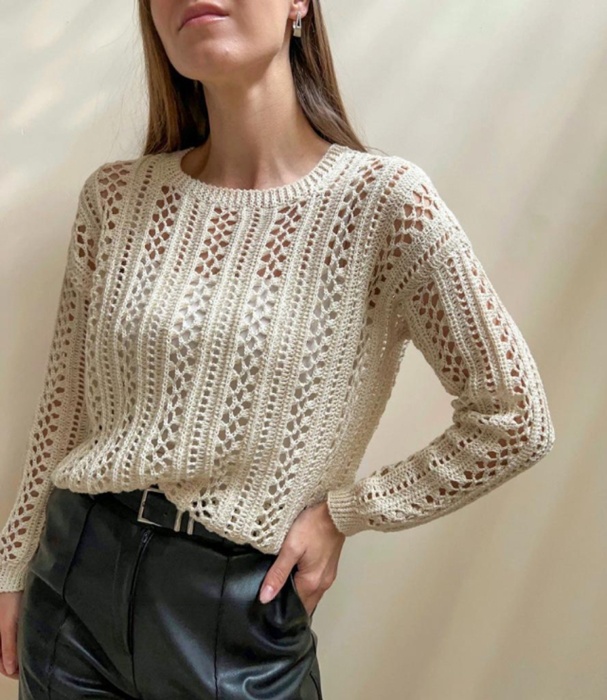
The master class is made for sizes: 42-44 / 46-48 / 50-52
For knitting you will need:
1. Yarn: - cone linen 100g / 650m or an equivalent with the required meterage (100g / 400-650m).
2. Hook No. 2 or 2.5
3. Measuring tape, needle with a large eye, scissors
Alternative yarn:
- Seam Lambada fine;
- Kamtex Mercerized Cotton, Anna 16.
| Yarn consumption for the sweater:
Size 42-44 (length 52 cm) 300-400 g Size 46-48 (length up to 60 cm) 400-500 g Size 50-52 (length 65 cm) 500-600 g |
Yarn consumption for the top:
Size 42-44 (length 50 cm) 200 g Size 46-48 (length 55 cm) 200-250 g Size 50-52 (length 60 cm) 300-400 g |
*provided in average values
For the top - Seam Lambada fine, color 23.
The length of the sweater/top is 52 cm, width 48 cm, for a height of 160 cm.
Size 42-44.
The sweater and top are knitted in a transverse technique in one thread according to Pattern Scheme 1.
The finish of the neckline of the sweater/top and sleeve cuffs is done with connecting stitches through the back loops or “1*1 ribbing.”
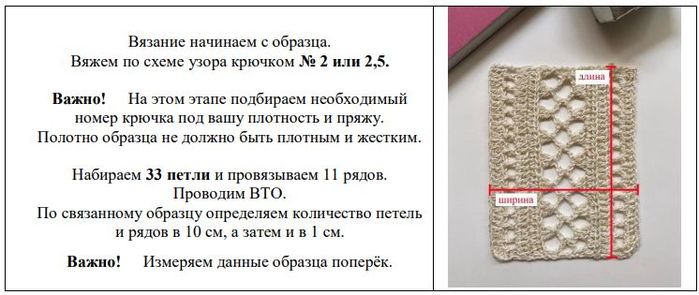
Knitting density:
1 cm – 2.7 stitches
1 cm – 1.3 rows
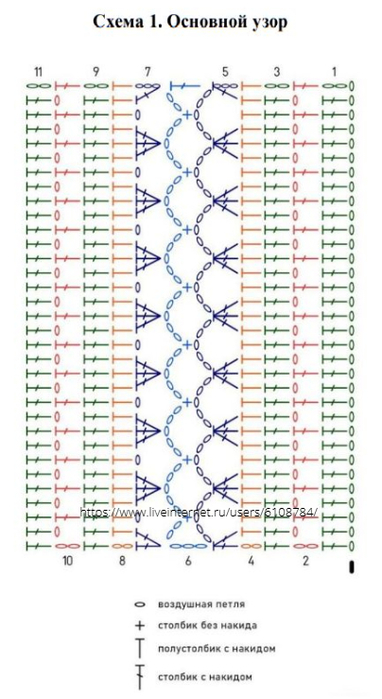
The pattern is knitted across.
Start knitting from the black dot.
The pattern consists of alternating stripes of double crochet and a lacy stripe (3 double crochets and arches). ,p>The rapport equals 8 rows.
Important! Rows: 5th, 9th, 13th, 17th, etc. - knit THROUGH the back loop.
STAGE 1. Taking measurements. Pattern. Knitting a sample
Necessary measurements:
- bust circumference;
- length of the sweater/top;
- shoulder length;
- sleeve length.
Author's measurements:
- Bust 88 cm
- Length 52 cm
- Shoulder 8 cm - Arm 56 cm Size 42-44
To determine the size of the sweater/top, it is necessary to take measurements and refer to these data:
• size 42-44 (Bust 88-92, Waist 68, Hips 96)
Width 48-50 cm, length 50-52 cm, sleeve 56 cm;
• size 46-48 (Bust 96-100, Waist 76, Hips 98-104)
Width 54-56 cm, length 60 cm, sleeve 58 cm;
• size 50-52 (Bust 105-110, Waist 86, Hips 106-112)
Width 60-62 cm, length 62 cm, sleeve 60 cm.
The ease allowance is 10 cm for the bust circumference.
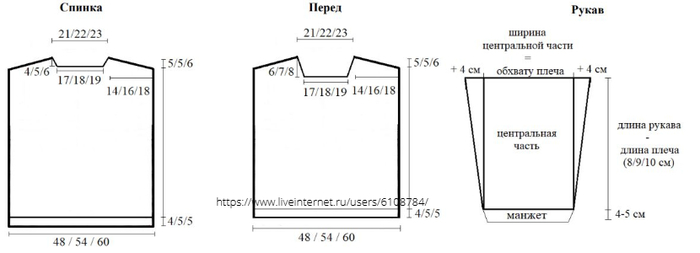
The sweater/top is knitted with one main pattern.
It has a semi-loose fit.
The back, front, and sleeves are knitted separately.
T O P
STAGE 2. Knitting the details
Back
(the back of the top and sweater is knitted similarly)
We start knitting by the length of the product.
We perform calculations. See Pattern and Measurements.
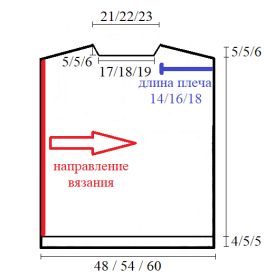
The length of the product = 52 cm, where 4 cm is the edging at the bottom with ribbing. 52 – 4 = 48 cm.
Shoulder slope = 5 cm, which gives 48 – 5 = 43 cm.
43 cm – the starting line for knitting the back (marked with a red line in the picture)
43 cm * 2.7 stitches (according to the sample) = 116.1 stitches. I round to 115 stitches.
Important! The number of stitches must be odd.
I cast on 115 stitches and knit according to the pattern.
Important! The multiplicity of the cast-on chain of stitches should be equal to 4, that is: (cast-on row + 1 stitch) / 4
For example, (107 + 1 stitch) / 4 = 27
(115 + 1 stitch) / 4 = 29
(135 + 1 stitch) / 4 = 34.
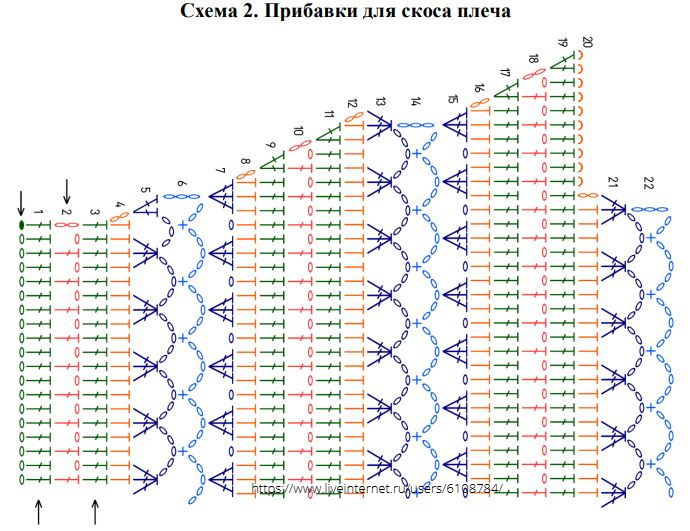
1, 2, 3 rows – without increase for all sizes! ,p>Then, we make an increase in each row by 1 stitch only on one side, where the shoulder slope is located.
See Pattern. The length of the shoulder is 14 cm.
14 cm * 1.3 rows (according to the sample) = 18.2 rows
I round to 19 rows (to finish the pattern rapport)
I knit 16 rows with an increase of 1 stitch. A total of 19 rows.
Important! For other sizes, perform increases to the required height of the shoulder slope and shoulder length.
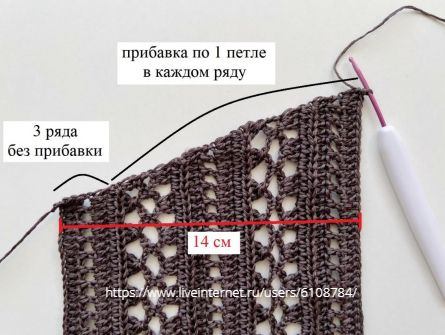
Having knitted the required number of rows equal to the length of the shoulder according to the pattern, we check ourselves by measuring the length with a measuring tape.
Back neckline
See Pattern.
The height of the neckline is 4 cm.
4 * 2.7 stitches = 10.8 stitches. I round to 10 stitches
I decrease along the edge 10 stitches.
Important!
Decreases are made with slip stitches.
Then, knit straight according to the pattern without decreases and increases.
The stitches of the second shoulder are cast on with an additional thread.
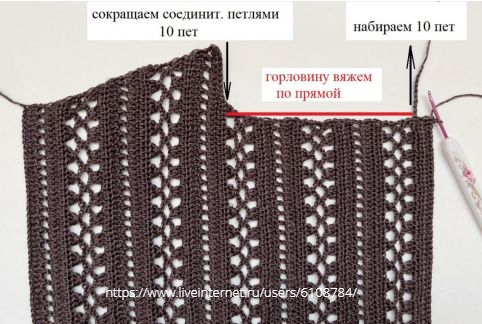
See Pattern.
The width of the neckline (lower part) is 17 cm.
17 * 1.3 rows = 22.1 rows. I round to 21 rows (for even placement of the pattern)
Important!
It is very important to determine the center when knitting the back neckline!
Both parts from the center according to the pattern must be identical!
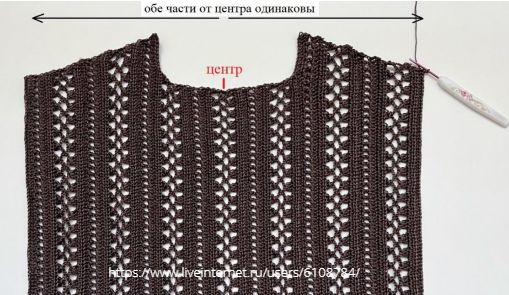
After knitting the neckline, we move to the second shoulder.
We knit similarly, decreasing by 1 stitch in each row.
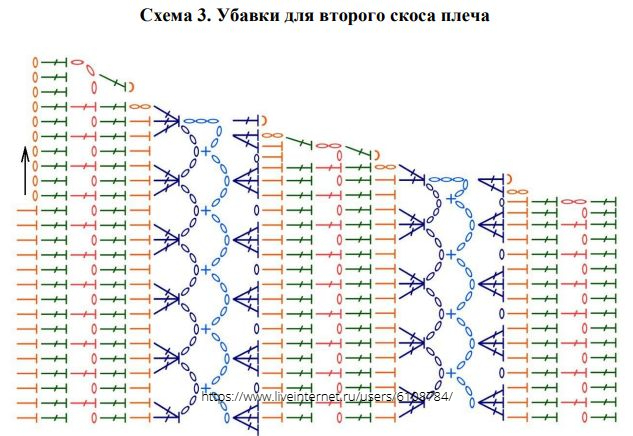
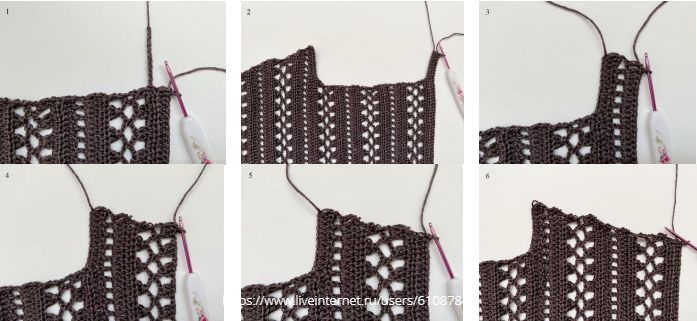
Front
(the front of the top and sweater is knitted similarly)
The initial chain of stitches for the front equals the initial chain of stitches for the back minus 1 rapport (that is, 8 stitches).
In this difference of stitches, we add the back rise of the product.
I cast on 107 stitches and knit according to the pattern. Increases and decreases are knitted similarly to the back.
Don't forget, about the multiplicity of the cast-on chain of stitches. It should equal 4, that is: (cast-on row + 1 stitch) / 4.
Front neckline
See Pattern.
The height of the neckline is 6 cm.
6 * 2.7 stitches = 16.2 stitches. I round to 16 stitches
I decrease along the edge 16 stitches.
Important!
Decreases are made with slip stitches.
Then, knit straight according to the pattern without decreases and increases.
The stitches of the second shoulder are cast on with an additional thread.
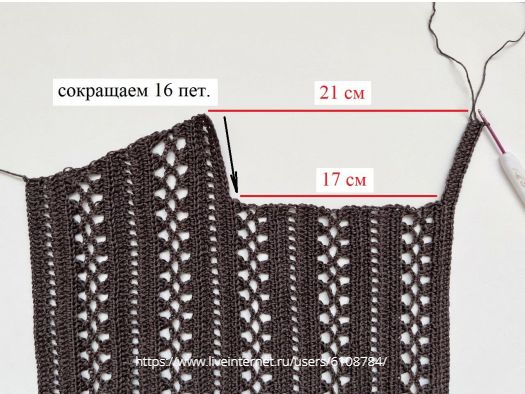
The back and front are ready!
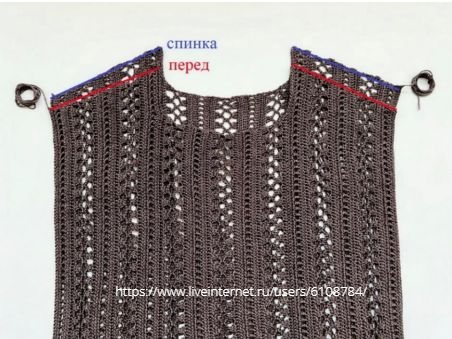
We perform steam blocking (wet-thermal treatment) of the details: hand wash at a temperature of 30 degrees, horizontal drying.
STAGE 3. Assembling the details
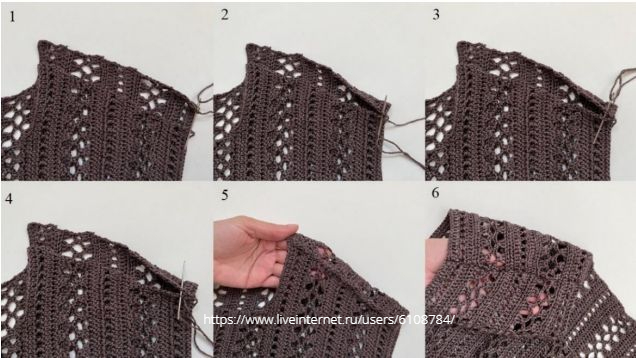
We assemble the shoulder and side seams with a needle.
We fold the front and back with the right side inwards.
Using a needle, we sew the shoulder seam along the entire shoulder, matching the pattern with each other.
We hide the yarn tails on the wrong side.
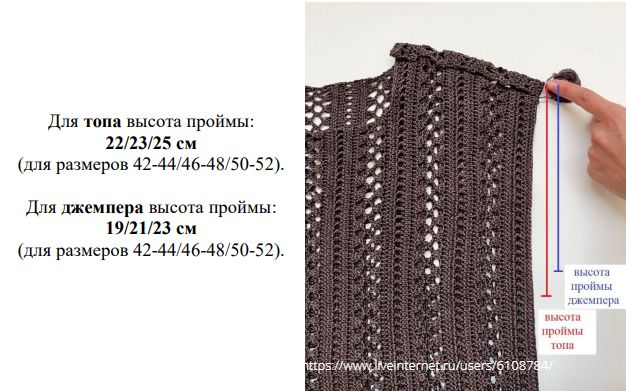
We move to the assembly of the side seam
First, we mark the height of the armhole.
We sew the side seam with a needle along the entire edge.
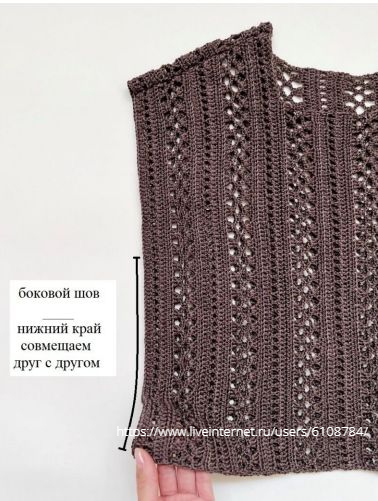
STAGE 4. Processing the neckline, bottom, and armholes
For processing (edging) the neckline and bottom of the top/sweater, we use the main hook size No. 2.5.
For the neckline edging of the top/sweater, I use ribbing with a 1*1 hook, that is slip stitches through the back loops. I cast on 6 chain stitches, which equal 2.5 - 3 cm.
For the bottom edging of the top/sweater, as well as for the sleeve cuffs I perform ribbing with a 1*1 hook, that is slip stitches through the back loops. I cast on 9 chain stitches, which equal 4 - 5 cm.
For the armhole edging of the top, I perform ribbing with a 1*1 hook, that is slip stitches through the back loops. I cast on 6 chain stitches, which equal 2.5 - 3 cm.
SW EATER
STAGE 1, 2, 3, 4 – similar to knitting the top
Sleeve
The sleeve of the sweater is tapered towards the bottom.
First, we knit the central (straight) part of the sleeve, then we add the wide part from both sides. ,p>The ribbing (cuff) is done at the end.
We start knitting by the length of the sleeve.
We perform calculations. See Pattern and Measurements.
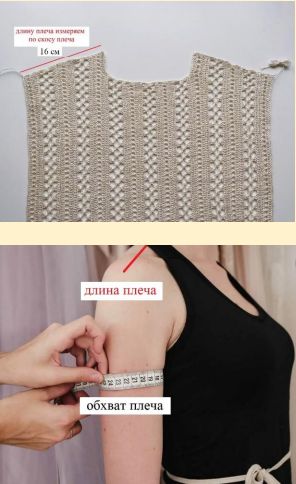
According to the measurements, the length of the sleeve is 46 cm, where 4 cm is the cuff of the sleeve. 46-4 = 42 cm.
Next, we look at the length of the shoulder on the product (since the model has dropped shoulders).
Measure along the shoulder slope!
It equals 16 cm.
The length of the shoulder (standard measurement)
for sizes:
42/44 = 8 cm;
46-48 = 9 cm;
50-52 = 10 cm.
16 cm – 8 = 8 cm.
We subtract the length of the shoulder from the length of the sleeve.
We get, 42 – 8 = 34 cm.
34 cm is the length of the sleeve according to the main pattern.
34 cm * 2.7 stitches = 91.8 stitches.
I round to 93 stitches.
The number of stitches must be odd.
The width of the central (straight) part of the sleeve equals the shoulder circumference (OС).
*Shoulder circumference is measured around the arm at the widest point.
Measurement OС = 25 cm.
I knit the width of the sleeve equal to 25 cm.
The number of stripes (lacy and double crochet) must be odd. In my case, 7.
I cast on 93 stitches and knit the central part according to the pattern.
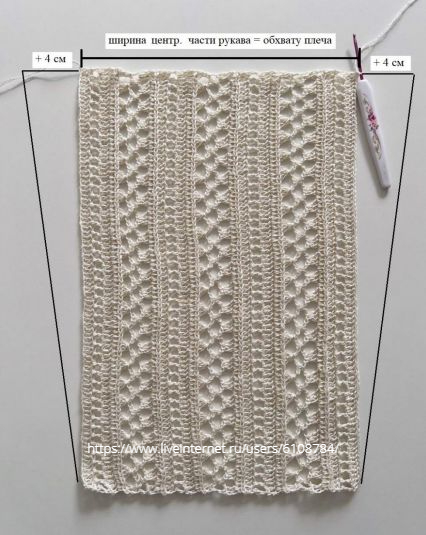
Having knitted the central (straight) part of the sleeve, we then add the wide parts – first, on one side, then on the other.
The width of the wide part = 4 cm.
*for size 50-52 = 5 cm.
4 cm * 1.2 rows = 5 rows.
How to determine the number of stitches for decreases in each row?
Number of stitches for the length of the sleeve / number of parts for decreases.
If I got 5 rows; the number of parts for decreases = 6.
We get, 93 stitches / 6 parts = 15.5 stitches.
In total: in each row we decrease 15 stitches.
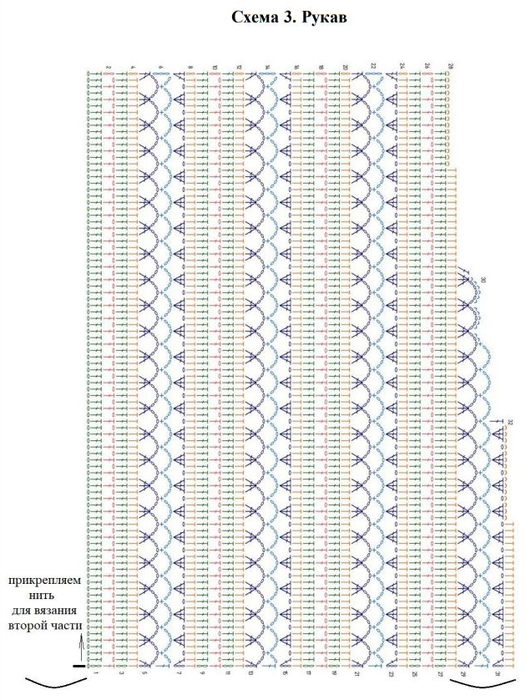
The second part is knitted similarly.
The sleeves are ready (we perform steam blocking) and we sew them into the armholes. See Stage 3.
We sew with a needle.