



Knit a sweater
Added: 09.11.2025 в 14:50 Views: 743
Knit a sweaterKlubokhttp://klubok.work/1/3/9287/Klubokhttps://klubok.work/css/image/top-logo-en.png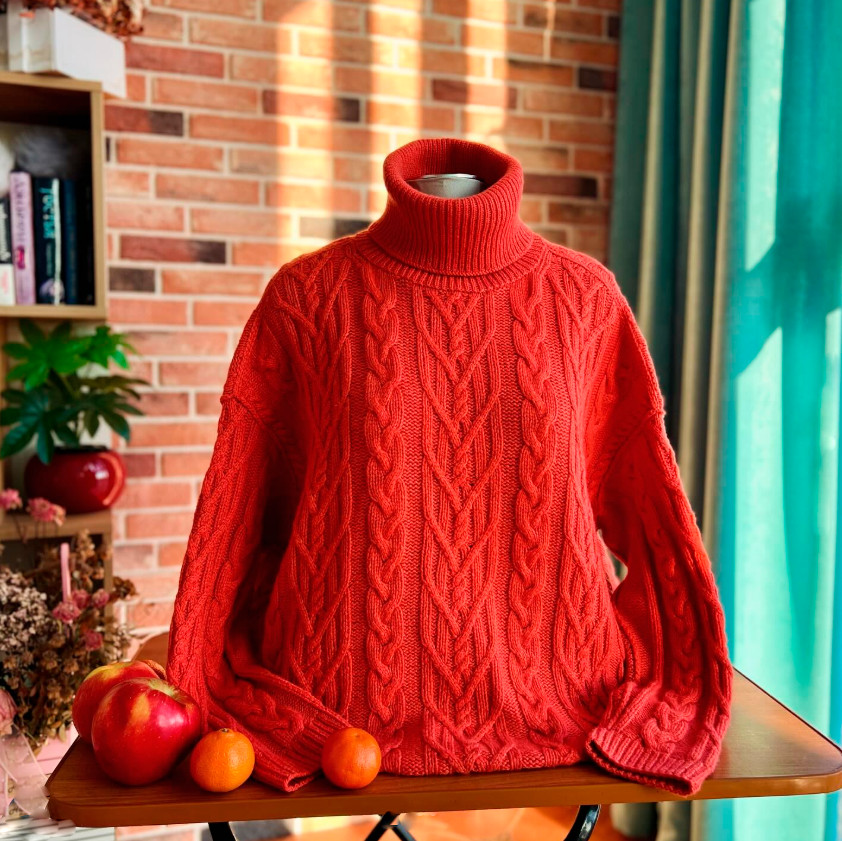
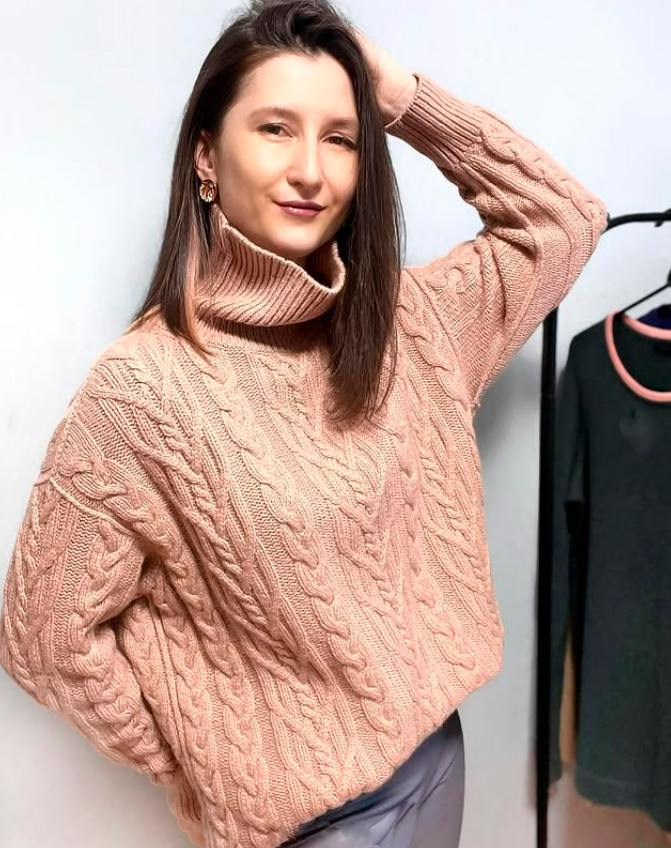
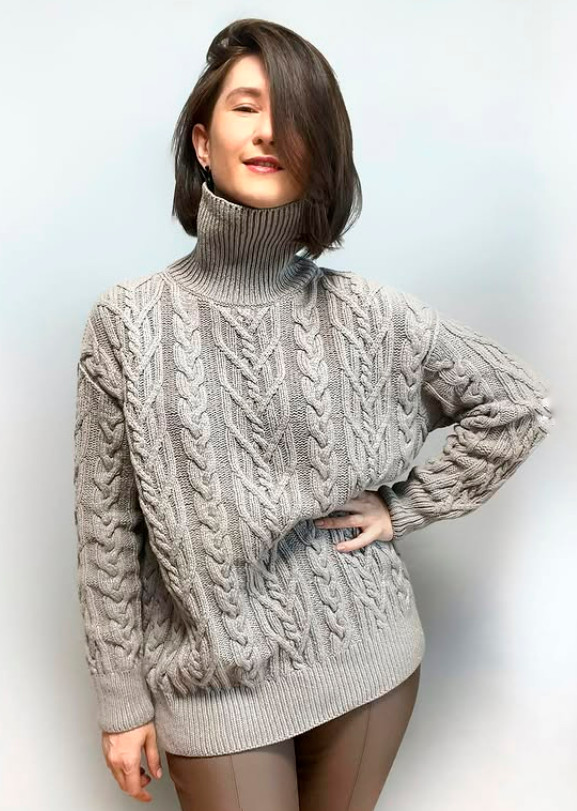
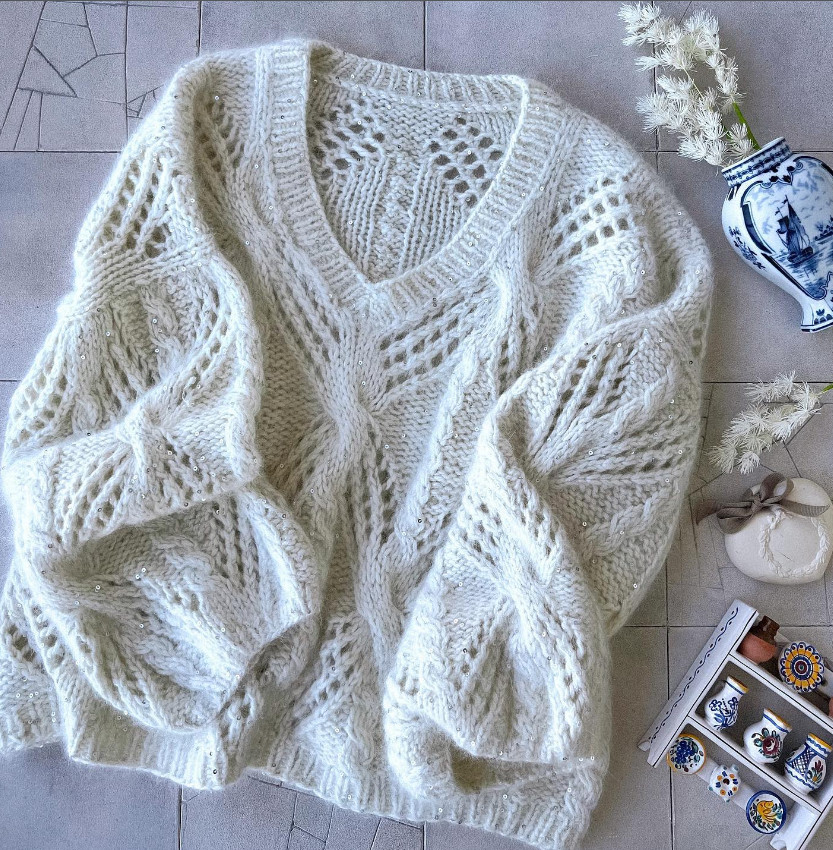
This description presents three sizes of the garments with small variations in the pattern and finish:
-
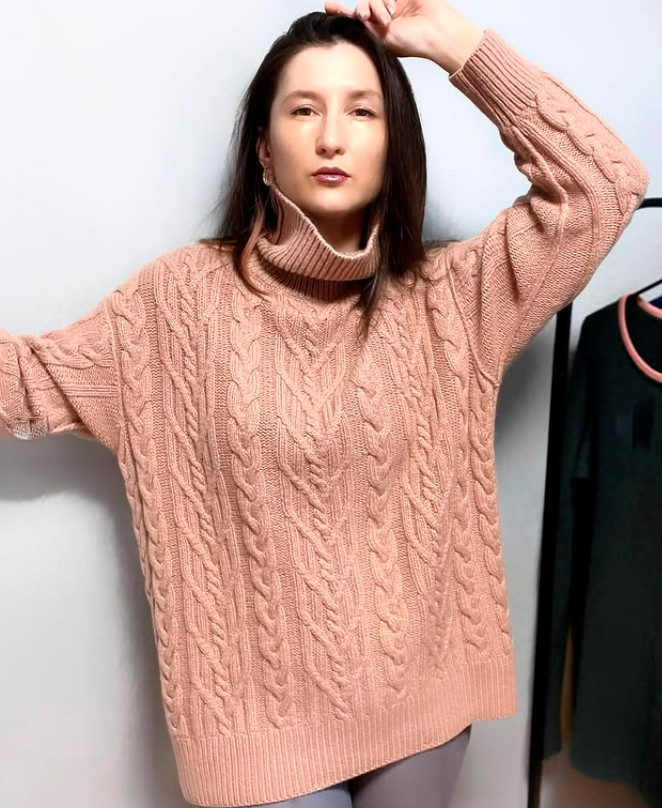
«Свитер М» – width - 60 cm, length - 69 cm, sleeve width - 40 cm, sleeve length - 49 cm, collar height - 17 cm (рекоменд. для 42-48 рр., рост 164-170).
-
«Джемпер L» – width - 66 cm, length - 75 cm, sleeve width - 44 cm, sleeve length - 48 cm, collar height - 3 cm (рекоменд. для 48-54 рр., рост от 172).
-
«Свитер XL» – width - 71 cm, length - 68 cm, sleeve width - 46 cm, sleeve length - 45 cm, collar height - 15 cm (рекоменд. для 54-64 рр., рост до 170).
To choose your option, refer to your favorite garments in your wardrobe. The garment should be tried on, measure the back length from the 7th cervical vertebra, and then on a horizontal surface measure the width with a measuring tape. In the same way you can measure in cm the widest part of the upper sleeve.
For knitting you will need:
– yarn Piuma 320 m/100 g (100% cashmere, Cariaggi factory) or other yarn with similar yardage. For example, 100% cashmere 2/27·2/28 in 4 plies, 100% cashmere 2/1250, 2/14 (Revive from G&G Filati) in 2 threads, other yarns 280-300 m/100 g (with adjustments to the pattern if PV* and PG* do not match) and so on.
Depending on the chosen size:
«Свитер М» – 600 grams
«Джемпер L» – 660 grams
«Свитер XL» – 660 grams
– needles 5.0 mm for the main pattern (Video 2. Needle Overview)
– needles 5.0 mm for the main pattern (Video 2. Needle Overview).
– needles 2.0 and 3.0 (or a class-5 two-bed knitting machine) for 1/1 rib
– stitch markers
– auxiliary needle for cables and Aran, crochet hook 1.75–2.0
– sewing needle
– scissors
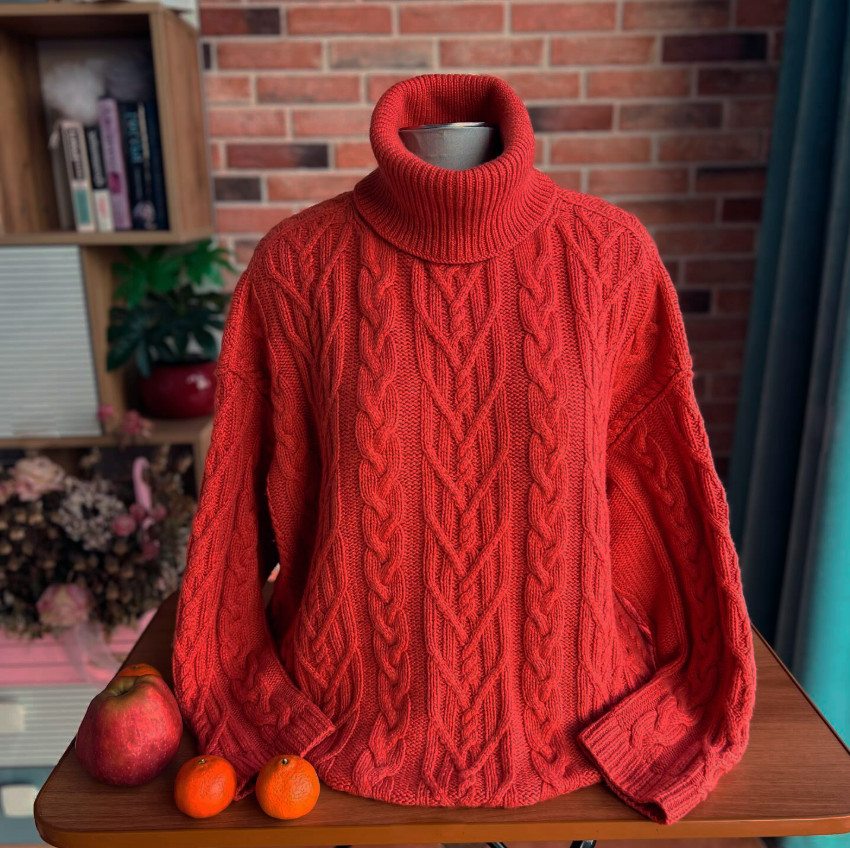
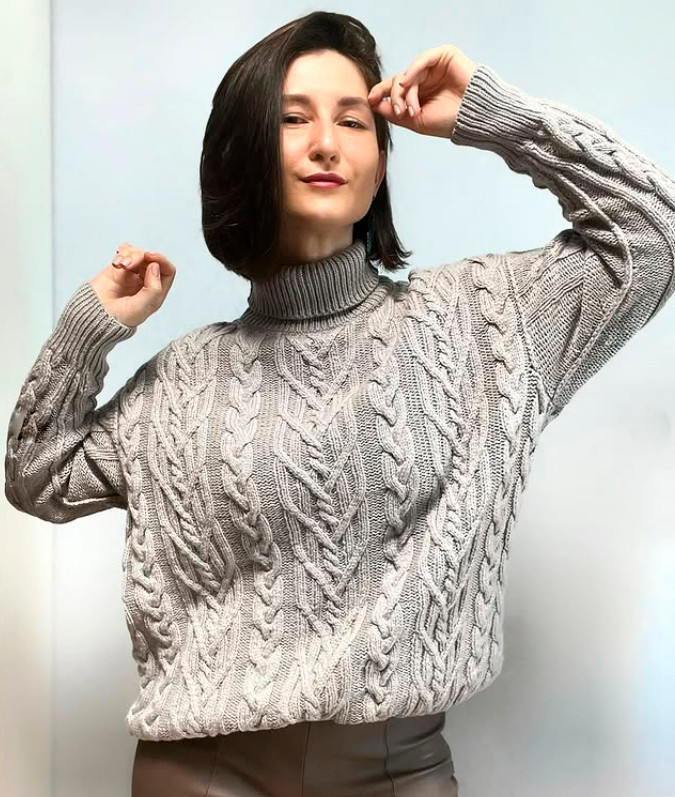
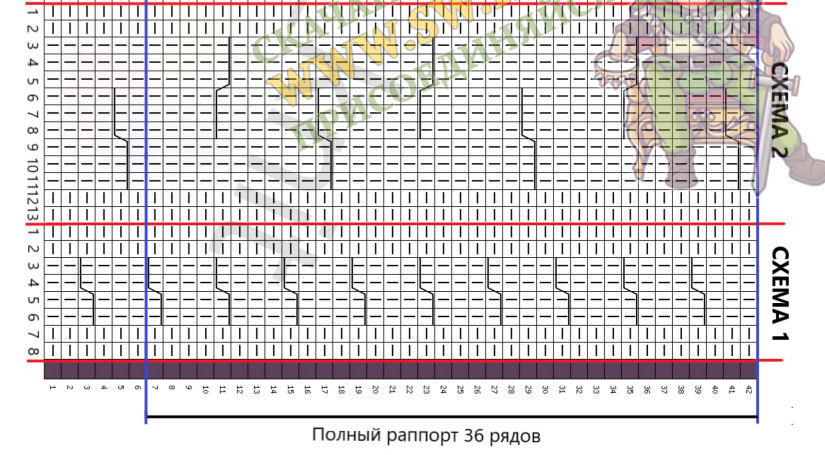
The pattern in the garments consists of three main elements (FIG.2): small cable (CHART 1 and CHART 5), large cable (CHART 2 and CHART 4) and the main aran (CHART 3). We form different sizes by adding various cables/aran motifs and purl stitches.
Let's knit a gauge swatch.
Cast on 52 stitches on 3.0 mm needles.
The fabric is worked in basic stitches: knit stitches through the front loop, purl stitches – yarn in front of the working needle.
Knit a 1/1 rib to a height of 28 rows. Start as: 1 edge stitch (slip, not knit), 1 knit, 1 purl, repeat (…) to the end of the row, 1 edge stitch (purling “grandmother's method”).
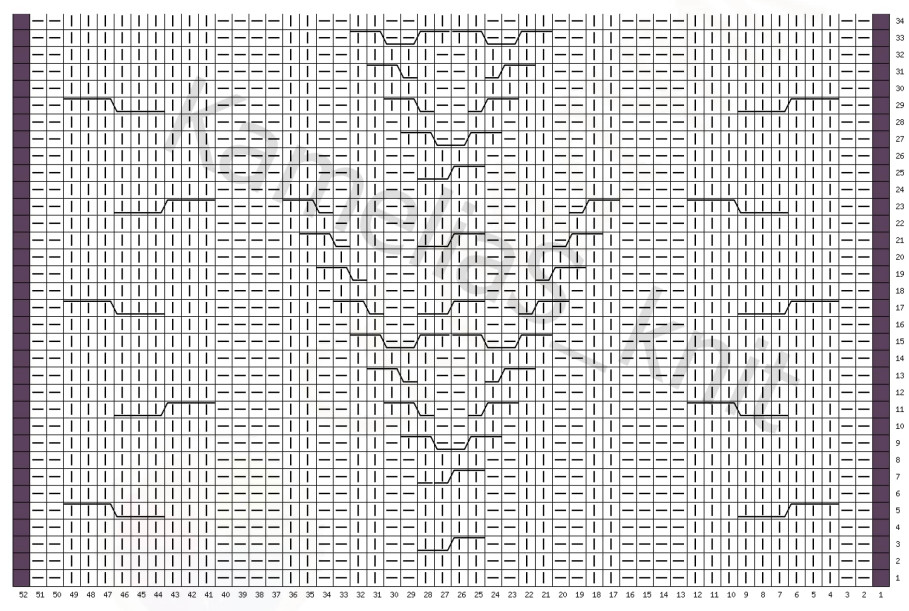
Switch to 5.0 mm needles, begin knitting the pattern from rows 1 to 34 according to the SWATCH CHART (FIG.1).
The cashmere swatch should be washed 2–3 times to achieve a fluffy texture. Lightly steam and measure.
The swatch after blocking from Piuma Cariaggi turned out: height (including rib) – 18 cm (pattern 11.5 cm; rib 6.5 cm), width at the top edge of the pattern – 21 cm.
Full PG* and PV* for the main body of the sweater are: 2.5 stitches per 3 rows (2.5 st/3 r).
PG stockinette = 2.0 st.
* PG – horizontal density = number of stitches per 1 cm of knitted fabric
* PV – vertical density = number of rows per 1 cm of knitted fabric
FIG.1 CHART FOR SWATCH
Pattern charts
1. «SWEATER M» WITH A HIGH COLLAR.
Length 69 cm, width 60 cm, sleeve length 49 cm. For example, for size 42–48, height up to 170 cm.
BACK.
Cast on 3.0 mm – 152 stitches.
Knit a 1/1 rib to a height of 30 rows.
Starting as: 1 edge stitch (slip, not knit), 1 knit, 1 purl, repeat (…) to the end of the row, 1 edge stitch (purling “grandmother's method”).
Switch to 5.0 mm needles, begin knitting the pattern.
Pattern on the front (right to left, FIG. 2): 1 edge stitch, 2 CHART 2, CHART 3, CHART 2, CHART 3, CHART 4, CHART 4, 2CHART 4, 1 edge stitch.
Knit together according to the pattern chart (FIG. 2 from rows 1 to 6).
Row 1: 1 edge stitch, 2 purl, 9 knit, 4 purl, 9 knit, 4 purl, 2 knit, 2 purl, 4 knit, 2 purl, 4 knit, 2 purl, 2 knit, 2 purl, 2 knit, 4 purl, 9 knit, 4 purl, 9 knit, 4 purl, 2 knit, 2 purl, 2 knit, 2 purl, 2 knit, 4 purl, 9 knit, 4 purl, 9 knit, 4 purl, 2 knit, 2 purl, 2 knit, 2 purl, 2 knit, 4 purl, 9 knit, 4 purl, 9 knit, 4 purl, 2 knit, 2 purl, 1 edge stitch.
Row 2: purl according to the pattern: knit = knit, purl = purl.
Row 3: 1 edge stitch, 2 purl, 9 knit, 4 purl, 9 knit, 4 purl, 2 knit, 2 purl, 2 knit, 2 purl, cross 4 stitches to the right: 2 stitches left on an auxiliary needle behind the work, knit 2 stitches, then knit the stitches from the auxiliary needle, 2 purl, 2 knit, 2 purl, 2 knit, cross 4 stitches to the right: 2 stitches left on an auxiliary needle behind the work, knit 2 stitches, then knit the stitches from the auxiliary needle, 2 purl, 2 knit, 2 purl, 2 knit, cross 4 stitches to the right: 2 stitches left on an auxiliary needle behind the work, knit 2 stitches, then knit the stitches from the auxiliary needle, 2 purl, 2 knit, 2 purl, 2 knit, cross 4 stitches to the right: 2 stitches left on an auxiliary needle behind the work, knit 2 stitches, then knit the stitches from the auxiliary needle, 2 purl, 2 knit, 2 purl, 2 knit, 4 purl, 9 knit, 4 purl, 9 knit, 4 purl, 2 knit, 2 purl, 1 edge stitch.
Row 4: purl according to the pattern: knit = knit, purl = purl.
Row 5: knit stitches: 1 knit, 2 purl, 6 stitches cross to the right: leave 3 stitches behind the work on the auxiliary needle, knit 3 stitches, then knit the stitches from the auxiliary needle, followed by the stitches from the auxiliary needle
Needles: knit, 3 knit, 4 purl, cross 6 stitches to the right: leave 3 stitches behind the work on the auxiliary needle, knit 3 stitches, then knit the stitches from the auxiliary needle, knit 3 knit, 4 purl, 2 knit, 2 purl, 2 knit, 2 purl, 4 knit, 2 purl, 2 knit, 2 purl, 2 knit, 4 purl, 3 knit, cross 6 stitches to the right: leave 3 stitches behind the work on the auxiliary needle, knit 3 stitches, then knit the stitches from the auxiliary needle, knit 3 knit, 4 purl, 2 knit, 2 purl, 2 knit, 2 purl, 4 knit, 2 purl, 2 knit, 2 purl, 2 knit, 4 purl, 3 knit, cross 6 stitches to the left: leave 3 stitches in front of the work on the auxiliary needle, knit 3 stitches, then knit the stitches from the auxiliary needle, knit 4 purl, 3 knit, cross 6 stitches to the left: leave 3 stitches in front of the work on the auxiliary needle, knit 3 stitches, then knit the stitches from the auxiliary needle, knit 2 purl, 1 knit.
Row 6: purl. According to the chart: knit = knit, purl = purl.
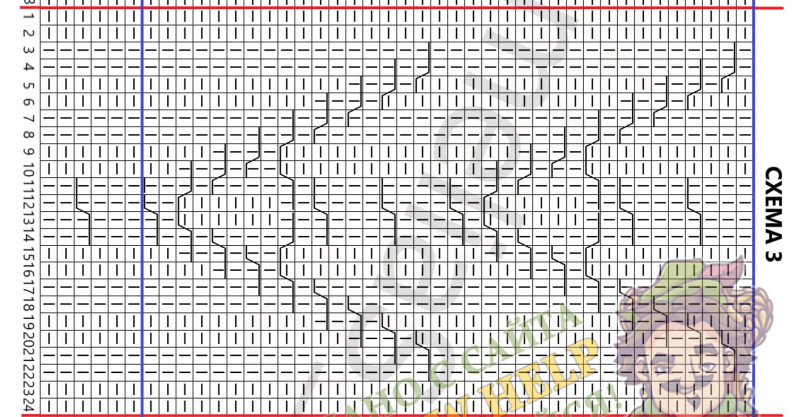
Next, knit according to the pattern chart (FIG. 2), repeating the repeat from rows 7 to 42. Pay attention to the crossings of 3 stitches to the right and to the left in the main motif (FIG. 3); in some cases in knit rows, knit stitches become purl and vice versa. Everything is shown in the chart.
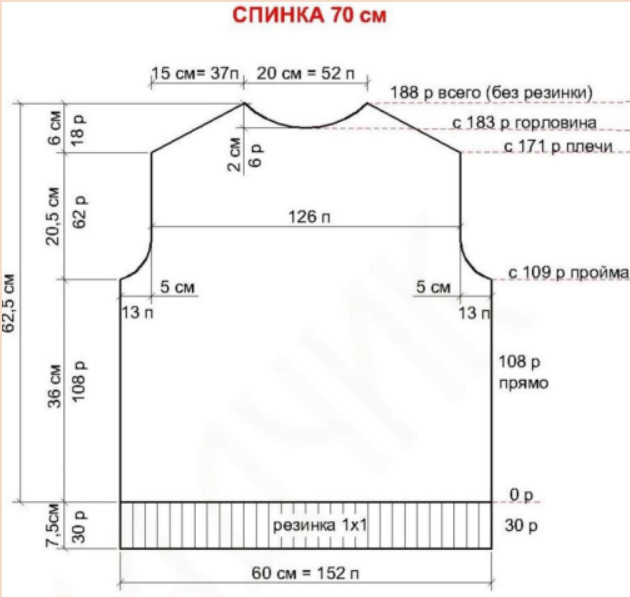
Knit to the armhole for 108 rows.
Decrease at the armhole: 13 stitches: 3, 3, 3, 2, 2.
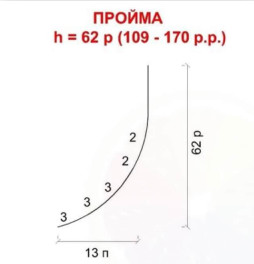
Thus, in rows 109 and 110 close 3 stitches, in rows 111 and 112 – 3 stitches, in rows 113 and 114 – 3 stitches, in rows 115 and 116 – 2 stitches, in rows 117 and 118 – 2 stitches. Thus the armhole is worked in 5 steps = 10 rows.
Knit straight for another 52 rows to the shoulder slope. The total height of the armhole is 62 rows (including decreases).
From row 171, shape the shoulders (37 stitches) with partial knitting: once 5 stitches and 8 times 4 stitches.
=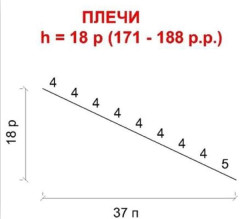
We knit as follows: knit row 171 to the end, at the end of the wrong-side 172nd row do not bind off 5 stitches, turn the knitting, make an auxiliary yarn over on the needle and hang a marker (video 6. Partial knitting, markers, shoulder). In row 173 do not bind off 5 stitches, turn the knitting, make a yarn over. In the following rows do not bind off
N stitches (4 stitches in our case) before the auxiliary yarn over or marker. We knit like this up to row 182 inclusive.
From row 183 we begin to shape the right half of the neckline (26 stitches) with a partial technique in 3 steps: 11, 9, 6. Place a marker at the middle of the back (this is the center of the main motif). In row 183, do not bind off 11 stitches to the marker, turn the knitting; in row 184 do not bind off 4 shoulder stitches. In row 185 do not bind off 9 stitches to the wrap, turn the knitting, in row 186 do not bind off 4 shoulder stitches. In row 187 do not bind off 6 stitches to the wrap, turn.
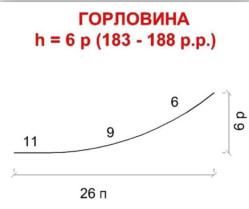
In row 188, begin a smoothing row for the right shoulder: knit the stitches according to the pattern, while the wrap should stay on the wrong side; if necessary, swap stitches and knit.
In row 189 bind off 37 shoulder stitches over the stitches with a wrap at the neckline (up to the marker).
Now knit the smoothing row for the right half of the neckline to the middle according to the pattern; leave the auxiliary yarn over on the wrong side. We knit without breaking the yarn, meaning that from the middle of the neckline the pattern will continue on the left side of the back, as in row 183 (39 stitches according to FIG. 2). Do not bind off 4 stitches to the marker at the left shoulder; turn the knitting, and in row 184 do not bind off to the middle marker 11 stitches, turn the knitting, make a yarn over. In row 185 do not bind off 4 stitches to the yarn over, turn, make a yarn over. In row 186 do not bind off 9 stitches of the neckline. In row 187 do not bind off 4 stitches to the yarn over, turn, in row 188 do not bind off 6 stitches of the neckline, turn, make a yarn over.
LOWER FRONT.
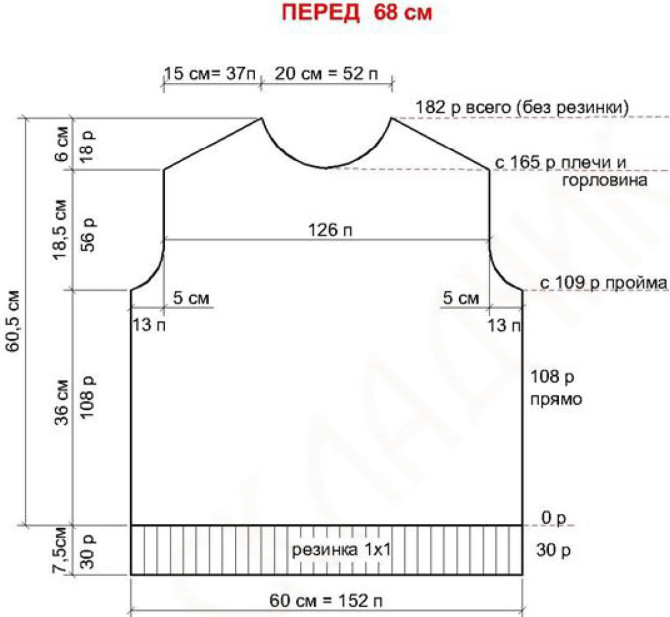
Cast on 3.0 – 152 stitches.
Work 1x1 rib for a height of 30 rows. Beginning as: 1 slip (remove, do not knit), 1 knit, 1 purl, repeat “…” to the end of the row, 1 slip (purling “grandmother’s method”).
Switch to needles 5.0, begin knitting the pattern.
Pattern on the front (right to left, FIG. 2): 1 slip, 2CHART 2, CHART 3, CHART 2, CHART 3, CHART 4, CHART 3, 2CHART 4, 1 slip.
Knit to the armhole 108 rows similar to the back.
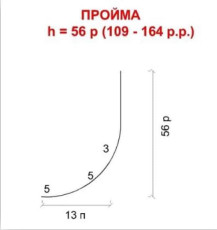
Armhole decreases: 13 stitches: 5, 5, 3.
Thus, in rows 109 and 110 close 5 stitches each, in rows 111 and 112 – 5 stitches each, in rows 113 and 114 – 3 stitches. Thus the armhole is shaped in 3 steps = 6 rows.
Knit straight for another 50 rows to the shoulder slope. Total armhole height is 56 rows (including decreases).
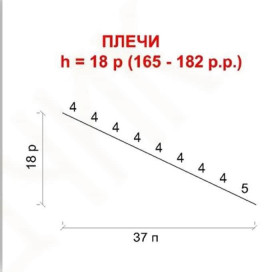
From row 165 we begin to knit the shoulders (37 stitches) with partial knitting: once 5 stitches and 8 times 4 stitches,
and the neckline (half – 26 stitches) with partial knitting in 3 steps: 9, 5, 3, 3, 3; and three times 2 stitches decoratively.
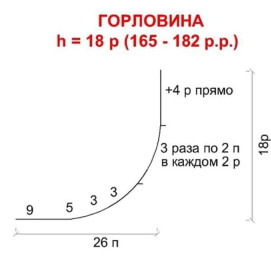
Hang a marker at the center of the front placket (this is the center of the main motif).
From row 165, begin shaping the shoulders (37 stitches) with partial knitting: once 5 stitches and 8 times 4 stitches,
and the neckline (half – 26 stitches): 9, 5, 3, 3, and three times 2 stitches decoratively.
Hang a marker at the center of the front placket (this is the center of the main motif).
In the 165th row, leave 9 stitches before the marker unworked; turn the work. At the end of the 166th row, leave 5 stitches of the shoulder unworked; turn the knitting, make an auxiliary yarn over on the needle and hang a marker.
In the 167th row, leave 5 stitches unworked, turn the knitting, make a yarn over. In the following rows we do not bind off N stitches (4 stitches in our case) before the auxiliary yarn over or marker. Knit like this up to row 172 inclusive.
Shoulders
In the 173rd row, without binding off 5 stitches, make a decorative decrease: slip 2 stitches, pass them to the work, knit together the 3rd and 1st stitches, then the 4th and 2nd stitches. The last stitch before the yarn over should be worked as the edge stitch – garter purl.
Purl side. Repeat this technique in rows 175 and 177. On the purl rows, remember to shape the shoulder, leaving 4 stitches to the marker.
In row 182 we begin the shaping row for the right shoulder: knit the stitches according to the pattern, while the yarn over should remain on the wrong side; if necessary, swap stitches and knit.
In row 183 bind off 37 stitches of the shoulder to the end of the row.
Neckline in the center — partial knitting, higher up — a straight vertical section from which we will pick up stitches. After binding off the shoulders, without breaking the yarn, pick up along the vertical section 9 knit stitches. This is convenient to do with a crochet hook or a thin needle. In total, on the right vertical section we will have 10 stitches. Continue knitting on the right side according to the pattern, knitting the stitches with yarn-overs. The yarn-overs should remain behind the work. Bind off to the end of the knit row, remembering that from the central marker comes row 165 (row 21 in Fig. 2).
Move to knitting the left part, resetting the row count to the start of the neckline +1 row: knit 54 stitches of the purl 166th row, i.e., leave 9 stitches unworked from the middle of the front; turn the knitting, make a backward yarn over, and continue following the pattern.
In row 167, leave 5 shoulder stitches unworked, turn the knitting, and make a backward yarn over.
In the odd knit rows we shape the shoulders: rows 169, 171, 173, 175, 177, 179, 181, 183 — 4 stitches each.
In the even purl rows we shape the front neckline with short rows:
168 – 5 stitches, 170, 172 – 3 stitches.
Next we will decoratively decrease the stitches at the neckline.
In row 174, leaving 5 stitches unworked, make a decorative decrease: slip 4 stitches, purl together the 1st and 3rd stitches, then the 2nd and 4th stitches. The last stitch before the yarn over should be worked as the edge stitch – garter purl. Repeat this method in rows 176 and 178. In the knit rows, remember to work the shoulder.
In row 183 we knit the shaping row for the left shoulder: knit the stitches according to the pattern, with the yarn over remaining on the wrong side.
In row 184 bind off 37 shoulder stitches purl-wise.
After binding off the shoulder, without breaking the yarn, pick up along the vertical section 9 purl stitches. In total on the right vertical section we will have 10 stitches. Continue to knit on the purl side according to the pattern, knitting the stitches with the auxiliary yarn-overs. The yarn-overs should stay in front of the work on the wrong side; if necessary, rearrange stitches and knit. Knit to the middle of the row (center of the pattern) + 8 stitches. Leave 5–7 cm of yarn and cut. The stitches left on the left needle can simply be slid onto a pair of needles.
Weave the yarn in at the start of the knit row and bind off the front neckline with knit stitches.
SLEEVE.
Cast on 3.0 – 62 stitches.
Work 1x1 rib for a height of 30 rows. Starting like this: 1 edge stitch (slip, not worked), 1 knit, 1 purl, …, 1 edge (the wrong side is “garter stitch”).
Switch to needles 5.0, begin to knit the pattern:
Pattern for the sleeve (right to left, FIG. 2): 1 edge stitch, 1 purl, 2 knit, 2 purl, CHART 2, CHART 3, CHART 4, 2 purl, 2 knit, 1 purl, 1 edge.
Knit 112 rows with increases to the sleeve cap.
Increases are worked with backward yarn overs as follows:
14 times in every 8th row (rows 7, 15, 23, 31, 39, 47... 103, 111) + 1 purl row following the pattern.
Knit together according to the chart of patterns (FIG. 2) from rows 1 to 6. Row 1: edge stitch, 1 purl, 2 knit, 4 purl, 9 knit, 4 purl, 2 knit, 2 purl, 4 knit, 2 purl, 4 knit, 2 purl, 2 knit, 2 purl, 4 purl, 9 knit, 4 purl, 2 knit, 1 purl, 1 edge.
Row 2 (purl). On the chart: knit = knit, purl = purl.
Row 3 (knit): 1 edge, 1 purl, 2 knit, 4 purl, 9 knit, 4 purl, 4 knit, 2 purl, 2 knit, 2 purl, cross 4 stitches to the right: 2 stitches left on an auxiliary needle behind the work, knit the 2 stitches, then knit the stitches from the auxiliary needle, 2 purl, 2 knit, 2 purl, 2 knit, 4 purl, 9 knit, 4 purl, 2 knit, 1 purl, 1 edge.
Row 4 (purl): On the chart: knit = knit, purl = purl.
Row 5: edge, 1 purl, 2 knit, 4 purl, 6 stitches cross to the right: leave 3 stitches behind the work on an auxiliary needle, knit 3 stitches, then knit the stitches from the auxiliary needle, 3 knit, 4 purl, 2 knit, 2 purl, 2 knit, 4 purl, 3 knit, 6 stitches cross to the left: leave 3 stitches in front of the work on an auxiliary needle, knit 3 stitches, then knit the stitches from the auxiliary needle, 4 purl, 3 knit, 2 knit, 1 purl, 1 edge.
Row 6 (purl): On the chart: knit = knit, purl = purl.
Next, knit according to the pattern (FIG. 2), repeating the repeat from rows 7 to 42. In row 7 there will be the first increase: 1 edge, 1 purl, backward yarn over (does not create a hole when knitted), 2 knit, …, 2 knit, backward yarn over, 1 purl, 1 edge. In row 8 and the subsequent purl rows, increases are knitted with knit stitches, giving on the right side the stockinette. We obtain 90 stitches.
From row 113, knit the sleeve cap, binding off stitches on the right and left in groups per the chart, starting from the right: 4, 4, 5, 5, 8, 8, 9, 10. In row 125, bind off 10*2 = 20 stitches in one go. Break the yarn.
The sleeve is ready. Knit the second one in the same way.
Back, front and sleeves to be washed and a collar to be knitted.
The collar can also be knitted before washing.
NECKLINE.
Sew both shoulders with a seam on the outside. Take needles 3.0.
Pick up along the back 52 stitches, and along the front 62 stitches (10–42–10). Create a false mattress stitch, join the knitting in a circle and knit 64 rows (17 cm) of 1/1 rib. Bind off the neckline rib with an in-needle technique.
ASSEMBLY.
Sew in the sleeves
Sew side seams and lower seams of the sleeves
Wash and lay the finished garment flat to dry on a towel.
2. JUMPER "L" WITH ROUND NECKLINE.
Length 75 cm, width 66 cm, sleeve length 48 cm. For example, for size 48–54, height 170–175.
BACK.
Cast on 168 stitches with 3.0 mm needles.
Knit 1/1 rib for 30 rows. Starting as follows: 1 edge stitch (slip, not worked), "1 knit, 1 purl", repeat "…" to end of row, 1 edge stitch (purl "garter stitch").
Switch to 5.0 mm needles, begin the pattern.
(In the image the diagram with the caption "BACK 74 cm" and row markings, including: from row 115 armhole, from row 181 shoulders, from row 195 neckline, 200 rows total (without ribbing), armhole height 68 rows, straight part 114 rows and shoulder width 17.5 cm = 44 stitches, 20 cm = 52 stitches.)
3rd row: knit. 1 edge stitch, 2 purl, 9 knit, 4 purl, cross 4 stitches to the right: 2 stitches held behind the work on an auxiliary needle, 2 stitches knitted, then the stitches from the auxiliary needle knitted, 4 purl, 9 knit, 4 purl, 2 knit, 2 purl, 2 knit, 2 purl, 4 stitches cross to the right: 2 stitches held behind the work on an auxiliary needle, 2 stitches knitted, then the stitches from the auxiliary needle knitted, 2 purl, 2 knit, 2 purl, 2 knit, 4 knit, 9 knit, 4 purl, 2 knit, 2 purl, 2 knit, 2 purl, 4 stitches cross to the right: 2 stitches held behind the work on an auxiliary needle, 2 stitches knitted, then the stitches from the auxiliary needle knitted, 2 purl, 2 knit, 2 purl, 2 knit, 4 purl, 9 knit, 4 purl, 2 knit, 2 purl, 2 knit, 2 purl, 4 stitches cross to the right: 2 stitches held behind the work on an auxiliary needle, 2 stitches knitted, then the stitches from the auxiliary needle knitted, 2 purl, 2 knit, 2 purl, 2 knit, 4 purl, 9 knit, 4 purl, 4 stitches cross to the left: 3 stitches held in front of the work on the auxiliary needle, 3 stitches knitted, then the stitches from the auxiliary needle knitted, 4 purl, 9 knit, 2 purl, 1 edge stitch.
4th row: purl. on the chart: knit = knit, purl = purl.
5th row: knit. 1 edge stitch, 2 purl, cross 6 stitches to the right: 3 stitches held behind the work on an auxiliary needle, 3 stitches knitted, then stitches from the auxiliary needle knitted, 3 knit, 4 purl, 4 knit, 4 purl, cross 6 stitches to the right: 3 stitches held behind the work on an auxiliary needle, 3 stitches knitted, then stitches from the auxiliary needle knitted, 3 knit, 4 purl, 2 knit, 2 purl, 2 knit, 2 purl, 4 knit, 4 purl, cross 6 stitches to the right: 3 stitches held behind the work on an auxiliary needle, 3 stitches knitted, then stitches from the auxiliary needle knitted, 3 knit, 4 purl, 2 knit, 2 purl, 2 knit, 2 purl, 4 knit, 4 purl, cross 6 stitches to the right: 3 stitches held behind the work on an auxiliary needle, 3 stitches knitted, then stitches from the auxiliary needle knitted, 3 knit, 4 purl, 2 knit, 2 purl, 2 knit, 2 purl, 4 knit, 4 purl, cross 6 stitches to the right: 3 stitches held behind the work on an auxiliary needle, 3 stitches knitted, then stitches from the auxiliary needle knitted, 3 knit, 4 purl, 2 knit, 2 purl, 2 knit, 2 purl, 4 knit, 4 purl, cross 6 stitches to the left: 3 stitches held in front of the work on the auxiliary needle, 3 stitches knitted, then stitches from the auxiliary needle knitted, 4 purl, 4 knit, 4 purl, 3 knit, 6 stitches cross to the left: 3 stitches held in front of the work on the auxiliary needle, 3 stitches knitted, then stitches from the auxiliary needle knitted, 2 purl, 1 edge stitch.
6th row: purl. on the chart: knit = knit, purl = purl.
Next, follow the pattern chart (FIG.2), repeating the repeat from rows 7 to 42. Pay attention to crossing 3 stitches to the right and to the left in the main motif (FIGURE 3); in some cases in right-side rows knit stitches change to purl stitches and vice versa. Everything is shown in the chart.
Knit until the armhole reaches 114 rows.
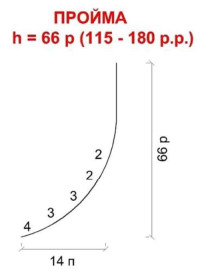
SHAPING AT THE ARMHOLE 14 STITCHES: 4,3,3,2,2.
Thus, in rows 115 and 116 bind off 4 stitches; in rows 117 and 118 — 3 stitches; in rows 119 and 120 — 3 stitches; in rows 121 and 122 — 2 stitches; in rows 123 and 124 — 2 stitches. Thus the armhole is shaped in 5 steps = 10 rows.
To the shoulder edge, continue knitting straight for 56 more rows. Total height of the armhole is 66 rows (including decreases).
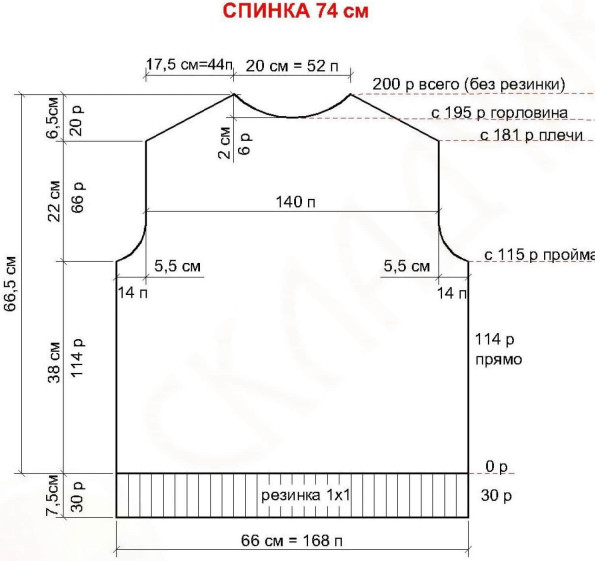
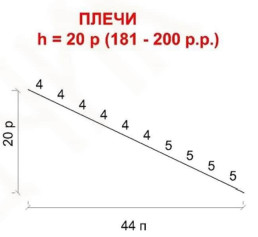
FROM ROW 181, SHOULDERS ARE KNITTED (44 stitches) using partial knitting: 4 times 5 stitches and 6 times 4 stitches.
We knit as follows: knit row 181 to the end, at the end of row 182 do not complete 5 stitches, turn, make an auxiliary yarn over on the needle and place a marker. In row 183 do not complete 5 stitches, turn the knitting, make a yarn over. In the following rows do not complete N stitches (5 stitches or 4 stitches in our case) before the auxiliary yarn over or marker. Knit like this up to row 194 inclusive.
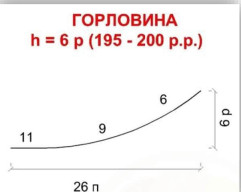
From row 195, begin knitting the half of the neckline (26 stitches) with partial knitting in 3 steps: 11, 9, 6. Place a marker at the center of the back (this is the center of the main motif). In row 195, do not work to the marker 11 stitches, turn the work; in row 196, do not work 4 shoulder stitches; in row 197, do not work to the yarn over 9 stitches, turn the knitting; in row 198, do not work 4 shoulder stitches; in row 199, do not work to the yarn over 6 stitches, turn the knitting.
In row 200, begin the smoothing row for the right shoulder: knit the stitches according to the pattern, keeping the yarn over on the wrong side; if needed, rearrange stitches and knit.
In row 201, bind off 44 stitches of the shoulder up to the yarn-over stitch at the neckline (up to the marker).
Now knit the smoothing row of the right half of the neckline up to the middle according to the pattern, keep the auxiliary yarn over on the wrong side. We knit without breaking the yarn, which means that from the middle of the neckline the pattern will continue on the left side of the back, as in row 195 (15 rows according to FIG.2). Do not bind off 4 stitches to the marker at the left shoulder; turn the knitting, and in row 196 do not bind off up to the center marker 11 stitches, turn the knitting, make a yarn over. In row 197 do not bind off to the yarn over 4 stitches, turn the knitting; in row 198 do not bind off 9 stitches of the neckline. In row 199 do not bind off to the yarn over 4 stitches, turn the knitting; in row 200 do not bind off 6 stitches of the neckline, turn the knitting, make a yarn over.
In row 201 begin the smoothing row for the left shoulder: knit the stitches according to the pattern, keeping the yarn over on the wrong side, if necessary rearrange and knit.
In row 202 bind off the stitches of the left shoulder with purl stitches so that a braid appears on the right side. Reach the yarn over, continue knitting the purl row according to the pattern.
In row 203 close the back neckline. Note that rows 201–203 are not shown on the chart—they are technical and not part of the calculation.
FRONT.
Cast on 168 stitches with 3.0 mm needles.
Cast on 168 stitches with 3.0 mm needles.
Knit 1/1 rib for 30 rows. Starting as follows: 1 edge stitch (slip, not worked), "1 knit, 1 purl", repeat "…" to end of row, 1 edge stitch (purl "garter stitch").
Switch to 5.0 mm needles, begin pattern.

Knit together according to the stitch pattern chart (FIG. 2) from rows 1 through 6.
1 row knit side: 1 edge, 2 purl, 9 knit, 4 purl, 4 knit, 4 purl, 9 knit, 4 purl, 4 knit, 4 purl, 2 knit, 2 purl, 2 knit, 2 purl, 4 knit, 2 purl, 2 knit, 2 purl, 2 knit, 2 purl, 4 knit, 9 knit, 4 purl, 4 knit, 4 purl, 9 knit, 4 purl, 4 knit, 4 purl, 2 knit, 2 purl, 2 knit, 2 purl, 2 knit, 2 purl, 4 knit, 2 purl, 2 knit, 2 purl, 2 knit, 2 purl, 4 knit, 9 knit, 4 purl, 4 knit, 4 purl, 9 knit, 2 purl, 1 edge.
2 row purl. according to the chart: knit=knit, purl=purl.
3 row knit side: 1 edge, 2 purl, 9 knit, 4 purl, cross 4 stitches to the right: 2 stitches held to the back on an auxiliary needle, knit the next 2 stitches, then knit the stitches from the auxiliary needle, 4 purl, 9 knit, 4 purl, 2 knit, 2 purl, 2 purl, cross 4 stitches to the right: 2 stitches held to the back on an auxiliary needle, knit the next 2 stitches, then knit the stitches from the auxiliary needle, 2 purl, 2 knit, 2 purl, 2 knit, 4 purl, 9 knit, 4 purl, 2 knit, 2 purl, 2 knit, 2 purl, cross 4 stitches to the right: 2 stitches held to the back on an auxiliary needle, knit the next 2 stitches, then knit the stitches from the auxiliary needle, 2 purl, 2 knit, 2 purl, 4 knit, 9 knit, 4 purl, 4 knit, 9 knit, 2 purl, 1 edge.
4 row purl. according to the chart: knit=knit, purl=purl.
5 row knit side: 1 edge, 2 purl, 6 stitches cross to the right: 3 stitches left on the auxiliary needle, 3 stitches knitted, then stitches from the auxiliary needle knitted, 3 knit, 4 purl, 4 knit, 4 purl, 6 stitches cross to the right: 3 stitches left on the auxiliary needle, 3 stitches knitted, then stitches from the auxiliary needle knitted, 3 knit, 4 purl, 2 knit, 2 purl, 2 knit, 2 purl, 4 knit, 6 stitches cross to the right: 3 stitches left on the auxiliary needle, 3 stitches knitted, then stitches from the auxiliary needle knitted, 3 knit, 4 purl, 2 knit, 2 purl, 2 knit, 2 purl, 4 knit, 6 stitches cross to the right: 3 stitches left on the auxiliary needle, 3 stitches knitted, then stitches from the auxiliary needle knitted, 3 knit, 4 purl, 6 stitches cross to the left: 3 stitches left in front of the work on the auxiliary needle, 3 stitches knitted, then stitches from the auxiliary needle knitted, 4 purl, 4 knit, 4 purl, 3 knit, 6 stitches cross to the left: 3 stitches left in front of the work on the auxiliary needle, 3 stitches knitted, then stitches from the auxiliary needle knitted, 4 purl, 4 knit, 4 purl, 3 knit, 6 stitches cross to the left: 3 stitches left in front of the work on the auxiliary needle, 3 stitches knitted, then stitches from the auxiliary needle knitted, 2 purl, 1 edge.
6 row purl. according to the chart: knit=knit, purl=purl.
Next we knit according to the pattern chart (FIG. 2), repeating the motif from rows 7 to 42. Note the crossing of 3 stitches to the right and to the left in the main aran (SCHEME 3); in some cases on knit rows knit stitches change to purl and vice versa. Everything is shown in the chart.
We knit until the armhole is 114 rows.
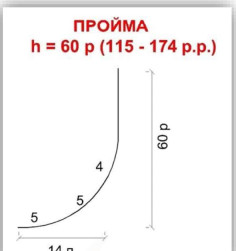
Sleeve decreases for the armhole: 14 stitches: 5, 5, 4.
Thus, in rows 115 and 116 close 5 stitches, in rows 117 and 118 — 5 stitches, in rows 119 and 120 — 4 stitches. Thus the armhole was worked off in 3 steps = 6 rows.
Knit straight for another 54 rows to the shoulder seam. Total armhole height is 60 rows (including decreases).
From row 175 we shape the shoulders (44 stitches) with short-row knitting:
4 times 5 stitches and 6 times 4 stitches, and the neckline (half — 26 stitches): 9,5,3,3, and 3 times by 2 stitches decoratively.
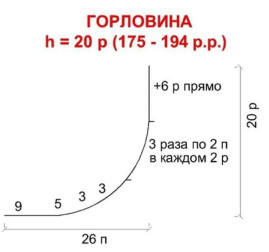
Hang a marker at the center of the placket (this is the center of the main aran).
In row 175 do not work 9 stitches up to the marker, turn the work, make an auxiliary yarn-over on the needle and hang a marker. In row 177 do not work 5 stitches, turn the work, make a yarn-over. In the following rows do not work N stitches (5 or 4 stitches in our case) before the auxiliary yarn-over or marker. Knit this way up to row 182 inclusive.
In row 183, do not work 5 stitches, make a decorative decrease: slip 2 stitches, bring them in front of the work, knit 1st and 3rd stitches together, then 4th and 2nd stitches together.
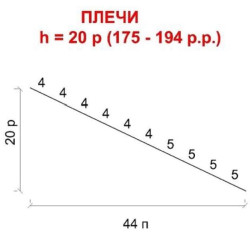
In row 183, not knitting 5 stitches, perform a decorative decrease: slip 2 stitches, bring them in front of the work, knit together the 3rd and 1st stitches, then the 4th and 2nd stitches.
The last stitch before the yarn over should be worked as an edge with grandmother's purl. Repeat this technique in rows 185 and 187. Then continue without decreases along the neckline, finishing the row with a grandmother's purl edge. In the purl rows, remember to shape the shoulder, keeping 4 stitches before the marker.
In row 194 begin a smoothing row for the right shoulder: knit the stitches according to the chart, keeping the yarn over on the wrong side; if necessary swap stitches and knit.
In row 195, bind off 44 stitches of the shoulder to the end of the row.
Neckline in the center — partial knitting; above it is a straight vertical section from which we will pick up stitches. After shaping the shoulders, without breaking the yarn, pick up along the vertical section 10 knit stitches. This is convenient to do with a crochet hook or a thin needle. In total on the right along the vertical section we will have 11 stitches. Continue knitting on the right side following the pattern, knitting the stitches with the yarn-overs kept on the wrong side. The yarn-overs should stay behind the work.
Knit to the end of the knit row, remembering that from the central marker row 175 begins (row 31 according to Fig. 2).
Transition to knitting the left part, resetting the row count to the start of the neckline +1 row: knit 61 purl stitches of the 176th row, i.e., leave 9 stitches unworked from the center front, turn the work, make a backward yarn-over, continue following the chart.
In row 177, do not work 5 stitches of the shoulder, turn the work, make a backward yarn-over.
In odd knit rows, shape the shoulders: rows 179, 181, 183 — 5 stitches each, 185, 187, 189, 191, 193, 195 — 4 stitches.
In even purl rows, shape the neckline of the front with short rows: 178 — 5 stitches, 180, 182 — 3 stitches.
Next we will decoratively decrease the neckline stitches.
In row 184, not knitting 5 stitches, perform a decorative decrease: slip 2 stitches, bring them to the front, knit the 1st and 3rd stitches together purlwise, then the 2nd and 4th stitches together. The last stitch before the yarn over to be knitted as an edge using grandmother's purl. (Video 13. Left decorative decrease). Repeat this technique in rows 186 and 188. In knit rows be sure to shape the shoulder.
In row 195, knit a smoothing row for the left shoulder: knit the stitches according to the pattern, with the yarn-over remaining on the wrong side.
In row 196, bind off 44 stitches of the shoulder purl-wise.
After closing the shoulder, without breaking the yarn, pick up 10 purl stitches along the vertical section. In total, on the right vertical section we will have 11 stitches. Continue knitting on the wrong side following the pattern, knitting the stitches with the auxiliary yarn-overs. The yarn-overs must stay in front of the work on the wrong side; if necessary, swap the stitches and knit them. Knit to the middle of the row (the center of the pattern) + 8 stitches. Leave 5–7 cm of yarn and cut. The remaining stitches from the left needle simply transfer to the right.
Insert the yarn at the beginning of the right-side row and bind off the front neckline with knit stitches. When you reach the cut yarn, join it to the working yarn with a knot, continue binding off. At the end cut the yarn.
SLEEVE.
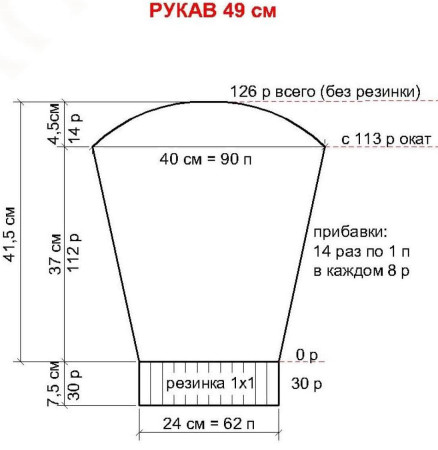
Cast on 64 stitches on 3.0 mm needles.
Knit 1×1 rib to a height of 30 rows.
Starting as: 1 edge stitch (slip, not worked), 1 knit, 1 purl, ..., 1 edge stitch (purl “grandmother’s method”).
Switch to 5.0 mm needles, begin knitting the pattern.
Pattern on the sleeve (from right to left, FIG. 2):
1 edge stitch, 1 purl, 3 knit, 2 purl, CHART 2, CHART 3, CHART 4, 2 purl, 3 knit, 1 purl, 1 edge stitch.
Knit 108 rows with increases up to the sleeve head.
Increases are performed as follows:
— 18 times every 6th row (rows 5, 11, 17, 23, 29, 35, ..., 101, 107).
-
1 purl row in pattern.
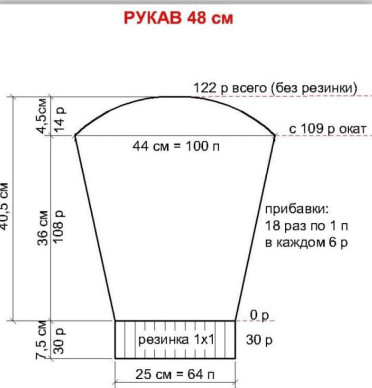
Knit together according to the pattern (FIG. 2) from row 1 to row 6.
Row 1 (RS).: 1 edge stitch, 1 purl, 3 knit, 4 purl, 9 knit, 4 purl, 2 knit, 2 purl, 2 knit, 2 purl, 4 knit, 2 purl, 2 knit, 2 purl, 4 purl, 9 knit, 4 purl, 3 knit, 1 purl, 1 edge stitch.
Row 2 (WS): according to the pattern: knit=knit, purl=purl.
Row 3 (RS): 1 edge, 1 purl, 3 knit, 4 purl, 9 knit, 4 purl, 2 knit, 2 purl, 2 knit, 2 purl, cross 4 stitches to the right: 2 stitches leave behind the work on an auxiliary needle, knit the 2 stitches, then knit the stitches from the auxiliary needle, 2 purl, 2 knit, 2 purl, 2 knit, 4 purl, 9 knit, 4 purl, 9 knit, 4 purl, 2 knit, 2 purl, 2 knit, 2 purl, cross 4 stitches to the right: leave 2 stitches behind the work on the auxiliary needle, knit the 2 stitches, then knit the stitches from the auxiliary needle, 4 purl, 3 knit, backward yarn over, 1 purl, 1 edge stitch.
Row 4 (WS): according to the pattern: knit=knit, purl=purl.
Row 5 (RS): 1 edge, 1 purl, backward yarn over (when knitted it does not form a hole), 3 knit, 4 purl, 6 stitches cross to the right: 3 stitches leave behind the work on an auxiliary needle, 3 stitches knit, then stitches from the auxiliary needle knit, 3 knit, 4 purl, 2 knit, 2 purl, 2 knit, 2 purl, 4 knit, 2 purl, 2 knit, 2 purl, 4 purl, 3 knit, 6 stitches cross to the left: 3 stitches leave in front of the work on the auxiliary needle, 3 stitches knit, then stitches from the auxiliary needle knit, 4 purl, 3 knit, backward yarn over, 1 purl, 1 edge stitch.
Row 6 (WS): 1 edge, 1 knit, 1 purl, then follow the pattern: knit=knit, purl=purl, 1 purl, 1 knit, 1 edge.
Next, work according to the pattern chart (FIG. 2), repeating the repeat from rows 7 to 42. Pay attention to crossing of 3 stitches to the right and to the left in the main aran (FIG. 3); in some cases in knit rows knit stitches alternate with purl stitches and vice versa. Everything is shown in the chart.
ATTENTION: From now on all yarn-overs must be purled from the right side: 1 edge stitch, 1 purl, 1 purl, ............1 purl, 1 purl, 1 edge stitch.
In row 13 from the increased front stitches at the side, form a small cable.
Sleeve pattern in row 13 (right to left, FIG. 2): 1 edge, CHART 1, CHART 2, CHART 3, CHART 4, CHART 5, 1 edge.
We obtain 100 stitches after the increases.
From row 109, sleeve cap shaping closes in rows as follows: 109, 110 — 9 stitches, rows 111–118 — 5 stitches, 119,120 — 10 stitches, 121 — 22 stitches.
Sleeve ready. Knit the second one similarly.
Back, front, and sleeves to be washed and a collar to be knitted. The collar can also be knitted before washing.
NECKLINE.
Sew both shoulders with the seam on the outside. Take needles 3.0 mm.
Along the back, cast on 52 stitches, and along the front 64 stitches (11–42–11). Form a fake Kett knit, join the knitting in the round and knit 12 rows (3 cm) of 1×1 rib. Bind off the neck ribbing with a needle
ASSEMBLY.
Sew in the sleeves.
Complete side seams and the lower seams of the sleeve.
Wash the finished garment and lay it flat to dry on a towel.
SWEATER “XL” WITH A HIGH NECK.
Length 68 cm, width 71 cm, sleeve length 45 cm. For example, for size 54–64, height up to 170 cm.
BACK.
Cast on 180 stitches on 3.0 mm needles.
Knit 1×1 rib to a height of 30 rows. Starting as: 1 edge (slip, not worked), “1 knit, 1 purl,” repeat to the end of the row, 1 edge (purl, “grandmother’s method”).
BACK 69 cm

Switch to 5.0 mm needles, begin knitting the pattern.
Pattern on the front (right to left, FIG. 2): 1 edge stitch, 1 purl, 3FIG. 2, FIG. 3, FIG. 2,
FIG. 3, FIG. 4, FIG. 3, 3FIG. 4, 1 purl, 1 edge.
Knit together according to the pattern (FIG. 1) from rows 1 to 6.
Row 1: 1 edge stitch, 3 purl, 9 knit, 4 purl, 9 knit, 4 purl, 9 knit, 4 purl, 2 knit, 2 purl, 2 knit, 2 purl,
4 knit, 2 purl, 2 knit, 2 purl, 2 knit, 4 purl, 9 knit, 4 purl, 2 knit, 2 purl, 2 knit, 2 purl, 4 knit, 2
purl, 2 knit, 2 purl, 2 knit, 4 purl, 9 knit, 4 purl, 9 knit, 3 purl, 1 edge.
Row 2: purl according to the pattern: knit=knit, purl=purl.
Row 3: 1 edge, 3 purl, 9 knit, 4 purl, 9 knit, 4 purl, 9 knit, 4 purl, 2 knit, 2 purl, 2 knit, 2 purl,
4 stitches cross to the right: leave 2 stitches behind the work on an auxiliary needle,
2 stitches knit, then the stitches from the auxiliary needle knit,
2 purl, 2 knit, 2 purl, 2 knit, 4 purl, 9 knit, 4 purl, 9 knit, 4 purl, 2 knit, 2 purl, 2 knit,
cross 4 stitches to the left: leave 2 stitches behind the work on the auxiliary
needle, knit the 2 stitches, then the stitches from the auxiliary needle knit,
2 purl, 2 knit, 2 purl, 2 knit, 4 purl, 9 knit, 4 purl, 9 knit, 3 purl, 1 edge.
4th row purl. according to the chart: knit=knit, purl=purl.
5th row knit: 1 edge stitch, 3 purl, cross 6 stitches to the right: 3 stitches leave behind the work on
auxiliary needle, knit the 3 stitches, then knit the stitches from the auxiliary
needle, 3 knit, 4 purl, cross 6 stitches to the right: 3 stitches leave behind the work on the auxiliary needle, 3 stitches knit, then knit the stitches from the auxiliary needle, 3 knit, 4 purl, cross 6 stitches to the right: leave 3 stitches behind the work on the auxiliary needle, 3 stitches knit, then knit stitches from the auxiliary needle, 3 knit, 4 purl, 6 stitches cross to the left: 3 stitches leave in front of the work on the auxiliary needle, 3 stitches knit, then stitches from the auxiliary needle knit, 3 knit, 4 purl, 2 knit, 2 purl, 2 knit, 2 purl, 4 knit, 2 purl, 2 knit, 2 purl, 4 knit, 3 knit, 6 stitches cross to the left: leave 3 stitches in front of the work on the auxiliary needle, 3 stitches knit, then stitches from the auxiliary needle knit, 3 knit, 4 purl, 2 knit, 2 purl, 2 knit, 2 purl, 4 knit, 2 purl, 2 knit, 2 purl, 4 knit, 3 knit,
6 stitches cross to the left: 3 stitches leave in front of the work on the auxiliary
needle, 3 stitches knit, then stitches from the auxiliary needle knit
knit, 4 purl, 3 knit, 6 stitches cross to the left: 3 stitches leave in front of the work on the auxiliary needle, 3 stitches knit, then stitches from the auxiliary needle knit, 3 knit, 4 purl, 3 knit, 6 stitches cross to the left: leave 3 stitches in front of the work on the auxiliary needle, 3 stitches knit, then stitches from the auxiliary needle knit, 3 purl, 1 edge stitch.
6th row purl according to the chart: knit=knit, purl=purl.
Далее вяжем по схеме узоров (FIG.1), повторяя раппорт с 7 по 42 ряд. Обратите
внимание на перекрещивание 3 петель направо и налево в главном аране (SCHEME 3), в
некоторых случаях в лицевых рядах лицевые петли меняются на изнаночные и
наоборот. Всё отображено в схеме.
Вяжем до проймы 96 рядов (24 ряд на FIG.2).
Decreases at the armhole: 15 stitches: 5,3,3,2,2.
Значит, в 97 и 98 рр. закрыть 5 петель, в 99 и 100 рр. – 3 п., в 101 и 102 рр. – 3 п., в 103 и 104 рр. – 2 п., в 105 и 106 рр. – 2 п. Таким
образом образуем пройму за 5 приёмов = 10 рядов.
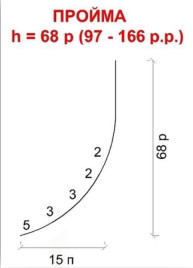
Decreases at the armhole: 15 stitches: 5,3,3,2,2.
Thus, in rows 97 and 98 close 5 stitches, in rows 99 and 100 — 3 stitches, in rows 101
and 102 rows — 3 stitches, in rows 103 and 104 — 2 stitches, in rows 105 and 106 — 2 stitches. This way we shape the armhole in 5 steps = 10 rows.
До скоса плеча вяжем прямо ещё 58 рядов. Всего высота
проймы = 68 рядов (вместе с убавками).
From row 165 we begin shoulder shaping (47 stitches) with short-row knitting:
3 times by 5 stitches, 8 times by 4 stitches.
Вяжем следующим образом:
связать 165 ряд до конца, в
конце 166 ряда не довязываем 5
петель, вязание повернуть, сделать
вспомогательный накид и повесить маркер. В 167 ряду не довязываем 5 п., и
поворачиваем вязание, делаем накид. В следующих
рядах не довязываем N петель (5 или 4 пп. в нашем
случае) до вспомогательного накида или маркера.
Так вяжем до 180 ряда включительно.
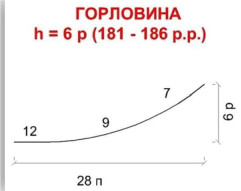
From row 181 we begin to knit half the neckline (28 stitches) in 3 steps: 12, 9, 7. Hang a marker at the middle of the back (this is the center of the main aran). In row 181 we do not knit to the marker 12 stitches, turn the work, in row 182 do not knit 4 stitches of the shoulder. In row 183 do not knit to the yarn over 9 stitches, turn, in row 184 do not knit 4 stitches of the shoulder.
In row 185 do not
knit up to the yarn over 7 stitches, turn the knitting.
In row 186 we begin smoothing row for the right shoulder:
knit the stitches according to the pattern, the yarn over must
stay on the wrong side, if needed swap stitches and
knit.
In row 187 close 47 shoulder stitches up to the neckline marker.
Now we knit the smoothing row of the right half of the neckline to the middle according to the pattern, the auxiliary yarn over is left on the wrong side. We knit without separating the yarn, this means that from the middle of the neckline the pattern will continue on the left back, as in row 181 (37 rows on FIG.2). Do not knit 4 stitches to the marker at the left shoulder, turn the knitting, and in row 182 do not knit to the middle marker 12 stitches, turn the knitting, make a yarn over. In row 183 do not knit to the yarn over 9 stitches, in row 184 do not knit 4 stitches of the shoulder. In row 185 do not knit to the yarn over 4 stitches, turn the knitting, make a yarn over.
In row 187 begin smoothing row for the left shoulder: knit the stitches according to the pattern, the yarn over must stay on the wrong side, if necessary
swap stitches and knit. In row 188 bind off the stitches of the left shoulder with purl stitches so that there is a braid on the face side (video 10. Closure of the left shoulder). Reach the top yarn over of the neckline, continue knitting the purl row according to the pattern.
In row 189, close the neckline of the back with knit stitches. Note that the diagram does not include rows 187–189 – they are technical – not counted in the calculation.
FRONT.
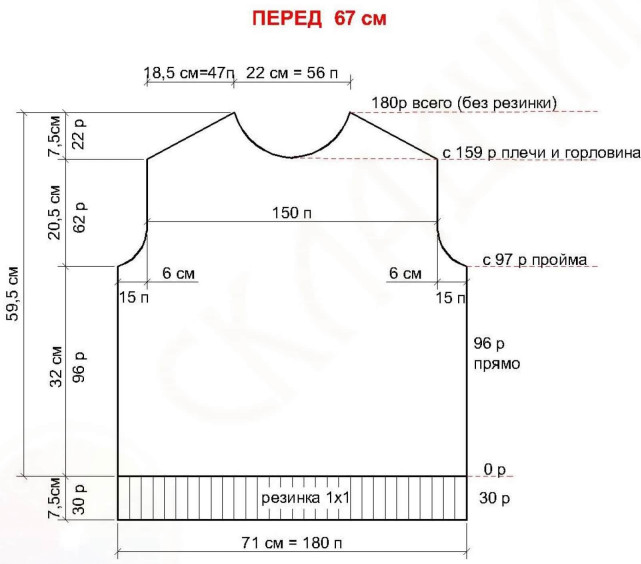
Cast on 3.0 – 180 stitches on needles.
Knit 1/1 rib for a height of 30 rows. Starting as follows: 1 edge stitch (slip, do not knit),
“1 knit, 1 purl”, repeat “…” to the end of the row, 1 edge stitch (purl “grandmother’s method”).
Switch to needles 5.0, begin knitting the pattern.
Pattern on the front (from right to left, FIG.2): 1 edge stitch, 1 purl, 3SCHEMA 2, SCHEMA 3, SCHEMA 2,
SCHEMA 3, SCHEMA 4, SCHEMA 3, 3SCHEMA 4, 1 purl, 1 edge stitch.
Knit to the armhole for 96 rows, the same as the back.
Armhole decreases: 15 stitches: 6, 5, 4.
Therefore, in rows 97 and 98, bind off 6 stitches; in rows 99 and 100 — 5 stitches, in 101
and 102 rows — 4 stitches. Thus the armhole was shaped in 3 stages = 6
rows. Up to the shoulder slope, knit straight for another 56 rows. Total height
of the armhole — 62 rows (including decreases).
Shoulders and neckline.
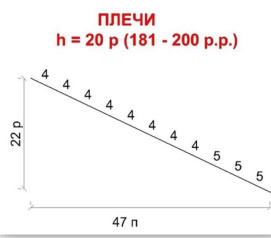
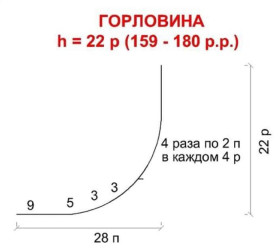
From row 159, knit the shoulders (47 stitches) with short-rows: 3 times by 5 stitches, 8 times by 4 stitches and the neckline (half — 28 stitches): 9,5,3,3 (short-rows) and 4 times by 2 stitches decoratively.
Place a marker at the center of the front (this is the center of the main motif).
Knit 66 stitches, i.e., leave 9 stitches unknit from the center of the front; turn, make an auxiliary yarn over, continue following the pattern.
In row 160, do not work 5 stitches of the shoulder, turn the work, make a yarn over.
In the even wrong-side rows shape the shoulders: rows 162, 164 — by 5 stitches each, rows 166,168,170,172,174,176,178,180 — by 4 stitches each.
In the odd right-side rows shape the front neckline with short rows: 161 — 5 stitches, 163 — 3 stitches, 165 — 3 stitches.
Next, we will decoratively decrease stitches at the neckline.
In row 167, with 5 stitches not yet joined, make a decorative decrease: slip 2 stitches, bring to the front, knit together the 3rd and 1st stitches, then the 4th and 2nd stitches. The last stitch before the yarn over knit as the edge, with a garter-stitch purl. Repeat this technique in rows 171, 175 and 179. In the purl rows, remember to work the shoulder.
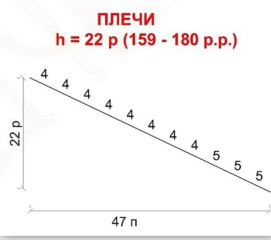
In row 180, knit a smoothing row for the right shoulder: knit the stitches as per the pattern, the yarn over should remain on the wrong side; if necessary, rearrange and knit.
In row 181, bind off 47 stitches of the shoulder knitwise to the end of the row.
Neckline in the center — short-row technique; the higher section is a straight vertical piece from which we will pick up stitches. After finishing the shoulder, without breaking the thread, pick up 10 knit stitches along the vertical section. This can be conveniently done with a crochet hook or a thin needle. In total, on the right vertical section you will have 11 stitches. Continue knitting on the knit side following the pattern, knitting the stitches with yarn overs. The yarn overs should remain behind the work on the wrong side.
Finish to the end of the knit row, remembering that from the central marker there are 159 rows (15 rows per Fig. 2).
Move on to knitting the left part, after resetting the row count to the start of the neckline + 1 row.:
Knit 66 stitches of the purl row 160, i.e., leave 9 stitches unworked from the center of the front; turn the knitting, make an auxiliary yarn over, continue following the pattern.
In row 161, do not complete 5 stitches of the shoulder, turn, make a backward yarn over.
In the odd knitting rows shape the shoulders: 163,165 rows — 5 stitches each, 167,169,171,173,175,177,179,181 rows — 4 stitches.
In the even wrong-side rows shape the front neckline with short rows: 162 — 5 stitches, 164 — 3 stitches, 166 — 3 stitches.
Next, we will decoratively decrease stitches at the neckline.
In row 168, with 5 stitches not yet knitted, make a decorative decrease: slip 2 stitches, bring to the front, knit the 1st and 3rd stitches together purlwise, then the 2nd and 4th stitches together. (video 13. Left decorative decrease). Knit the last stitch before the yarn over as the edge stitch — garter-stitch purl. Repeat this technique in rows 172, 176 and 180. In the knit rows, remember to work the shoulder.
In row 181, knit a smoothing row for the left shoulder: knit the stitches as per the pattern, the yarn over should remain on the wrong side.
In row 182, bind off 47 stitches of the shoulder purlwise.
After binding off the shoulders, without breaking the yarn, pick up 10 purl stitches along the vertical section. In total on the right vertical section you will have 11 stitches. Continue knitting on the wrong side following the pattern, knitting the stitches together with the auxiliary yarn overs. The yarn overs should remain in front of the work on the wrong side; if necessary, rearrange the stitches and knit. When you reach the middle of the row (center of the motif) plus 8 stitches. Leave 5-7 stitches for later work. The remaining stitches on the left simply transfer to the right needle.
Insert the yarn at the beginning of the knit row and bind off the front neckline with knit stitches — 62 stitches. When you reach the detached thread, tie it with a working knot, continue binding off. At the end, cut the yarn.
RIBBING.
Cast on 68 stitches on needles 3.0.
Knit 1x1 rib for a height of 28 rows. Starting as: 1 edge stitch (slip, not worked), 1 knit, 1 purl, …, 1 edge stitch (purl “grandmother's method”).
Switch to needles 5.0, begin to knit the pattern:
Pattern on the sleeve (from right to left, FIG.2): 1 edge stitch, SCHEMA 1, SCHEMA 2, SCHEMA 3, SCHEMA 4, SCHEMA 5, 1 edge stitch.
Knit 100 rows with increases up to the sleeve cap. Increases are done as follows:
– 10 times in every 6th row (5,11,17,23,29,35,41,47,53,59 rows)
– 8 times in every 5th row (64,69,74,79,84,89,94,99) + 1 purl row according to the pattern.
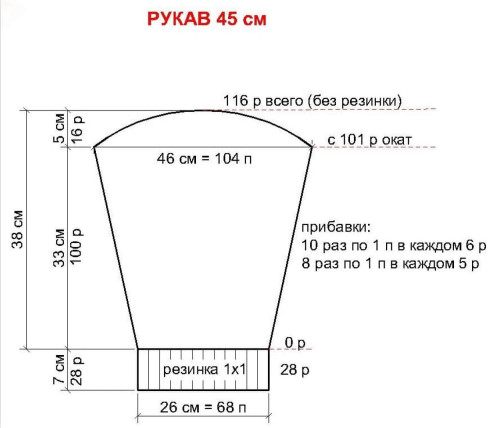
Knit together according to the pattern (FIG.2) from rows 1 to 6.
Row 1 (knit side): 1 edge, 2 purl, 4 knit, 4 purl, 9 knit, 4 purl, 2 knit, 2 purl, 2 knit, 2 purl, 4 knit, 2 purl, 2 knit, 2 purl, 4 knit, 4 purl, 1 edge.
Row 2 (purl side): as per pattern: knit=knit, purl=purl.
Row 3 (knit side): 1 edge, 2 purl, cross 4 stitches to the right: 2 stitches set behind the work on an auxiliary needle, knit the 2 stitches, then knit the stitches from the auxiliary needle, 4 purl, 9 knit, 4 purl, 2 knit, 2 purl, 2 knit, 2 purl, cross 4 stitches to the right: set 2 stitches behind the work on the auxiliary needle, knit the 2 stitches, then knit the stitches from the auxiliary needle, 2 purl, 2 knit, 2 purl, 2 knit, 4 purl, 9 knit, 4 purl, cross 4 stitches to the left: place 2 stitches in front of the work on the auxiliary needle, knit the 2 stitches, then knit the stitches from the auxiliary needle, 2 purl, 1 edge.
Row 4 (purl side): as per pattern: knit=knit, purl=purl.
Row 5: Knit stitches: 1 edge stitch, 1 purl, backward loop (first increase), 1 purl, 4 knit, 6 stitches cross to the right: 3 stitches hold to the back on an auxiliary needle, knit the 3 stitches, then knit the stitches from the auxiliary needle, 3 knit, 4 purl, 4 knit, 9 knit, 4 purl, 2 knit, 2 purl, 2 knit, 4 purl, 3 knit, cross 6 stitches to the left: leave 3 stitches in front of the work on the auxiliary needle, knit the 3 stitches, then knit the stitches from the auxiliary needle, 4 purl, 4 knit, 1 purl, backward loop (first increase), 1 purl, 1 edge stitch.
Row 6: Purl. As per pattern: knit = knit, purl = purl, backward loop increase to be worked as a knit.
Next, knit according to the pattern chart (FIG. 2), repeating the repeat from rows 7 to 42. The backward yarn-overs (side increases) are worked further according to the chart so that the right side has a purl fabric.
We end up with 104 stitches.
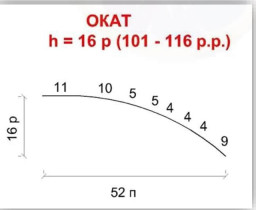
From row 101, shape the sleeve cap, close off stitches on the right and left in groups according to the chart, starting from the right: 9,4,4,4,5,5,10,11. In row 115 bind off 11*2 = 22 stitches at once. Cut the yarn.
The sleeve is ready. Knit the second one similarly.
Wash the back, front, and sleeves and knit the collar.
The collar can also be knitted before washing.
COLLAR.
Sew the two shoulders with a seam on the outside. Take 3.0 mm needles.
ASSEMBLY.
Sew in the sleeves.
Complete the side seams and bottom seams of the sleeve
Wash the finished garment and lay it out to dry flat on a towel.