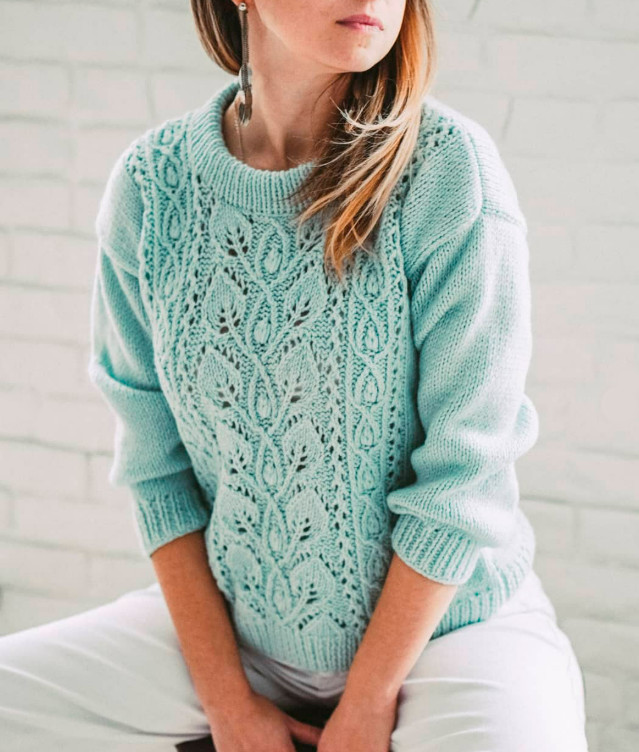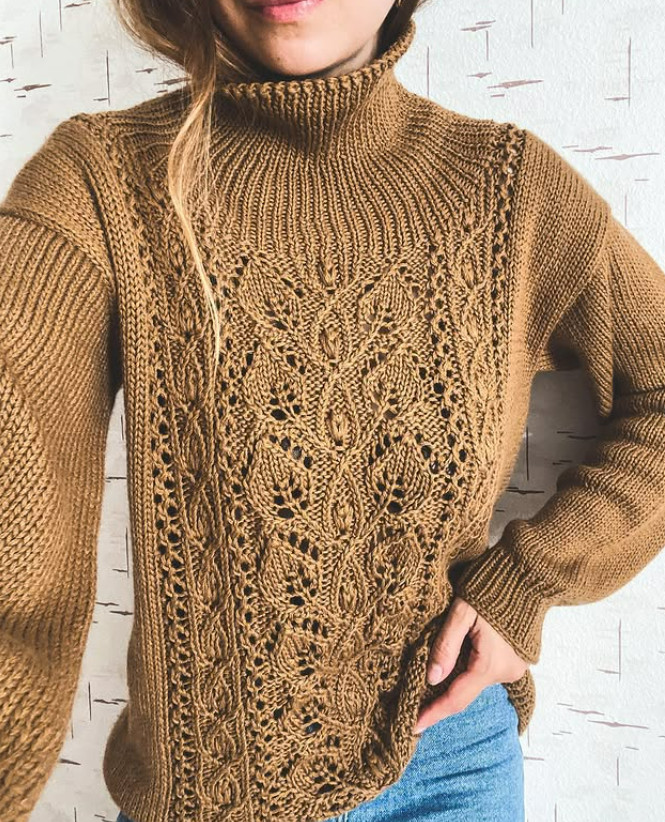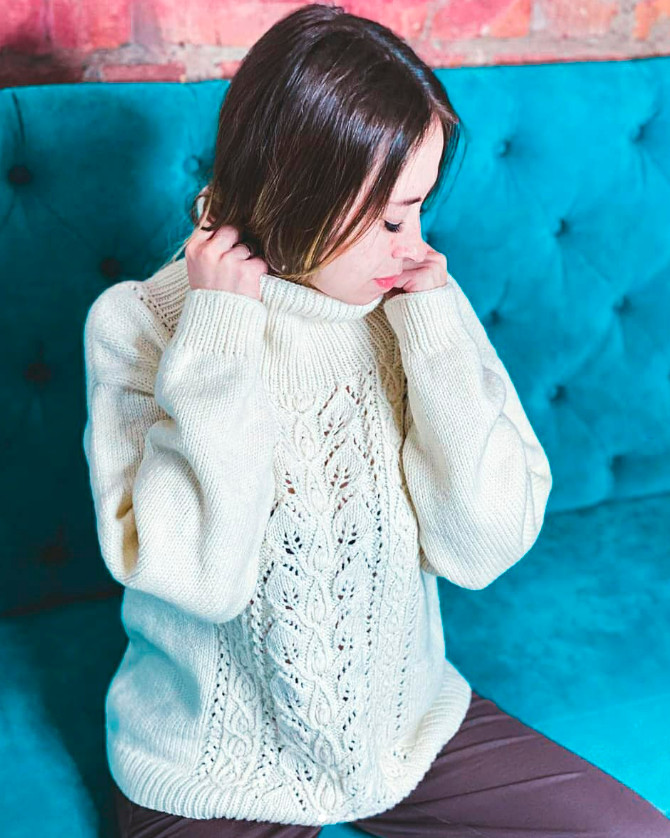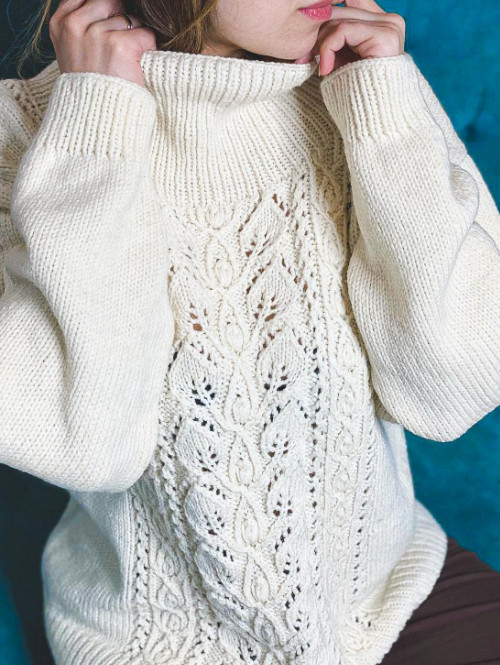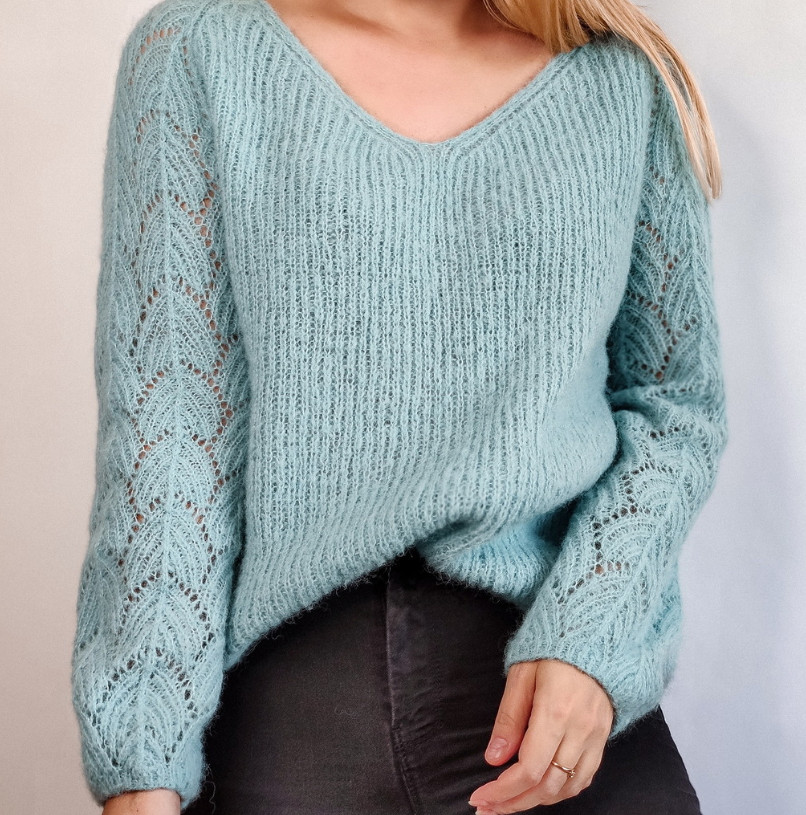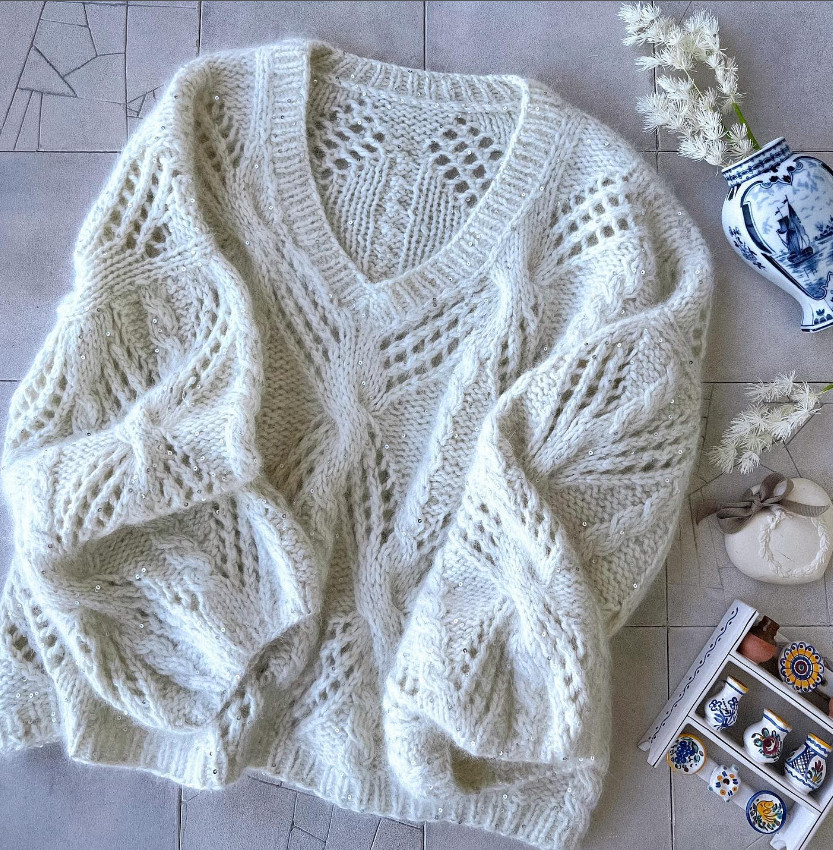




Свитер спицями
Added: 24.11.2025 в 15:37 Views: 733
Свитер спицямиKlubokhttp://klubok.work/1/3/9317/Klubokhttps://klubok.work/css/image/top-logo-en.png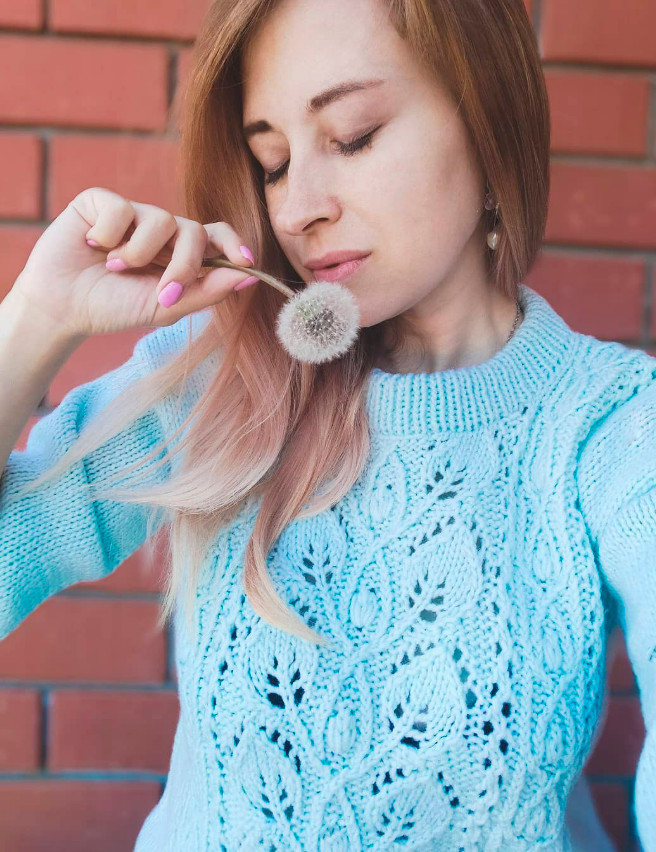
Sizes:
XS-S — bust circumference of the sweater 105 cm
M-L — bust circumference of the sweater 110 cm
XL-XXL — bust circumference of the sweater 115 cm
Back length of the sweater — 60 cm
Sleeve length — 52 cm
(If this length is inconvenient, you can knit the classic length.)
Materials:
-
Alize Lanagold 240/100 on needles 4.5 mm — 5 (6) (7) skeins.
The thickness of the yarn may vary slightly depending on the color. -
Circular needles 80 cm: 4 mm for ribbing, 4.5 mm for the main fabric.
-
Needles of the main size 40 cm for sleeves (or Magic Loop 80 cm).
-
Two additional needles for the pattern.
-
Crochet hook, measuring tape, scissors.
Different yarn may be used as long as the gauge is maintained.
Gauge and Swatch:
Cast on ~30 stitches on 4.5 mm needles, knit 30 rows, block, and steam press.
Measure the number of stitches in a 10×10 cm square.
My gauge: 18 sts and 28 rows = 10×10 cm.
If your gauge differs — choose the needle size individually.
Small variations are acceptable (oversize).
Abbreviations:
Knit — knit stitch
Purl — purl stitch
Crossed knit — crossed knit stitch
Auxillary needle
 Knit stitch
 Purl stitch
 2 knit stitches together with right-leaning decrease
 2 knit stitches together with left-leaning decrease
 Yarn over
 Slip 2 stitches together knitwise, knit 1, pass the slipped stitches over.
 3 knit stitches together with right-leaning decrease
 5 knit stitches together: slip 3 stitches together knitwise, knit 2 together, pass the 3 slipped stitches over
 Crossed knit:
 Insert the right needle in front of the first stitch, knit the second stitch twisted, without dropping from the left needle; knit the first stitch purlwise and drop both.
 Insert the right needle behind the first stitch, knit the second stitch purlwise, then knit the first stitch twisted and drop both stitches.
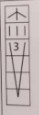
Bobble made from three elongated stitches three rows below
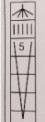 Bobble made from five elongated stitches four rows below
 Transfer 1 stitch to the auxiliary needle, hold in front of the work; transfer another stitch to the auxiliary needle, hold behind the work, 1 knit crossed; from the back auxiliary needle 1 purl; from the front auxiliary needle 1 knit crossed.
 Transfer 1 stitch to the auxiliary needle, hold in front of the work, 1 purl, 1 knit; from the auxiliary needle 1 crossed knit.
Transfer 2 stitches to the auxiliary needle, hold behind the work; 1 crossed knit, from the auxiliary needle 1 knit, 1 purl.
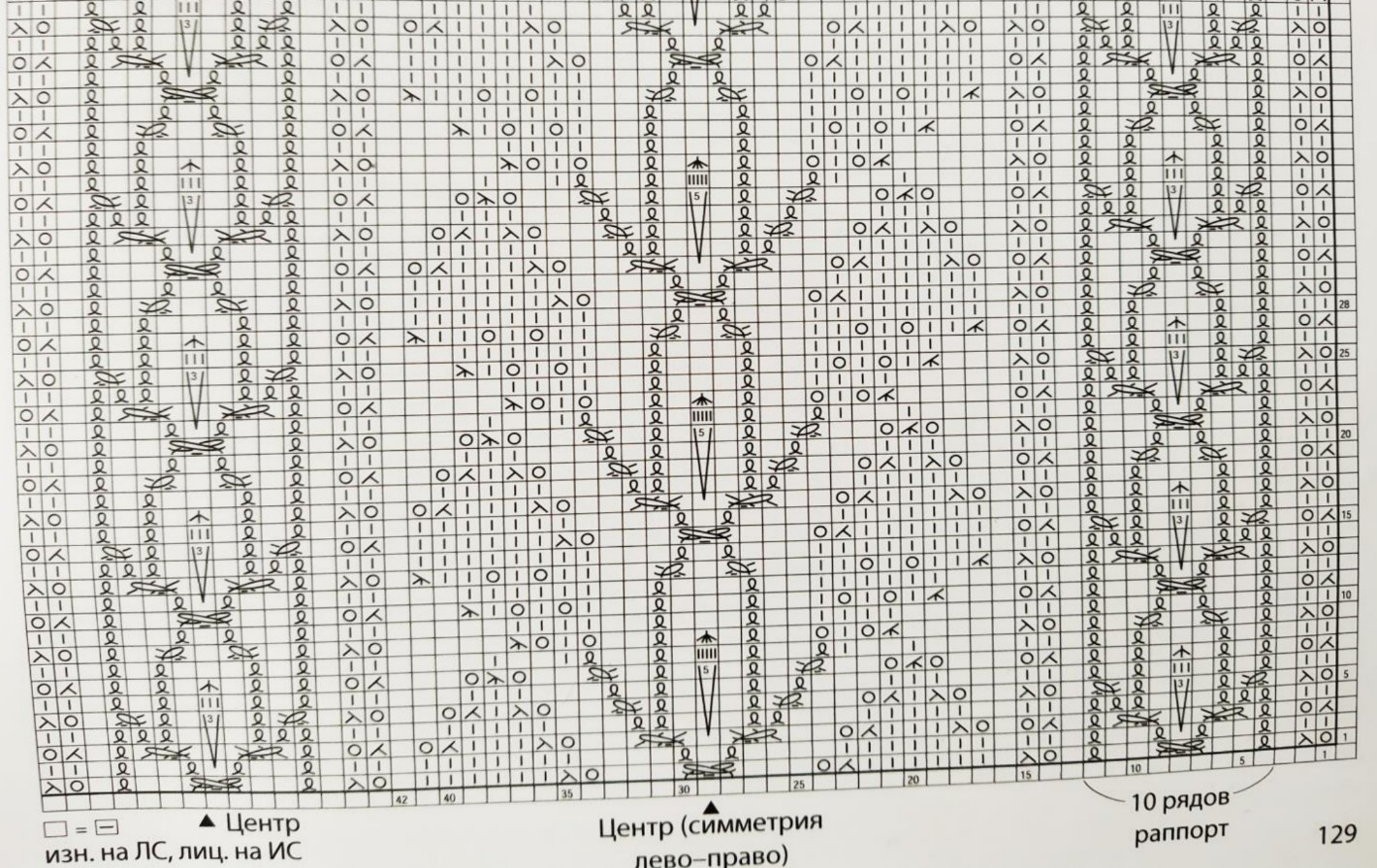
Pattern diagram:
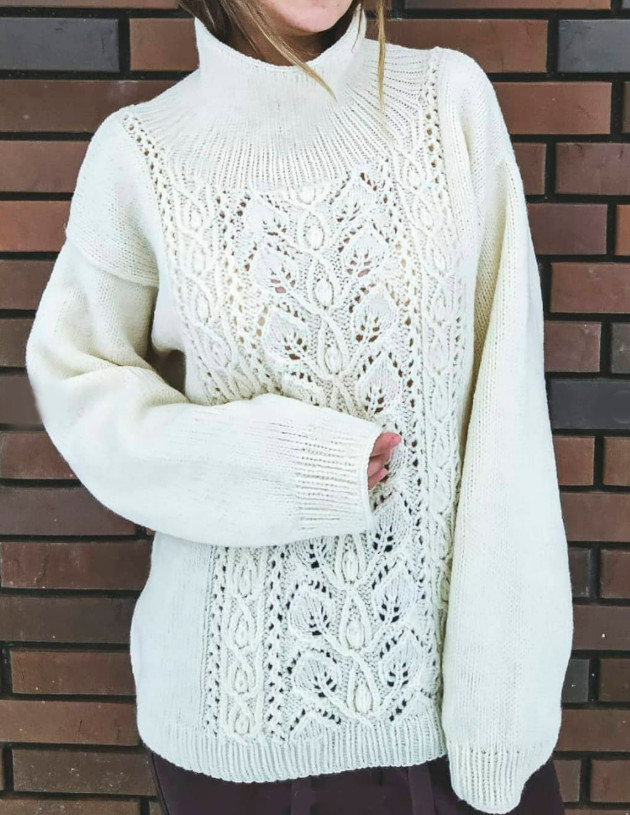
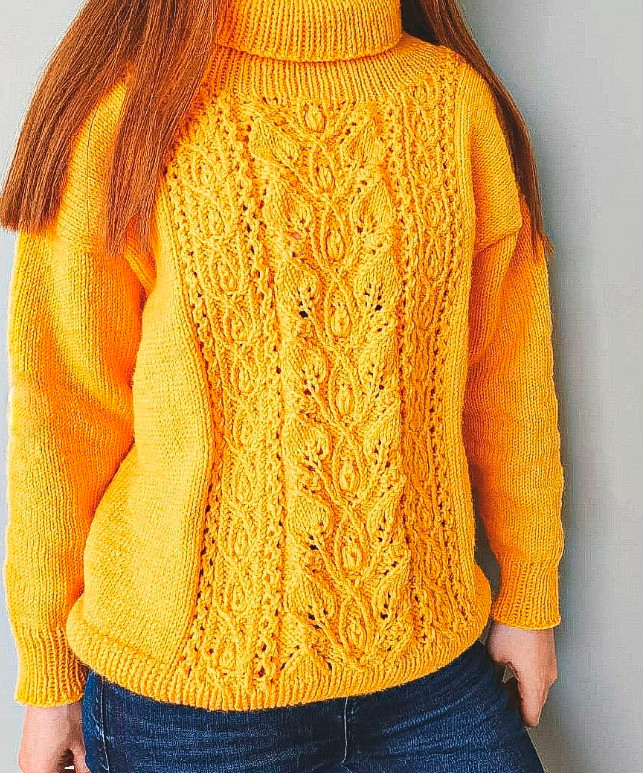
(on the page, a large chart of the main pattern with central leaves and side braids is shown)
Getting started.
Pattern repeat — 57 stitches.
In parentheses is the number of stitches for sizes M-L / XL-XXL.
Take needles one size smaller than the main and cast on 187 (199) (211) stitches.
Join the knitting in the round. After joining — 186 (198) (210) stitches.
Knit in 1×1 rib — 18 rounds.
Switch to the main-size needles (4.5 mm).
Stitch distribution:
For the front and back — by 93 (99) (105) stitches.
Front:
17 (20) (23) knit stitches, 1 purl (to separate the pattern), 57 pattern stitches, 1 purl, 17 (20) (23) knit stitches.
Back — 93 (99) (105) knit stitches in stockinette.
Beginning of the round — between the right front piece and the back (place a marker).
Since we knit in the round, there are no purl rows, but they are indicated in the description for convenience.
Read the chart from right to left.
Row 19 (knit, row 1 of chart):
17 (20) (23) knit; 1 purl; yarn over; 2 knit together with left-leaning; purl; twisted knit; 2 purl;
slip 1 stitch onto the cable needle in front of the work, the next — onto the cable needle behind the work, 1 twisted knit,
with the cable needle behind, 1 purl, with the cable needle in front, 1 twisted knit; 2 purl; 1 knit; 1 purl; yarn over;
2 knit together with left-leaning; 1 purl; 6 knit; 2 knit together with right-leaning; yarn over;
3 purl; (the rest repeats the same construction symmetrically);
at the end of the row 110 (123) (128) knit.
Row 20 (purl):
Knit according to the pattern as the stitches face. Pay attention to the crossed stitches — in the wrong-side row they also need to be crossed so that they face in the same direction.
Row 21 (knit, chart row 3):
17 (20) (23) knit; 1 purl; 2 knit together with left-leaning; yarn over; 1 purl; 1 twisted knit;
slip 2 stitches to the cable needle, hold in front of the work, 1 twisted knit, with the cable needle 1 knit, 1 purl;
1 purl; slip 1 stitch to the cable needle in front of the work, 1 purl, 1 knit, from the cable needle 1 twisted knit;
1 twisted knit; 1 purl; 2 knit together with right-leaning; yarn over; 1 purl; yarn over;
2 knit together with left-leaning; 3 knit; 2 knit together with right-leaning;
yarn over; 2 purl; slip 2 stitches to the cable needle in front of the work, hold in front, 1 knit, from the cable needle 1 knit, 1 purl;
1 purl; slip 1 stitch onto the cable needle in front of the work, 1 purl, 1 knit, from the cable needle 1 twisted knit;
2 purl; yarn over; 2 knit together with left-leaning; 3 knit; 2 knit together with right-leaning;
yarn over; 1 purl; 2 knit together with right-leaning; yarn over; 1 purl; 1 twisted knit;
slip 2 stitches to the cable needle in front of the work, hold in front, 1 knit; from the cable needle 1 purl, 1 purl;
1 purl; slip 1 stitch to the cable needle in front of the work, 1 purl, 1 knit, from the cable needle 1 knit;
1 knit; 1 purl; 2 knit together with right-leaning; yarn over; 1 purl; 110 (123) (128) knit.
Row 22 (purl):
Knit according to the pattern as the stitches face, not forgetting the crossed knits.
Row 23 (knit, chart row 5):
17 (20) (23) knit; 1 purl; yarn over; 2 knit together with left-leaning; 1 purl;
bring the right needle to the front of the first stitch, knit the second twisted;
without dropping, then the first purl and drop both;
1 twisted knit, 1 purl; next is a bobble of five stitches on four rows below:
insert the right needle into the center stitch four rows below, pull up 1 stitch, yarn over,
another 1 stitch from the same stitch — all five elongated stitches are the same size; drop the stitch.
1 purl; 1 twisted knit; drop the first purl and drop both; 1 purl; yarn over; 2 knit together with left-leaning;
3 purl; yarn over; 3 knit together with right-leaning; yarn over; 2 purl;
2 knit together with left-leaning; 1 knit; 2 knit together with right-leaning; yarn over; 1 purl; 1 twisted knit;
insert the right needle into the center stitch three rows below, pull up 1 stitch, yarn over,
another 1 stitch, drop; 1 purl; 1 twisted knit; insert the right needle behind the first stitch and knit the second twisted,
then the first twisted knit; drop both; 1 purl; yarn over; 2 knit together with left-leaning; 1 purl; 110 (123) (128) knit.
Row 26 (purl):
Knit according to the pattern.
Row 27 (knit, chart row 9):
17 (20) (23) knit; 1 purl; yarn over; 2 knit together with left-leaning; 1 purl; 1 twisted knit; 1 purl;
slip 1 knit to the cable needle in front of the work, 1 purl, from the cable needle 1 twisted knit; 1 purl;
slip 1 purl to the cable needle behind the work, 1 knit, 1 purl from the cable needle 1 twisted knit; 1 purl; 1 knit;
1 purl; yarn over; 2 knit together with left-leaning; 5 knit; 3 knit together with right-leaning;
yarn over; 1 knit; yarn over; 2 purl; 1 knit; 1 purl; 5 knit together (slip 3 stitches as if to knit, knit 2 together, pass the 3 slipped stitches over); 1 purl; 1 knit; 2 purl; yarn over; 1 knit;
yarn over; 3 knit together with left-leaning; 5 knit; yarn over; 2 knit together with left-leaning;
1 purl; 1 knit; 1 purl; 1 purl; slip 1 knit to the cable needle in front of the work, 1 purl, from the cable needle 1 knit;
1 purl, slip stitch to the cable needle behind the work, 1 knit, from the cable needle 1 purl; 1 purl; 1 knit;
1 purl; yarn over; 2 knit together with left-leaning; 1 purl; 110 (123) (128) knit.
Row 28 (purl):
Knit according to the pattern.
29th row (knit, 11th row of chart):
17 (20) (23) knits; 1 purl; 2 knits together with a right-leaning decrease; yarn over; 1 purl; 1 stitch slipped knitwise through the back;
2 purls; slip 1 stitch onto the front between stitches, next stitch onto the back,
1 knit slipped, with a back auxiliary stitch 1 purl, with a front auxiliary stitch 1 knit slipped; 2 purls; 1 knit slipped; 1 purl;
2 knits together with a right-leaning decrease; yarn over; 3 purls; 3 knits together with a right-leaning decrease;
1 knit; yarn over; 1 knit; yarn over; 1 knit; 2 purls; 1 knit slipped; 3 purls; 1 knit slipped; 2 purls;
1 knit; yarn over; 1 knit; yarn over; 1 knit; 3 knits together with a left-leaning decrease; 3 purls;
2 knits together with a right-leaning decrease; yarn over; 1 purl; 1 knit slipped; 1 purl;
slip 1 stitch to the front, the next onto the back,
1 knit slipped, with a back auxiliary stitch 1 purl, with the front auxiliary stitch 1 knit slipped; 2 purls; 1 knit slipped; 1 purl;
2 knits together with a right-leaning decrease; yarn over; 1 purl; 110 (123) (128) knits.
30th row (purl side):
Knit according to the pattern.
Continue knitting the pattern according to the chart.
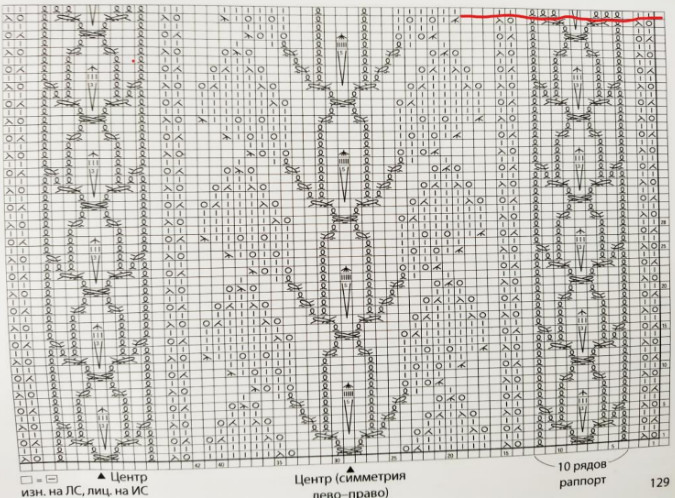
The chart ends at row 54.
This pattern consists of several repeats, which are controlled separately:
-
Side columns (marked in red) — a 10-row repeat, repeated continuously.
-
Central pattern (leaves) — a separate 14-row repeat
-
This pattern is not a single full repeat, but several.
From this point on we will control these repeats separately.
The repeat of the side columns, highlighted in red, consists of 10 rows. -
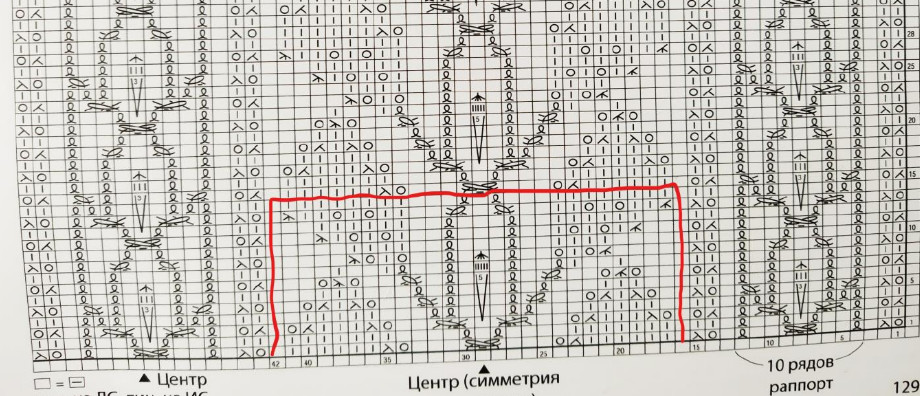
-
And this repeat does not change — it always repeats.
And in row 55 (per chart) we continue knitting this column from row 5 of the repeat.The central pattern (leaves) will now be controlled separately from the side columns.
Its repeat consists of 14 rows.
The repeats are highlighted in red to help you control the pattern and understand where you are.We knit the fabric in height about 36 cm (the author got 98 rows).
Then we separate the knitting into the front and back.
Row 99 (rs):
Knit 17 (20) (23); 1 purl; 57 pattern stitches; 1 purl; 17 (20) (23) knit —
and turn the knitting.Thus we divide the knitting into front and back.
Then they are knitted in turning rounds.There will be no selvage stitches:
-
on the right-side row the edge stitches are knits,
-
on the wrong side — purls.
Turning the work, we knit the wrong-side row according to the pattern,
but carefully watch the crossed stitches —
we knit them as purls (to preserve the direction).
Next we knit the front in turning rounds for about 12–13 cm in height (the author has 34 rows).
Neckline shaping
We will shape the neckline with short rows, in a classic way, not the German method,
so as not to get tangled in the pattern. -
-
 We reach the row where five bobble stitches are worked together from five elongated stitches four rows below — this row is the most convenient place to start shaping the neckline.
At this point the leaf ends, and the new one (which should have started) is not worked; instead, simply purl these stitches, and then continue the row according to the chart.
Left side (as we look at the work):
Row 134 (WS): Turn the knitting and knit up to the point where the leaf ended.
Here is what it looks like (the turning point is shown on the chart). 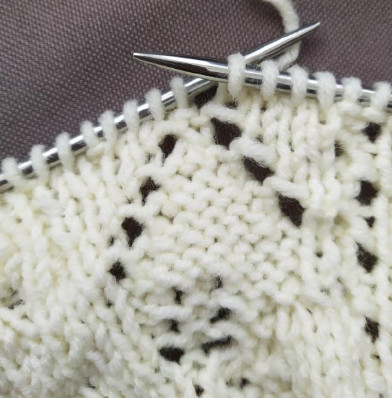
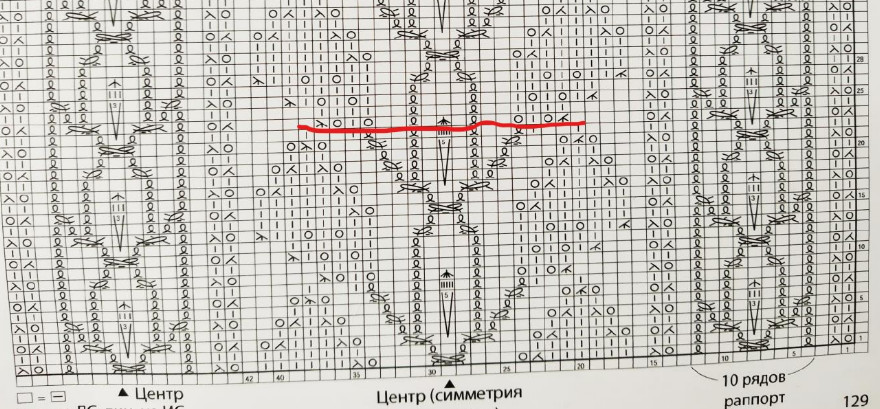
Front neckline diagram (XS–S):
(the image shows gradual decreases on each side of the neckline)
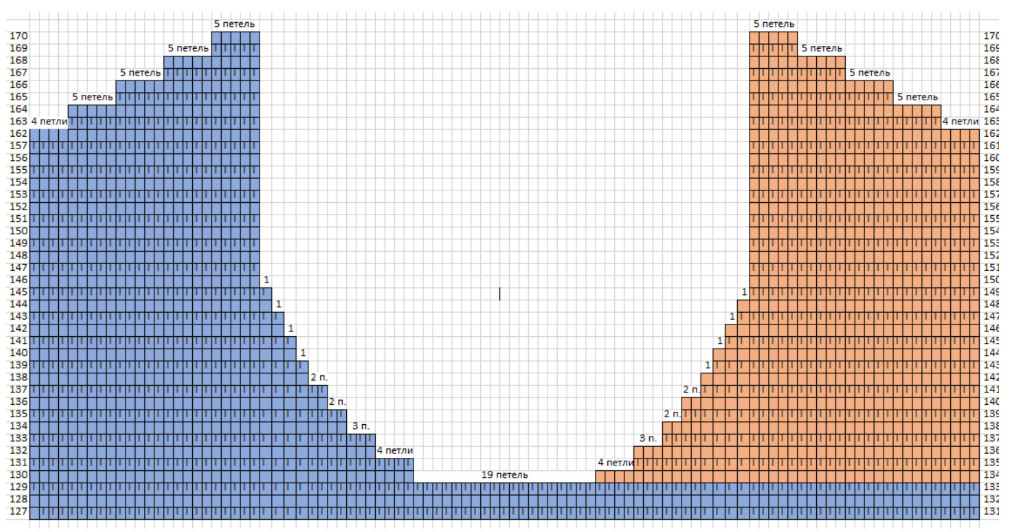
Front neckline diagram (M–L):

Front neckline diagram (XL–XXL):
(similar charts with a larger number of rows)

Row 135 (knit): Yarn over, 4 purl stitches, then continue the row as charted.
Row 136 (purl): Knit until there are 4 stitches left on the left needle and the yarn over from the previous row.
Row 137 (knit): Yarn over, then continue the row as charted.
Row 138 (purl): Knit until there are 3 stitches left on the left needle before the last yarn over.
Row 139 (knit): Yarn over, then continue the row as charted.
Row 140 (purl): Knit until there are 2 stitches left on the left needle before the yarn over.
Row 141 (knit): Yarn over, then continue the row as charted.
Row 142 (purl): Knit until there are 2 stitches left on the left needle before the yarn over.
Row 143 (knit): Knit according to the chart.
Row 144 (purl): Knit until there is 1 stitch left on the left needle before the yarn over.
Row 145 (knit): Knit according to the chart.
Row 146 (purl): Knit until there is 1 stitch left on the left needle before the yarn over.
Row 147 (knit): Knit according to the chart.
Row 148 (purl): Knit until there is 1 stitch left on the left needle before the yarn over.
Row 149 (knit): Knit according to the chart.
Row 150 (purl): Knit until there is 1 stitch left on the left needle before the yarn over.
Row 151 (knit):
From this row, end the neckline decreases.
Slip the first stitch as the edge stitch, then purl, and follow the chart.
Next — knit in height:
-
12 rows for XS–S,
-
14 rows for M–L,
-
16 rows for XL–XXL.
Shoulder slope
Row 163 (165) (167) (knit):
Knit until there are 4 (5) (6) stitches left on the left needle.
Row 164 (166) (168) (purl): Yarn over, then knit to the end.
Row 165 (167) (169) (knit): Knit until there are 5 (5) (6) stitches left before the yarn over.
Row 166 (168) (170) (purl): Yarn over, then knit to the end.
Row 167 (169) (171) (knit): Knit until there are 5 (5) (6) stitches left before the yarn over.
Row 168 (170) (172) (purl): Yarn over, then knit to the end.
Row 169 (171) (173) (knit): Knit until there are 5 (6) (6) stitches left.
Row 170 (172) (174) (purl): Yarn over, knit the remaining 5 (6) (6) stitches.
Binding off:
We cast off in the classic way, paying attention to the yarn overs:
knit the yarn over and the next stitch together so that the stitch sits over the yarn over.
To do this, turn the knit stitch so that its right side faces you and knit them together.
Right side (as we view the work)
We transfer all stitches to the right needle up to the right leaf.
This is how it should look.
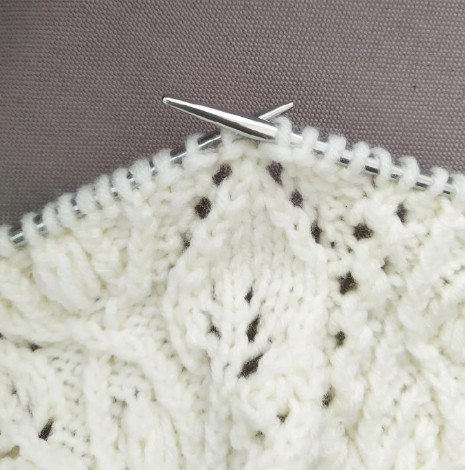
Turn the knitting to the wrong side. Join the yarn.
Row 134 (purl): Knit the row as the stitches appear, remembering the crossed knits.
Row 135 (knit): Knit according to the chart until there are 4 stitches left on the left needle before the leaf.
Leave these stitches unworked.
Row 136 (purl): Yarn over, then knit to the end as the stitches appear.
Row 137 (knit): Knit according to the chart, until there are 3 stitches left on the left needle before the yarn over.
Row 138 (purl): Yarn over, then knit to the end as the stitches appear.
Row 139 (knit): Knit according to the chart, until there are 2 stitches left on the left needle before the yarn over.
Row 140 (purl): Yarn over, then knit to the end as the stitches appear.
Row 141 (knit): Knit according to the chart, until there are 2 stitches left on the left needle before the yarn over.
Row 142 (purl): Yarn over, then knit to the end as the stitches appear.
Row 143 (knit): Knit according to the chart, until there is 1 stitch left on the left needle before the yarn over.
Row 144 (purl): Yarn over, then knit to the end as the stitches appear.
Row 145 (knit): Knit according to the chart, until there is 1 stitch left on the left needle before the yarn over.
Row 146 (purl): Yarn over, then knit to the end as the stitches appear.
Row 147 (knit): Knit according to the chart, until there is 1 stitch left on the left needle before the yarn over.
Row 148 (purl): Yarn over, then knit to the end as the stitches appear.
Row 149 (knit): Knit according to the chart, until there is 1 stitch left on the left needle before the yarn over.
Row 150 (purl): Yarn over, then knit to the end as the stitches appear.
Neckline decreases are finished.
Row 151 (knit): Knit according to the chart, the last stitch worked as the edge stitch.
Continue knitting in height:
— 12 rows (XS–S),
— 14 rows (M–L),
— 16 rows (XL–XXL).
Shoulder slope (right side)
163 (165) (167) row (WS): Knit until there are 4 (5) (6) stitches left on the left needle, leave them unworked, turn the work.
164 (166) (168) row (RS): Yarn over, then continue following the chart.
165 (167) (169) row (WS): Knit until there are 5 (5) (6) stitches left before the yarn over.
166 (168) (170) row (RS): Yarn over, then continue following the chart.
167 (169) (171) row (WS): Knit until there are 5 (5) (6) stitches left before the yarn over.
168 (170) (172) row (RS): Yarn over, then continue following the chart.
169 (171) (173) row (WS): Knit until there are 5 (6) (6) stitches left before the yarn over.
170 (172) (174) row (RS): Yarn over, knit the remaining 5 (6) (6) stitches.
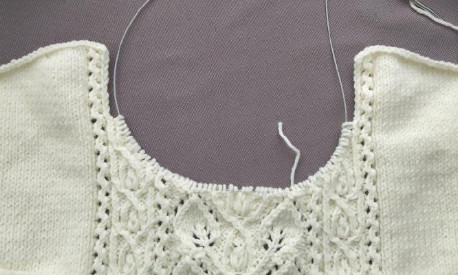
Close the right shoulder from the WS, paying attention to the yarn overs:
the yarn over and the next stitch worked together,
turning the yarn over and the purl stitch with the left edge,
so that the purl is on top.
Here is what it should look like.
Back
The back will be two rows longer than the front, so that the shoulder seams do not pull back.
For women with a larger bust, you can increase the back by another 4 rows.
Row 99: Attach the yarn from the right side and knit the back in stockinette stitch —
63 (65) (67) rows in height.
Back neckline
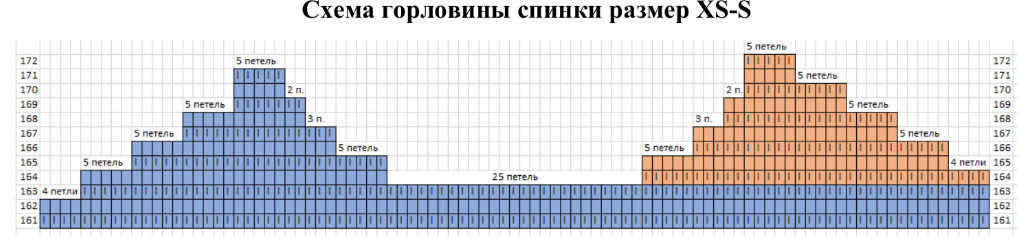
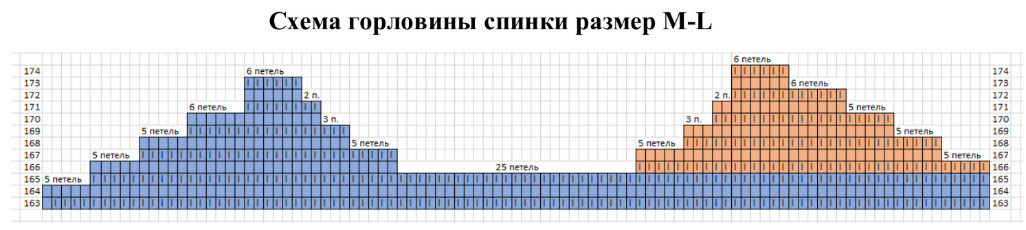
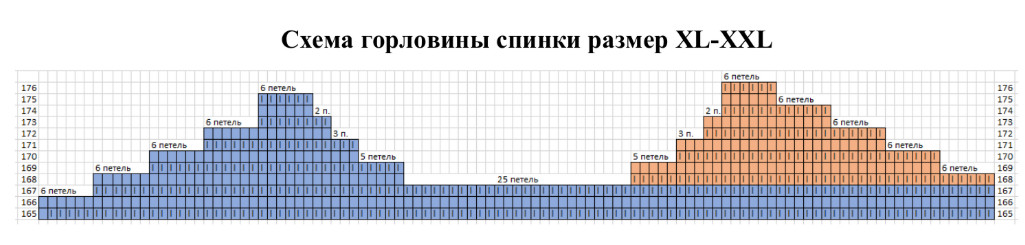
163 (165) (167) row (RS):
Knit one row, leaving 4 (5) (6) stitches unworked at the end of the row.
Left side (as we view the work):
164 (166) (168) row (WS): Yarn over, then 30 (31) (32) purl, turn the work.
165 (167) (169) row (RS): Yarn over, then knit, leaving another 5 (5) (6) stitches unworked.
166 (168) (170) row (WS): Yarn over, then knit, leaving 5 stitches unworked.
167 (169) (171) row (RS): Yarn over, then knit, leaving another 5 (5) (6) stitches unworked.
168 (170) (172) row (WS): Yarn over, then knit, leaving 3 stitches unworked.
169 (171) (173) row (RS): Yarn over, then knit, leaving another 6 (6) (5) stitches unworked.
170 (172) (174) row (WS): Yarn over, then knit, leaving 2 stitches unworked.
171 (173) (175) row (RS):
There are 5 (6) (6) stitches left — close the shoulder in the classic way,
paying attention to the yarn overs: knit the yarn over and the next stitch together,
turning the knit stitch with the right edge so that it sits on top.
Right side (as viewed from the work):
164 (166) (168) row (RS): Join the yarn from the right side and knit 34 (37) (40) stitches.
165 (167) (169) row (WS): Yarn over, then knit, leaving 4 (5) (6) stitches unworked.
166 (168) (170) row (RS): Yarn over, then knit, leaving 5 stitches unworked.
167 (169) (171) row (WS): Yarn over, then knit, leaving 5 (5) (6) stitches unworked.
168 (170) (172) row (RS): Yarn over, then knit, leaving 3 stitches unworked.
169 (171) (173) row (WS): Yarn over, then knit, leaving 5 (5) (6) stitches unworked.
170 (172) (174) row (RS): Yarn over, then knit, leaving 2 stitches unworked.
171 (173) (175) row (WS): Yarn over, then knit, leaving 5 (6) (6) stitches unworked.
172 (174) (176) row (RS): Knit the remaining 5 (6) (6) stitches, keeping the yarn over.
Close the shoulder, paying attention to the yarn overs:
knit the yarn over and the next purl stitch together,
turning the purl stitch with the left edge so that it is on top.
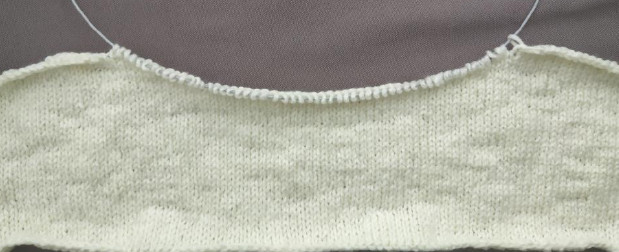
Sew the shoulder seams between the front and back with a stockinette stitch.
Neckline
There are stitches left on both the front and back parts.
Take a needle one size smaller (4 mm).
Begin knitting the neckline from the left shoulder toward the front.
Pick up stitches along the edge with a 1×1 rib, where the neckline on the front was worked,
then continue along the front, knitting the remaining stitches,
paying attention to the yarn overs — they are knitted together with the next stitch,
so that the next stitch sits on top.
Pick up stitches along the second side and proceed to the back.
The neckline stitches have been picked up.
High neckline "sock"
Knit to the required height — the author uses 14 cm.
Close off the stitches with the classic method.
Elastic bind-off is not recommended to prevent the neckline from stretching.
Short double neckline
We knit the neckline to a height of about 8 cm.
Fold the ribbing to the wrong side and sew it down in any convenient way.
Do not pull the yarn tight, so the neckline won’t gather.
Sleeves
We pick up stitches from the armhole, starting in the armpit area.
From each sleeve stitch, pull out two consecutive knit stitches,
skip one armhole stitch, again two knit stitches, skip one —
and so on around the armhole.
Sleeves are knitted in the round, seamless, using the Magic Loop method.
Knit this way for about 12 cm.
Next, begin decreases:
— at the start of the row, two knit stitches together with a right-leaning decrease,
— at the end of the row (before the last stitch) two knit stitches together with a left-leaning decrease,
— the last stitch is knit.
Two decreases occur in every row.
These decreases are made every 5th row.
We knit the desired sleeve length (the model has a longer sleeve).
If you prefer a classic length, you can shorten it.
Next, switch to a smaller needle size and knit the ribbing for 5 cm.
Cast off the stitches in the usual way.
Carefully sew the underarm hole and hide the yarn ends.
Washing and heat treatment (WHT)
Wash in room-temperature water using shampoo
or a special product (for example, "Laska").
Gently squeeze, do not twist, but simply squeeze with your hands.
Wrap in a towel to absorb excess moisture.
Lay the garment flat and air-dry.
After it is completely dry — carefully steam,
especially the pattern area (it may be slightly pulled).
Steaming evens out the pattern and gives a neat appearance.