



Slippers - shells
Added: 10.08.2018 в 10:46 Views: 36120
Slippers - shellsKlubokhttp://klubok.work/1/53/7295/Klubokhttps://klubok.work/css/image/top-logo-en.png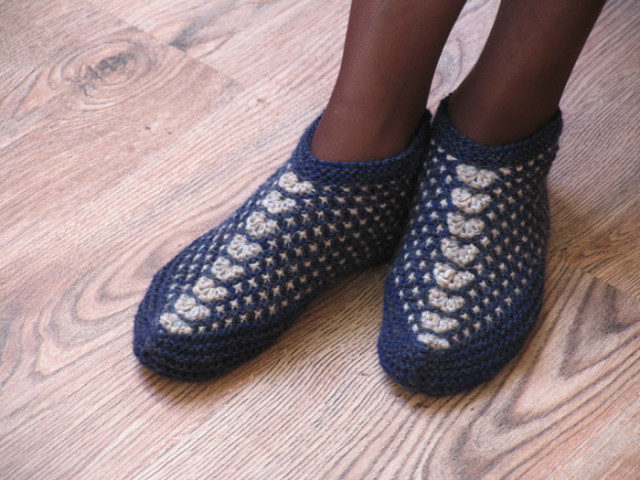
SLIPPERS – “SHELLS 7 in 1” on 5 needles. A wonderful way to get rid of yarn scraps and make people happy. They knit up quickly, look good, and can be made very warm. The method is universal; you can knit both women's and children's slippers. This description is made for sizes 36 to 39 and for the yarn mentioned below. Approximate dimensions of the slipper when folded: cuff 10 cm, length after finishing increases 22 cm, “depth” 13 cm. Yarn is approximately 100 m in 50 g. Circular needles No. 3.5. For the main color yarn, you will need a little more than 50 g, probably about 65-70 g. The contrasting yarn is needed in much smaller quantities, about 30 g. You can take a little more yarn to add it when knitting the sole – to make it thicker or warmer. Or both at once. All of this can vary greatly; it is enough to knit one pair to understand all the nuances. An important note: all odd rows are knitted with knit stitches, even rows with purl stitches to achieve garter stitch. Cuff. Cast on 48 stitches onto the needles. Knit 1 row with knit stitches, distributing the stitches on 4 needles and trying not to twist the knitting. The next row is purl (see above). The cuff can be knitted in a solid color; in stripes, alternating the main color with the contrasting one; wide, narrow – any style, but the last 2 rows should be in the main color. I usually knit 4 - 6 rows. A tail from the cast-on stitches serves as a marker. An important note: the stitch from which we will knit 7 stitches is the first stitch on the 3rd needle. 
Increases: Attach the contrasting yarn. With the contrasting yarn: 1. Odd row. Knit as follows until the first stitch on the 3rd needle: knit 1 stitch with the contrasting color, slip the next stitch (main color) as if to purl (yarn at the back) and so on. That is, when all the stitches on the two needles are knitted, we will have alternating stitches of contrasting and main colors. Knit 7 stitches from one with the contrasting color: (knit, yarn over) 3 times, knit. Try to knit these 7 stitches very loosely. This is our first “shell”. Next, continue to knit on the 3rd and 4th needle as written above: slip one, knit the next with the contrasting color. 2. Even row. Purl the contrasting stitch, slip the main color stitch as in the knit row. Knit the “shell” stitches with the contrasting yarn as purl stitches. For convenience in further work, knit the first three stitches of the “shell” with the second needle. Then the stitch from which the next “shell” will be knitted will again be the first on the 3rd needle. Continue knitting as at the beginning of the purl row: slip, knit, etc.
With the main color yarn: Knit 2 rows (knit - purl). With the contrasting yarn. 3. Odd row. The same as 1. Odd row, but slip the first stitch, and knit the next with the contrasting color. Then the “dots” will be arranged in a checkerboard pattern. 4. Even row. The same as 2. Even row, i.e., slip the main color stitch, and purl the contrasting one. With the main color yarn: Knit 2 rows (knit – purl). Repeat these rows until you have 8 shells (finish with the contrasting yarn). For thick yarn or children's slippers, there may be fewer shells, depending on the size and yarn.
“THICKNESS” of the sole: Cut the contrasting yarn and knit with the main color straight, without increases for 6-8 rows. An important note: the central stitch for forming the heel is the first stitch on the 1st needle. In the last two rows of the “thickness” of the sole, we begin to form the heel, namely: knit 2 together knit the last 2 stitches on the 4th needle; knit or purl the 1st stitch on the 1st needle (depending on whether it is an even or odd row); 2 stitches together with a left-leaning decrease: slip one, knit the next, and pull it through the slipped stitch. Decreases for the sole are made in every row.
Sole: If you wish to attach another yarn, you can use the contrasting one that has already been used. Knit 12 rows, alternating knit - purl rows and forming the toe and heel. How to form the heel is described above; consider the first stitch on the first needle as its center. The toe is formed similarly, but only in knit rows: knit 2 together knit the last 2 stitches on the 2nd needle; knit the 1st stitch on the 3rd needle; 2 stitches together with a left-leaning decrease on the 3rd needle: slip one, knit the next, and pull it through the slipped stitch. The 13th row is knitted with knit stitches, making the same decreases. Then close the stitches with three needles (see internet description). The number of rows for the sole may be fewer, again depending on the size and thickness of the yarn. It may seem scary at first glance: first needle, third needle… In fact, the logic of knitting is easily grasped, and then everything is performed only by hands, without engaging the brain. Once I had 2 skeins of yarn, 50 g each with 100 m in each. The main color was categorically not enough, while the contrasting yarn was left over. So I unraveled the sole of the already knitted slipper and re-knit it every other row: main color row, contrasting row, and so on. The yarn was used up almost completely. This addresses the question of yarn consumption.