



Socks on two needles
Added: 11.08.2018 в 09:42 Views: 28012
Socks on two needlesKlubokhttp://klubok.work/1/53/7305/Klubokhttps://klubok.work/css/image/top-logo-en.png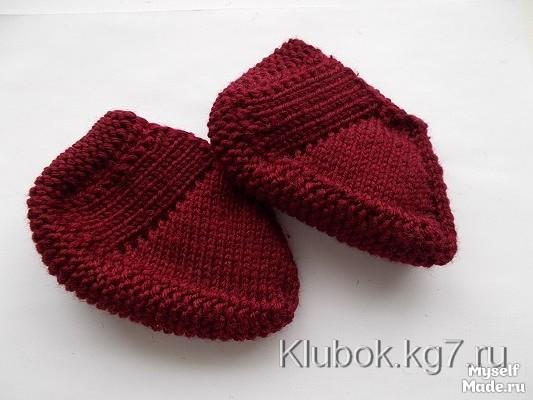
Depending on the chosen knitting size, the presented model of slippers is suitable for both women and children. It is especially nice that they are knitted very quickly and easily, on two needles and without seams. Slippers on two needles, description Size: training — 33, below — 36 For knitting you will need: yarn 100% microfiber, two needles No.3.5 (in this example, the needles are pointed, this is not a mandatory point) Rib 1x1: alternately 1 knit, 1 purl Upper part of the slipper Cast on 26 stitches: 11 stitches — rib 1x1, 4 central stitches — for increasing stitches, 11 stitches — rib 1x1 For larger slippers, increase the number of rib 1x1 stitches, the central 4 stitches remain unchanged. For example, for size 36, I cast on 32 stitches: 14 stitches — rib 1x1, 4 central stitches — for increasing stitches, 14 stitches — rib 1x1. Row 1: edge stitch, knit all stitches; Row 2 (right side): edge stitch, knit 10 stitches rib 1x1, 1 yarn over, 1 knit, 1 yarn over, 2 knits, 1 yarn over, 1 knit, 1 yarn over, 11 stitches — rib 1x1 (always knit the last stitch as knit, as it is the edge stitch) Row 3 (wrong side): edge stitch, knit 10 stitches rib 1x1 as per pattern, all central stitches (which are involved in increasing) knit as purls, knit the last 11 stitches rib 1x1 as per pattern; Row 4 (right side): edge stitch, knit 10 stitches rib 1x1, 1 yarn over, 3 knits, 1 yarn over, 2 knits, 1 yarn over, 3 knits, 1 yarn over, 11 stitches — rib 1x1. Row 5 (wrong side): repeat Row 3. Continue knitting, making increases, i.e., repeat rows 2-5. Until the number of “holes” horizontally equals 11. Finish with a wrong side row Thus, the number of “holes” should equal the number of rib stitches, in this case, 11 rib stitches = 11 “holes”. Sole of the slipper The sole is formed from 11 central stitches. Again, the number of stitches for the sole = the number of stitches for the rib. Knit as follows: edge stitch, 10 stitches — rib 1x1, central stitches — knit to two central stitches 1st central — knit, starting from the 2nd knit garter stitch 5 stitches, 6-7 stitches — knit together (total 6 stitches). Turn the work, slip the stitch, knit garter stitch 9 stitches (including the slipped stitch — 10), knit 11-12 stitches together. *Turn the work again, slip the first stitch, knit 9 stitches — garter stitch, knit 11-12 stitches together. Continue knitting from *, making decreases. Decrease all side stitches, leaving 11 central stitches Side walls of the slipper Cast on 11 stitches on the first side. To do this, grab the yarn with the needle, pull it through the edge stitch of the rib, repeat 10 more times Turn the work, knit: edge stitch, 21 stitches — garter stitch (11 side + 11 central). On the second side, cast on 11 stitches Turn and knit: edge stitch, 10 stitches — garter stitch, 10 central — garter stitch, knit 11-12 stitches together. *Turn the work again, slip the first stitch, knit 9 stitches — garter stitch, knit 11-12 stitches together. Continue knitting from *, making decreases. Decrease all side stitches, leaving 11 central stitches Bind off the stitches, secure and cut the yarn. Knit the second slipper similarly For slippers of size 36, as mentioned above, I cast on 32 stitches: 14 stitches — rib 1x1, 4 central stitches — for increasing stitches, 14 stitches — rib 1x1. Accordingly, the number of “holes” = 14; the number of central stitches for the sole = 14, side stitches = 14