



Socks
Added: 23.08.2019 в 12:41 Views: 34943
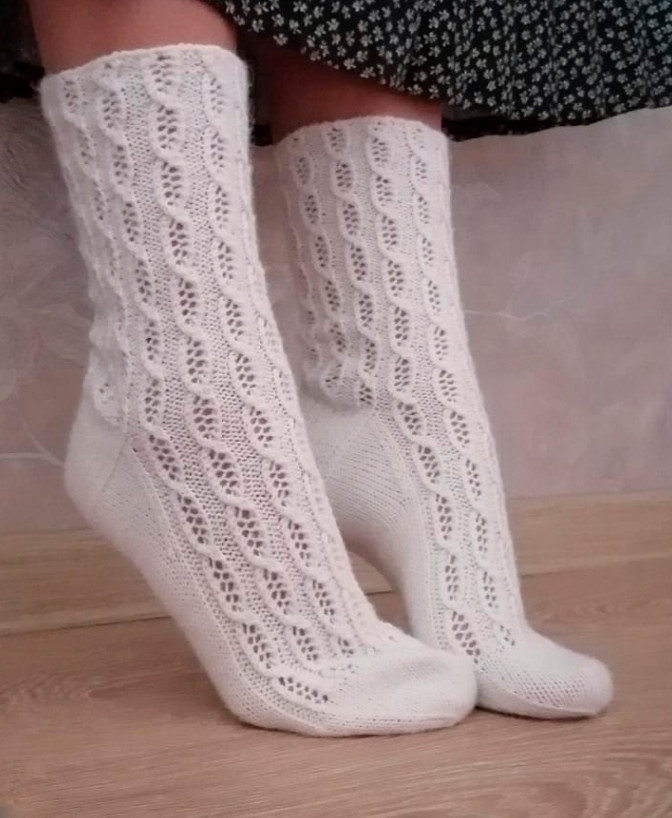
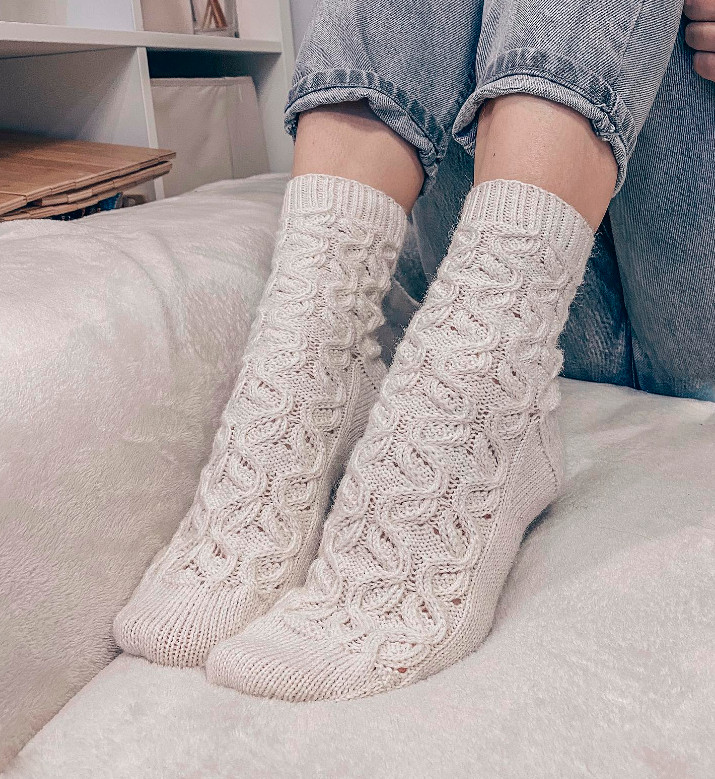
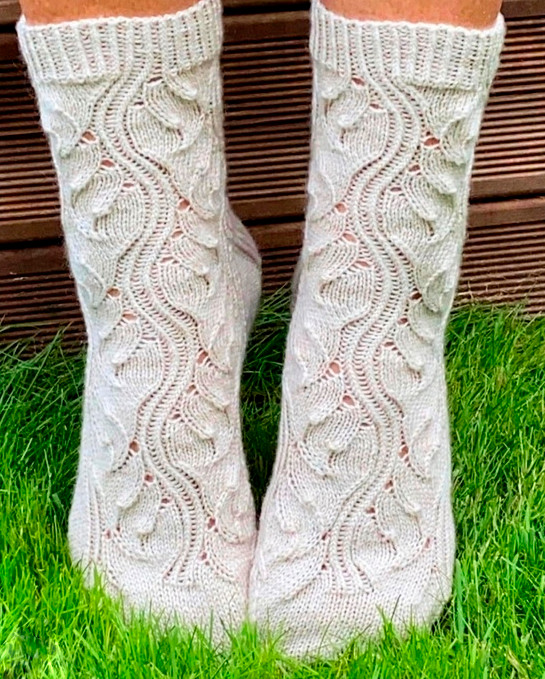
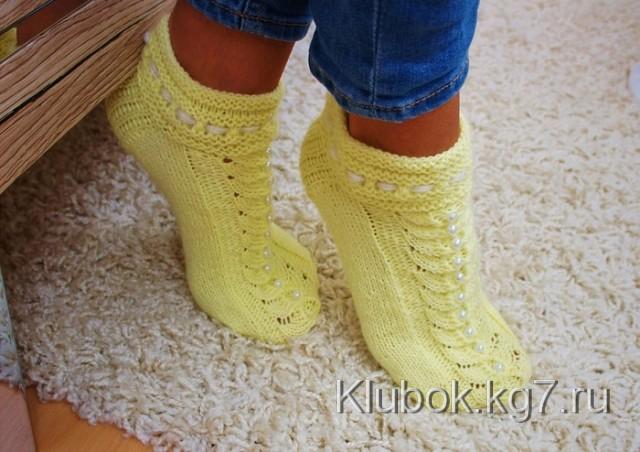
SocksKlubokhttp://klubok.work/1/53/7842/Klubokhttps://klubok.work/css/image/top-logo-en.pngThis is a description of short socks. How to obtain longer versions is explained at the end of the article. First of all, you need to cast on 56 stitches and distribute them across four needles (14 stitches each). Then join them in a circle. It is important to ensure they do not twist. The top part of the sock is knit in a 1 by 1 rib for 10 rows. After that, the description recommends moving on to the heel. It is worked according to a specific pattern of stitches on two needles in stockinette stitch (knit on odd rows and purl on even rows). Since the heel is not knitted in the round, do not forget about the edge stitches. After 20 rows, the heel fabric needs to be divided into 3 parts: 9 + 10 + 9. You can mark the boundaries of each section of the sock with special rings. Now, partial knitting begins according to the following description: knit all stitches of the edge part of the sock; knit the 9 central stitches; the last stitch of the center should be knitted together with the first from the edge needle; turn the work and repeat from the first point. In partial knitting, all stitches of the sock are worked according to the pattern. The knitting of the heel continues according to the described scheme until only 10 stitches remain. Transitioning to the foot To continue working on the sock, you need to knit a row and cast on 11 stitches from the closed edge on the side of the heel. After that, knit 14 stitches from the two set-aside needles. Now cast on 11 stitches again from the opposite side. After knitting 5 stitches, we get the following number of stitches in work: 16 on the first and fourth needles; 14 on the second and third. Next, the socks are knitted in the round, and the number of stitches on all needles should be equalized according to the following scheme: knit 14 stitches on the first needle, and combine the 15th and 16th; knit the second and third needles unchanged; on the fourth, at the beginning of the row, knit two together, and finish the round; after a decrease row, repeat by knitting the last two stitches together on the first and the first two on the last needle; after that, there will be an equal number of stitches on all needles – 14 each. Beginning of the lace Now you can start working on the lace. It should be knitted according to the pattern below. It contains descriptions of all symbols. To create a left tilt when combining stitches, you need to slip the first stitch, knit the second, and then place the unknitted stitch over it. For a right tilt, simply knit the stitches together. In this model, the lace is only at the top part of the sock, opposite the heel. That is, if the heel is knitted on the first and last needles, the lace pattern should be knitted on the second and third according to the scheme. The rapport of the proposed pattern consists of 14 stitches. Therefore, after finishing knitting the lace pattern on the first needle, start the pattern again on the second. While knitting lace socks with needles according to the proposed description, the bottom is recommended to be knitted only in knit stitches. Conclusion When the fabric from the heel reaches about 14 cm, you can start working on the toe. It is important to adhere to several rules: the toe that will finish the lace socks will be knitted in stockinette stitch, so the rapport according to the pattern should be completed (i.e., the number of rows must be a multiple of six); the description corresponds to size 37. Based on knitting density and foot size, the length of the sock should be adjusted for each individual case. To execute the toe, the knitting is done according to the description provided below. Two stitches, located before the last (12th and 13th) on the first needle, are knitted together with a right tilt, the last stitch is knitted as usual. On the second needle, knit the first stitch as knit, and the next two together tilted left. On the third, knit two stitches together with a right tilt, and on the fourth as on the second. The next row is knitted as usual with knit stitches. Then again decrease according to the described scheme. Continue this way until only 8 stitches remain. At this point, the lace socks need to be turned inside out and the remaining stitches pulled together with a thread. Finally, knit the second sock according to the description, and the lace socks will be ready. The top can be edged with a crochet using any pattern. If it is lacy, a satin ribbon can be threaded through it for decoration.
-
Pattern Rapport — 14 stitches.
-
Knit on each needle 14 stitches, a total of 28.
-
The pattern is given only for knit rows (in circular knitting, all rows are knit).
🔣 Symbols:
| Symbol | Meaning |
|---|---|
| ● — vertical line | Knit stitch |
| ∧ — left tick | 2 stitches together with a left tilt |
| V — right tick | 2 stitches together with a right tilt |
| O — circle | Yarn over |
| ≡ — three horizontal lines | Crossing 6 stitches: |
| 3 slip in front of the work, knit 3 knit stitches, then knit the slipped stitches knitwise (cable of 6 stitches) |

Category: Slippers, socks, knee socks