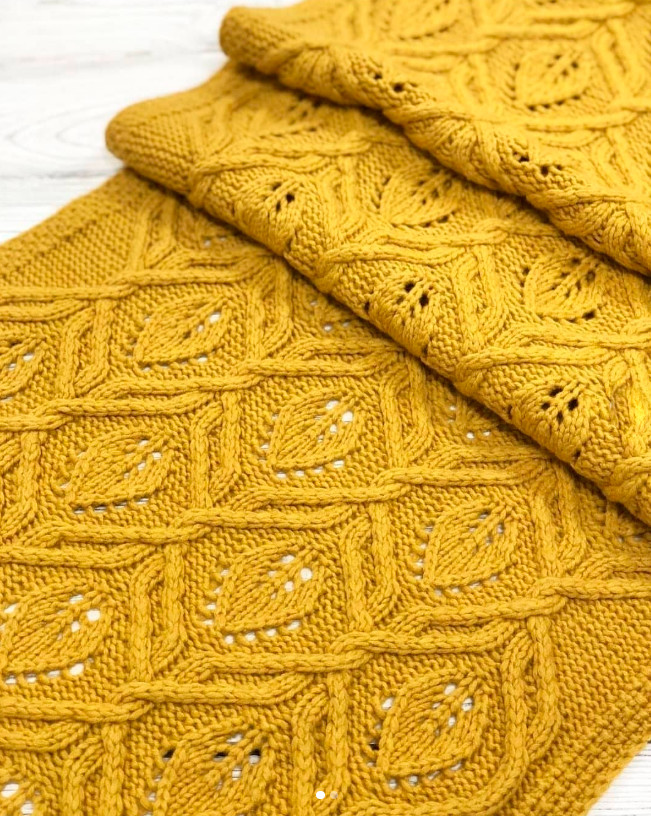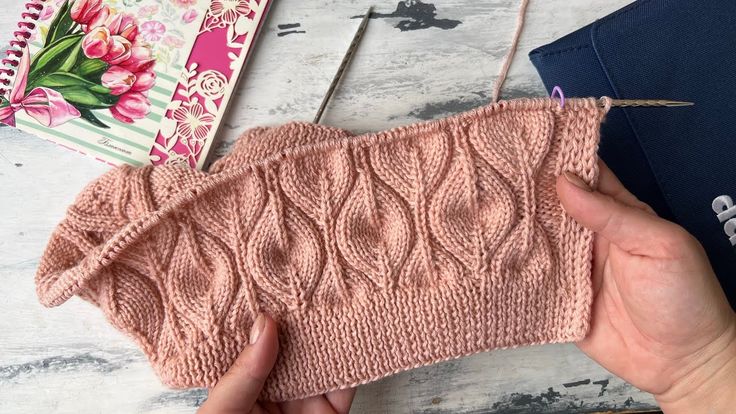




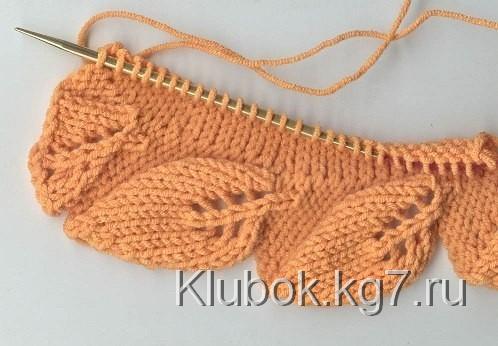
Edge with leaves. Workshop by Olga.
Added: 23.09.2014 в 11:41 Views: 341191
Edge with leaves. Workshop by Olga.Klubokhttp://klubok.work/1/89/5299/Klubokhttps://klubok.work/css/image/top-logo-en.png

Leaves are generally considered a fairly serious pattern, as the scheme itself is more likely to confuse than help, but if you understand the logic of the pattern formation - you can create any wonders.
It's easier to knit leaves on the border, especially if you are just starting; if the leaves are in the main fabric - you need to have some knitting experience so as not to mess up the pattern.
The border is formed from right to left. The first leaf is knitted according to the description, and then - variations.
The rapport in height consists of 18 rows.
I repeat that patterns in leaves are a thankless task; it's more convenient to keep notes in words, but the main thing is to simply understand what you are knitting.
For the first leaf, I cast on 8 stitches. 2 edge stitches. The description states - 8 stitches. Then I tried to knit based on the assumption that the edge stitches are included in those 8 stitches. See what you like. That's how you will come up with your own leaves... :p
I write without edge stitches, only the stitches of the pattern.
Row 1: 5 knit, yarn over, 1 knit, yarn over, 2 knit.
This row forms the base of the leaf. In subsequent rapports, the leaf will start with a branch that overlaps the previous rapport, but here it is not.
We also see that in the description the border is made with garter stitch. This is, of course, justified - garter stitch is more elastic, and the leaves are not just a stockinette fabric; in my scan, it is clearly visible that the length of the fabric along the leaves is ultimately shorter than the fabric of the border itself. But garter stitch is not quite appropriate for me; I plan to knit upwards from this border in stockinette stitch - so here I am varying...
We turn the work and knit the second row.
Row 2: 6 purl, from 1 knit make 2, knitting it through the back and front loops; 3 knit.
That is, immediately after the leaf goes an INCREASE of purl fabric. And it will be like this all the time, as long as yarn overs are used for leaf formation, while there is an increase and actually the width of the leaf. In fact, the leaf is positioned at an angle, so it is essential to lead increases of the background purl fabric for its position.
I note that you can vary the width of the leaf, and the angle of the leaf formation can also be varied.
Next are six rows of completely similar knitting, where the leaf expands and the purl stitch expands.
Row 3: 4 knit, 1 purl, 2 knit, yarn over, 1 knit, yarn over, 3 knit.
Row 4: 8 purl, from 1 = 2 knit, 4 knit.
Row 5: 4 knit, 2 purl, 3 knit, yarn over, 1 knit, yarn over, 4 knit.
Row 6: 10 purl, from 1 = 2 knit, 5 knit.
Row 7: 4 knit, 3 purl, 4 knit, yarn over, 1 knit, yarn over, 5 knit.
Row 8: 12 purl, from 1 = 2 knit, 6 knit.
Thus, the lower part of the leaf has formed. Next, according to this description, you need to immediately switch to decreases, which I did. In the third leaf, the transition to decreases was made through one row, that is, in the middle of the leaf, there are 2 rows when there were neither increases nor decreases. In my opinion, this makes the leaf look better.
Let’s move on to the decreases. As everyone knows, leaves can be decreased with a braid along the edge or without it. It all depends on the yarn and knitting style. If the yarn is bulky, like mine, the braid doesn't look very elegant, so I didn't bring it out, that is, I narrow the leaf with straight stitches.
That is, I simply write in the rows 2 stitches together, and HOW exactly to knit them - see for yourself, however you find it more convenient, so that the leaf looks finished. :p
Row 9: 4 knit, 4 purl, 2 together, 7 knit, 2 together knit, 1 knit.
Row 10: 10 purl, from 1 = 2 knit, 7 knit.


Category: Patterns