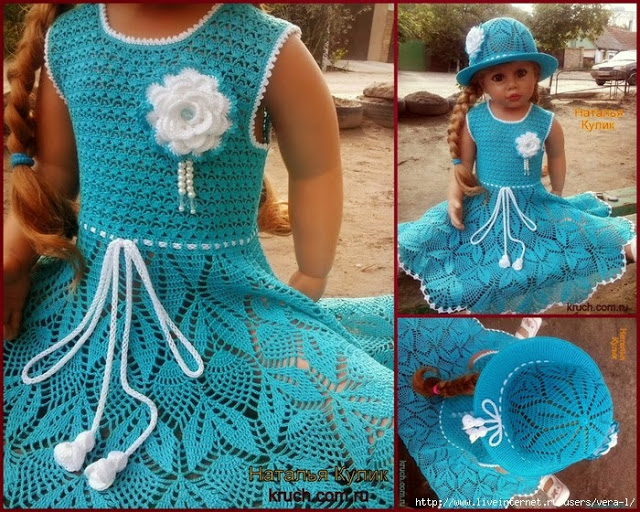




Amazing dress for a baby girl
Added: 22.05.2014 в 08:23 Views: 42784
Amazing dress for a baby girlKlubokhttp://klubok.work/22/175/4922/Klubokhttps://klubok.work/css/image/top-logo-en.png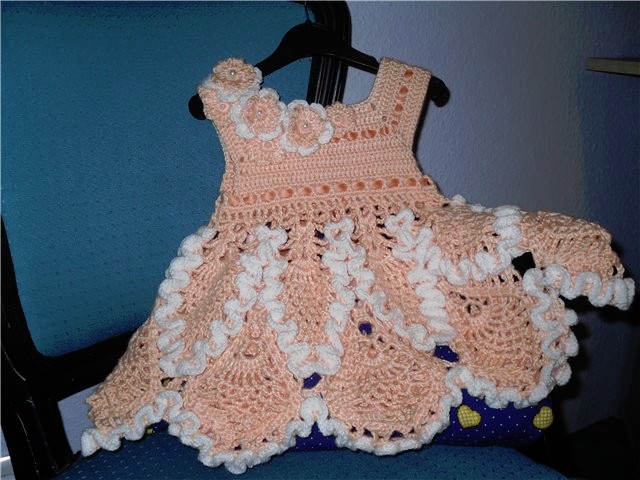
We measure the circumference of the neck plus 1–2 cm. For example, this value equals 124 stitches. Now let's move on to calculating the yoke itself.
From 124 stitches, we subtract 4 stitches, which are for increases (forming the raglan). This leaves us with 120 stitches, which I divide into 3 parts, i.e. each part equals 40 stitches: 1 part — front, 2 part — back, 3 part — 2 sleeves (20 stitches + 20 stitches).
For example, in my knitting, I took 52 stitches, i.e. 16 stitches — front, 16 stitches — back, 16 stitches — 2 sleeves (8 stitches + 8 stitches) and 4 stitches for forming the raglan. 1 row — I make the first stitch, in which I cast on 52 chain stitches (you will have a different number of stitches, of course) and close them into a ring using a slip stitch. (You can also knit the yoke in turning rows, in which case you don't need to make a slip stitch, but you will need to sew in a fastener into the already knitted yoke).
I make 3 lifting stitches, 7 double crochets (back), from the next stitch I knit 2 double crochets, a chain stitch, 2 double crochets, then 8 double crochets (sleeve), from the next stitch I knit 2 double crochets, a chain stitch, 2 double crochets, then 16 double crochets (front), from the next stitch I knit 2 double crochets, a chain stitch, 2 double crochets, then 8 double crochets (sleeve), from the next stitch I knit 2 double crochets, a chain stitch, 2 double crochets, then 8 double crochets (back). At the end of the row, a slip stitch. (If you are knitting in turning rows, then we do not make the slip stitch and turn the work).
2 row — I make 3 lifting stitches, 9 double crochets (back), from the next stitch I knit 2 double crochets, a chain stitch, 2 double crochets, then 12 double crochets (sleeve), from the next stitch I knit 2 double crochets, a chain stitch, 2 double crochets, then 20 double crochets (front), from the next stitch I knit 2 double crochets, a chain stitch, 2 double crochets, then 12 double crochets (sleeve), from the next stitch I knit 2 double crochets, a chain stitch, 2 double crochets, then 10 double crochets (back). At the end of the row, a slip stitch. (If you are knitting in turning rows, then we do not make the slip stitch and turn the work).
In each subsequent row, I add evenly 16 stitches, knitting 2 double crochets, a chain stitch, 2 double crochets into each arch of 1 chain stitch.
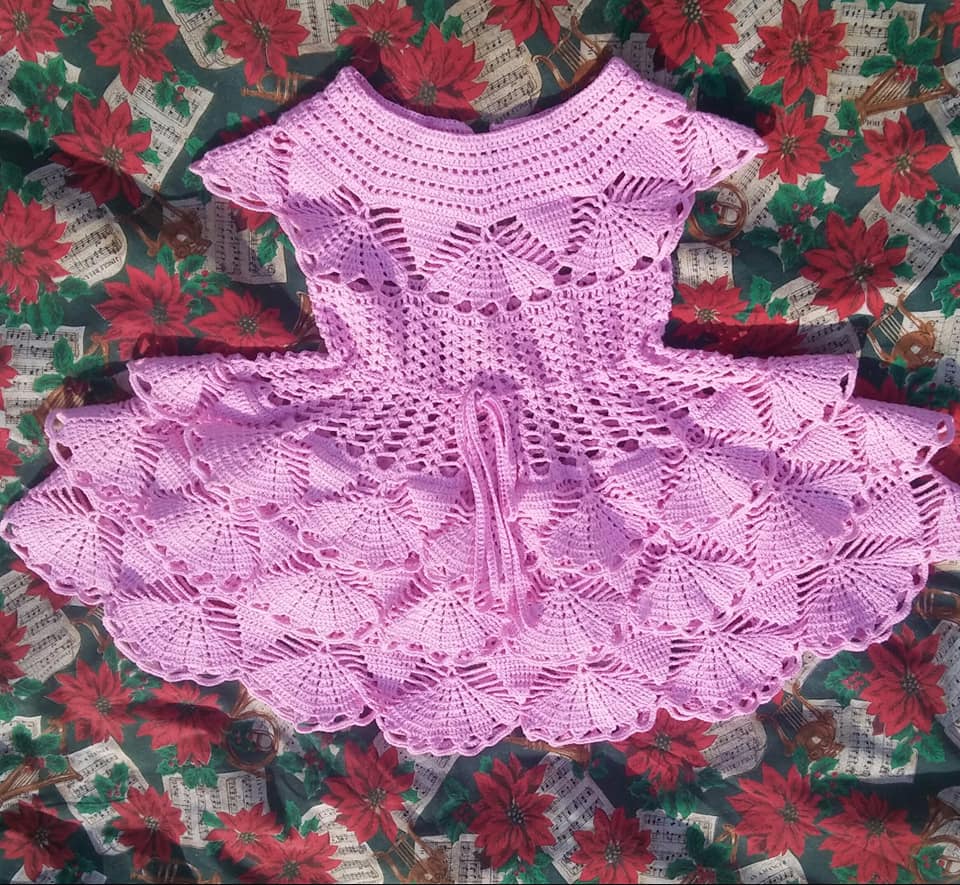
I attach the working yarn, 3 lifting stitches, in the same stitch 3 double crochets, then in every 4th stitch of the previous row I knit 4 double crochets, knitting in a circle while connecting the lower parts of the armholes. In the middle of the fan of 4 double crochets, I knit 2 double crochets, a chain stitch, 2 double crochets. At the end of the row, a slip stitch.
In the following rows, I will knit in arches of 1 chain stitch — 2 double crochets, a chain stitch, 2 double crochets. In this way, we knit if we want the hem of the dress to be straight. If we want the hem to flare out at the bottom, then we make increases, for example, every 10 rows we increase the number of double crochets: in the arch we knit 3 double crochets, a chain stitch, 3 double crochets, then after 10 rows 4 double crochets, a chain stitch, 4 double crochets, etc.).