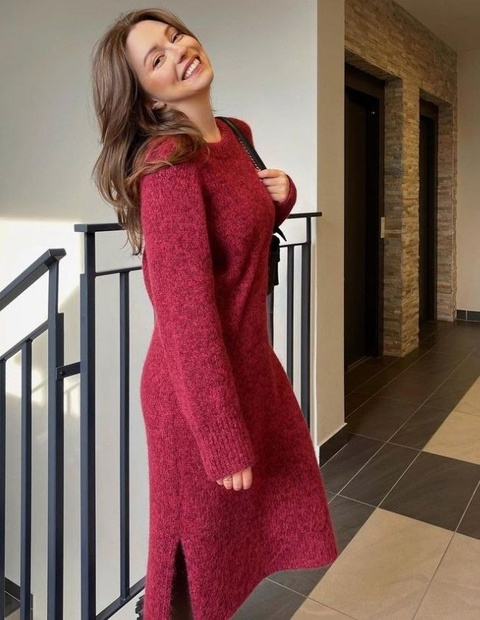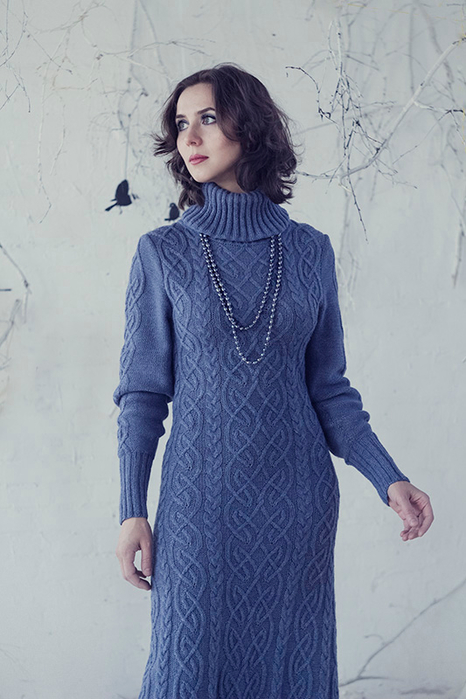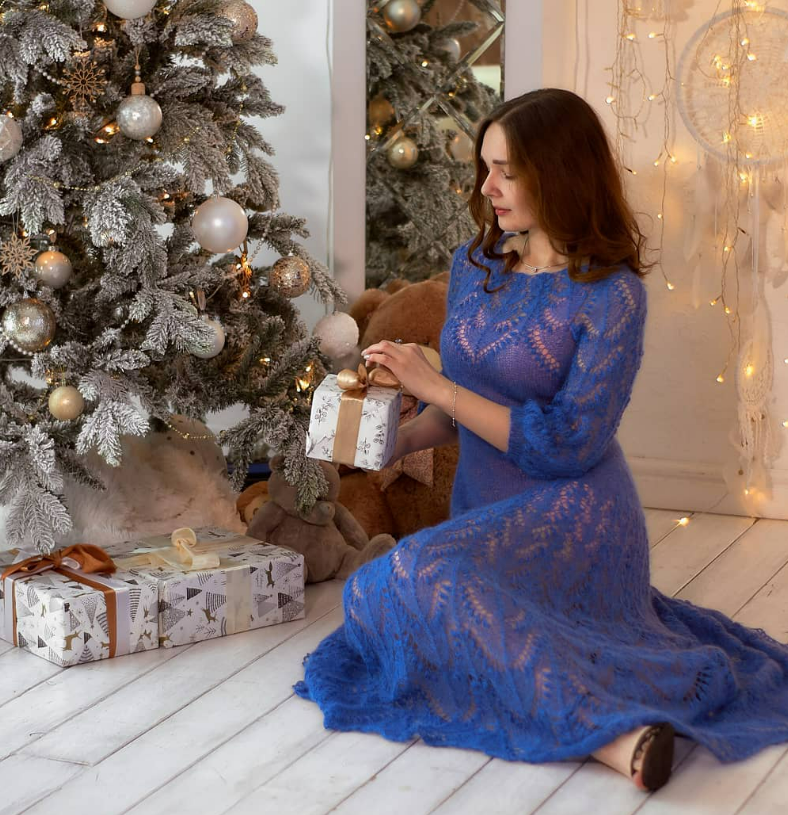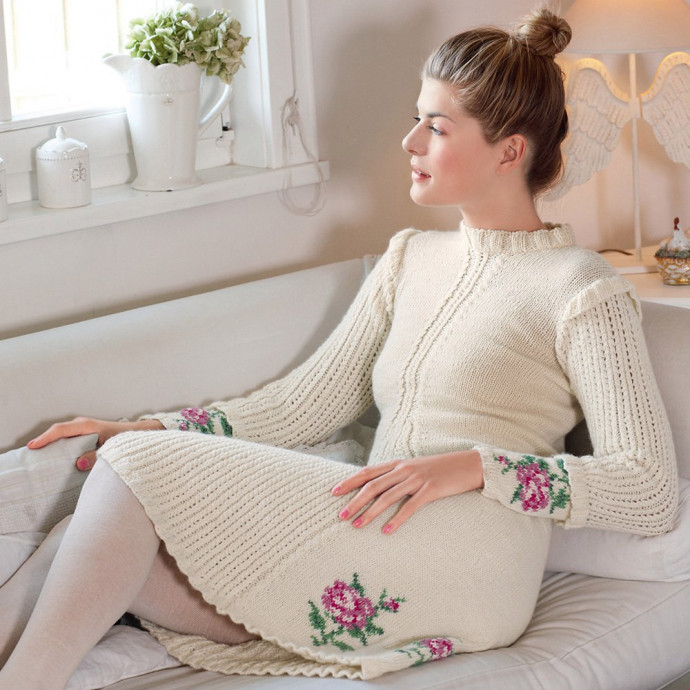




Brown dress with aran patterns and a versatile silhouette.
Added: 03.01.2015 в 04:59 Views: 43060
Brown dress with aran patterns and a versatile silhouette.Klubokhttp://klubok.work/1/100/5572/Klubokhttps://klubok.work/css/image/top-logo-en.png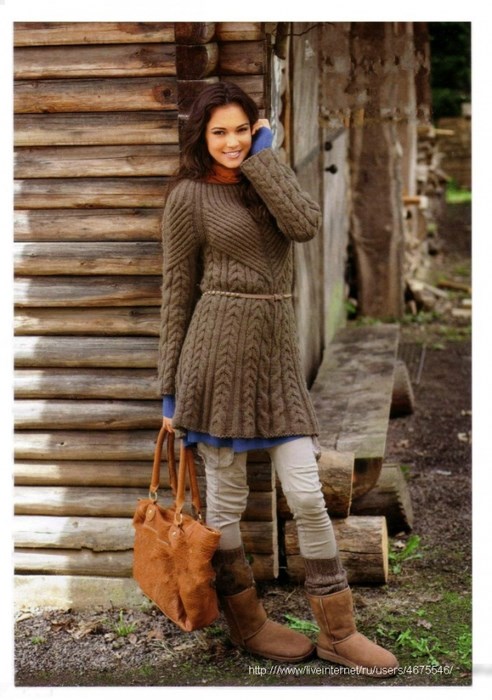
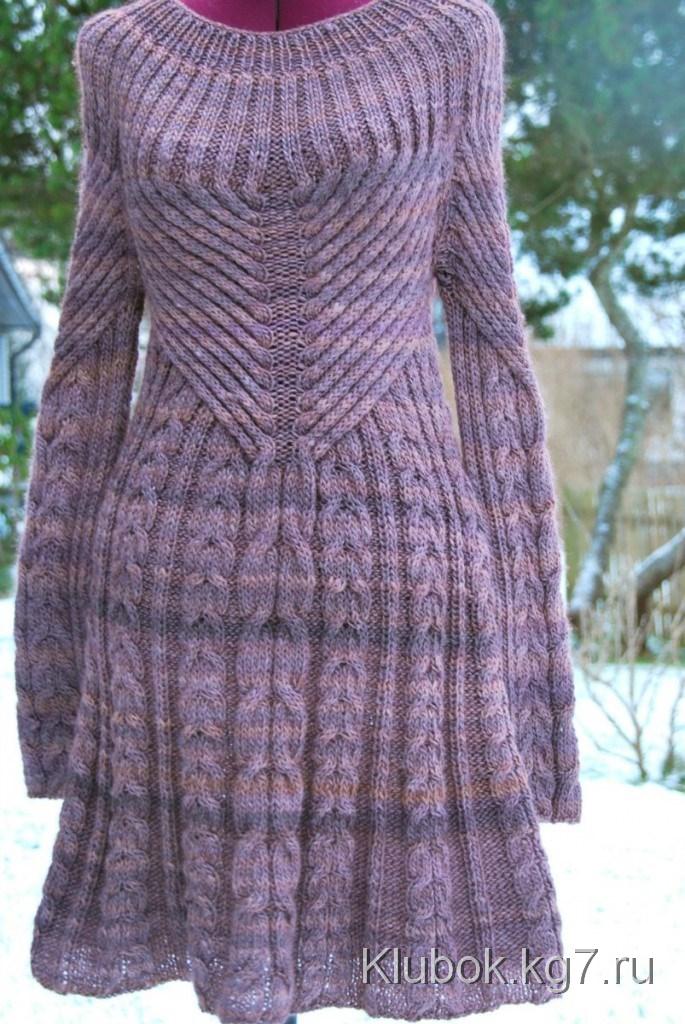
The original model is designed for German sizes 36-38, which corresponds to a bust measurement of 85-95. The gauge for the suggested yarn of 135m for 50g: For Arans: 18 stitches and 22 rows - square 10 by 10 cm For ribbing: 32 stitches and 22 rows - square 10 by 20.
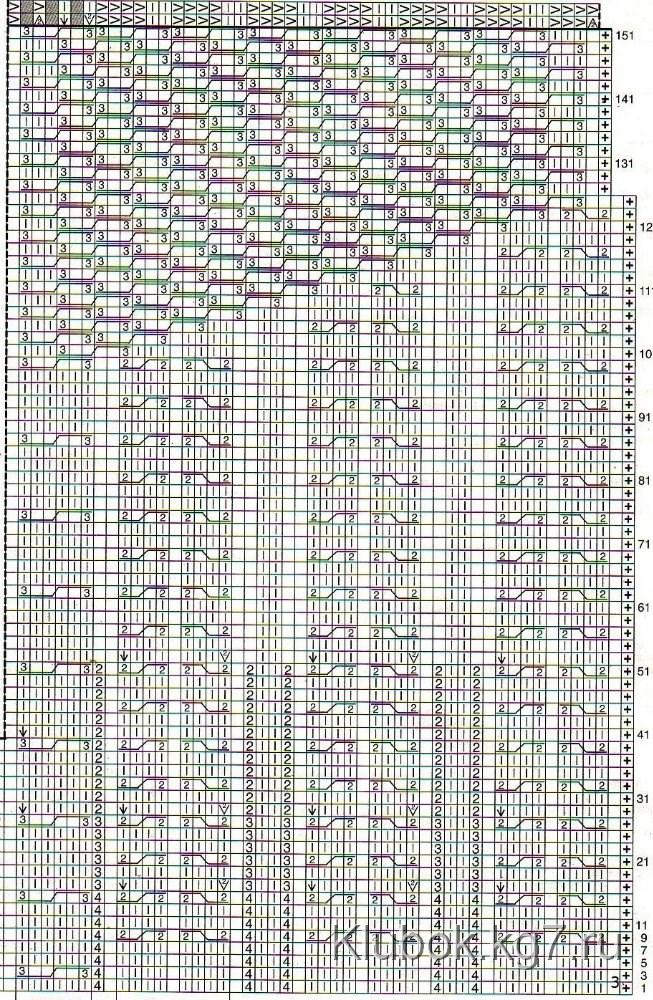
ATTENTION! - it is recommended to take the ribbing as a basis for further calculations, because the knit, as you can see, very tightens the fabric. For those who hit the gauge and size: Cast on 134 stitches, to establish the pattern knit: edge, 3 purl, 4 knit, purl, 4 knit (1st small cable) 5 purl, 2 knit, 5 purl (path of knits) 4 knit, purl, 4 knit, (second small cable) 5 purl, 2 knit, 5 purl, (path of knits) 4 knit, purl, 4 knit (third small cable) 5 purl, 6 knit, 1 purl (large cable) And now accurately - in reverse: 1 purl, 6 knit, 5 purl 4 knit.... Note that the chart does NOT show 3 purls at the beginning of the row, but only one. This is because in the original chart they are moved to the middle of the pattern and are knitted between 6 knits on the left and 6 knits on the right side. You can knit either way. For those who did not hit: Where the cables and paths are separated by 5 purls, you can vary it - you can start with 6, 7, 8 purls - as the yarn and size require. Where and how to start decreasing - again, depends on you. I decreased from 5 to 4 purls in all purl paths after four rounds of the large cable in the center, then again after two rounds - from 4 to 3 and another two - from 3 to 2. You can reduce to 1 or remove completely if a radical narrowing is needed. When satisfied with the waist, you can start with the diagonal cables. Each row on either side of the center introduces the next three stitches into the pattern, and so on, until the pattern stretches across the entire width of the fabric. After that, I made increases on the sides, where there is one purl and an edge for sewing. After every two "ribs" I added one stitch on each side. It fit well, but my yarn is very stretchy. I think I could have added more. When you have knitted all 7 ribs, set the fabric aside and knit the next one.
SCHEME OF FRONT AND BACK:
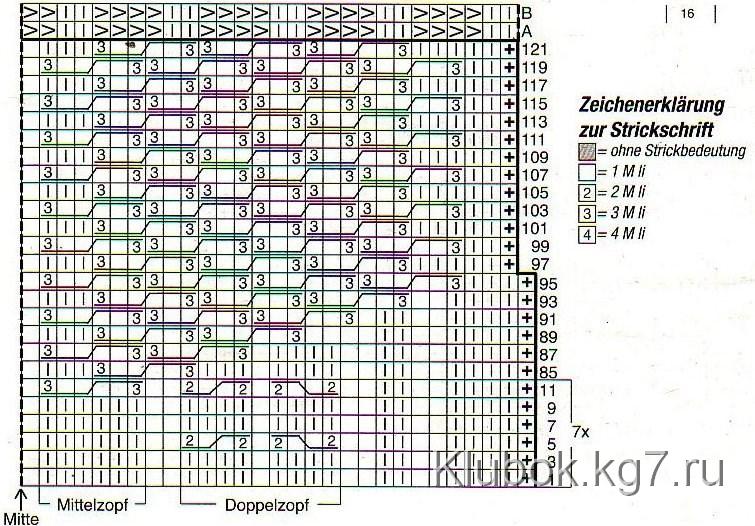
The back, front, and sleeves of the dress are knitted from the bottom to the underarms, then all are joined on one circular needle for ribbing. If you look closely at the photos (I apologize for the quality, I shot in twilight), you can see that the two central stitches in the "corset" are spreading apart. This is not pretty, so it is advisable to knit these stitches tighter. Another problem area is the sleeves near the underarms. In the chart, this is rows 95-97. Make sure the sleeve is not too tight there. The length of the sleeve also needs to be adjusted, mine turned out to be too long. After all the pieces are assembled on the common needles, you need to knit 4 purls, 2 knits so that each "rib" smoothly transitions into a path of 2 knits. Personally, after 4 rows, I made decreases as described - removed 2 purls. Then I basted all the pieces and knitted, trying it on. 16 rows of ribbing 2x2, I removed half of the stitches, 12 rows of ribbing 1x1. I closed it tightly because the neckline was turning out too wide. The table of "standard sizes": XS - 0-2 (USA); 34-36 (France, Spain, Russia); 32-34 (Germany, Scandinavia); 36-38 (Italy), bust circumference 74-82 cm, S - 4-6 (USA); 38-40 (France, Spain, Russia); 36-38 (Germany, Scandinavia), 40-42 (Italy), bust circumference 82-90 cm M - 8-10 (USA); 42-44 (France, Spain, Russia); 40-42 (Germany, Scandinavia), 44-46 (Italy), bust circumference 90-98 cm L - 12-14 (USA); 46-48 (France, Spain, Russia); 44-46 (Germany, Scandinavia), 48-50 (Italy), bust circumference 98-106 cm XL - 16-18 (USA); 50-52 (France, Spain, Russia); 48-50 (Germany, Scandinavia), 52-54 (Italy), bust circumference 107-119 cm
to determine the hip volume in "standard sizes," add 8 cm to the bust, i.e., in size XS with a bust of 74-82, the hips "should be" 82-90

The back, front, and sleeves of the dress are knitted from the bottom to the underarms, then all are joined on one circular needle for ribbing. If you look closely at the photos (I apologize for the quality, I shot in twilight), you can see that the two central stitches in the "corset" are spreading apart. This is not pretty, so it is advisable to knit these stitches tighter. Another problem area is the sleeves near the underarms. In the chart, this is rows 95-97. Make sure the sleeve is not too tight there. The length of the sleeve also needs to be adjusted, mine turned out to be too long. After all the pieces are assembled on the common needles, you need to knit 4 purls, 2 knits so that each "rib" smoothly transitions into a path of 2 knits. Personally, after 4 rows, I made decreases as described - removed 2 purls. Then I basted all the pieces and knitted, trying it on. 16 rows of ribbing 2x2, I removed half of the stitches, 12 rows of ribbing 1x1. I closed it tightly because the neckline was turning out too wide. The table of "standard sizes": XS - 0-2 (USA); 34-36 (France, Spain, Russia); 32-34 (Germany, Scandinavia); 36-38 (Italy), bust circumference 74-82 cm, S - 4-6 (USA); 38-40 (France, Spain, Russia); 36-38 (Germany, Scandinavia), 40-42 (Italy), bust circumference 82-90 cm M - 8-10 (USA); 42-44 (France, Spain, Russia); 40-42 (Germany, Scandinavia), 44-46 (Italy), bust circumference 90-98 cm L - 12-14 (USA); 46-48 (France, Spain, Russia); 44-46 (Germany, Scandinavia), 48-50 (Italy), bust circumference 98-106 cm XL - 16-18 (USA); 50-52 (France, Spain, Russia); 48-50 (Germany, Scandinavia), 52-54 (Italy), bust circumference 107-119 cm
to determine the hip volume in "standard sizes," add 8 cm to the bust, i.e., in size XS with a bust of 74-82, the hips "should be" 82-90
Category: Dresses