



JACQUARD SKIRT
Added: 16.02.2014 в 12:27 Views: 49908
JACQUARD SKIRTKlubokhttp://klubok.work/1/152/4374/Klubokhttps://klubok.work/css/image/top-logo-en.png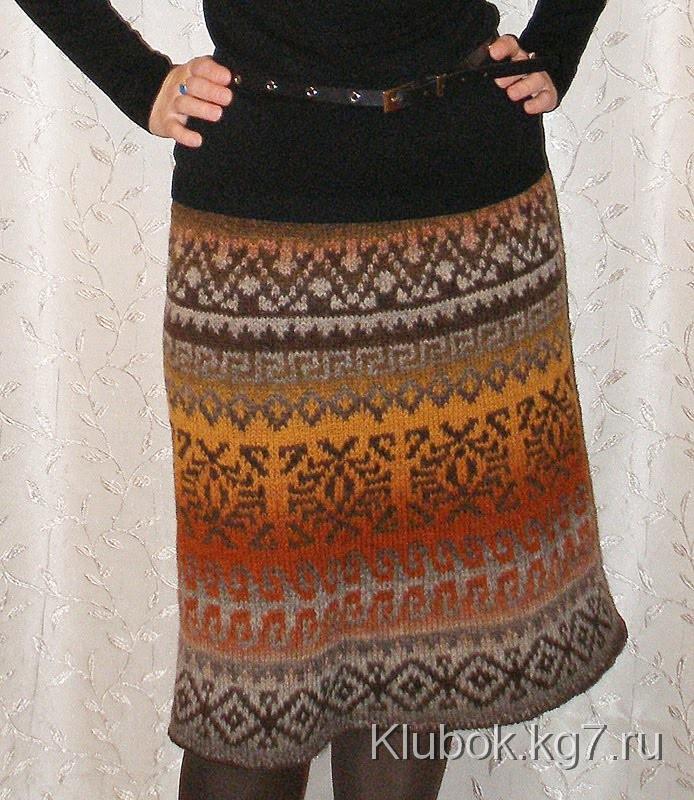
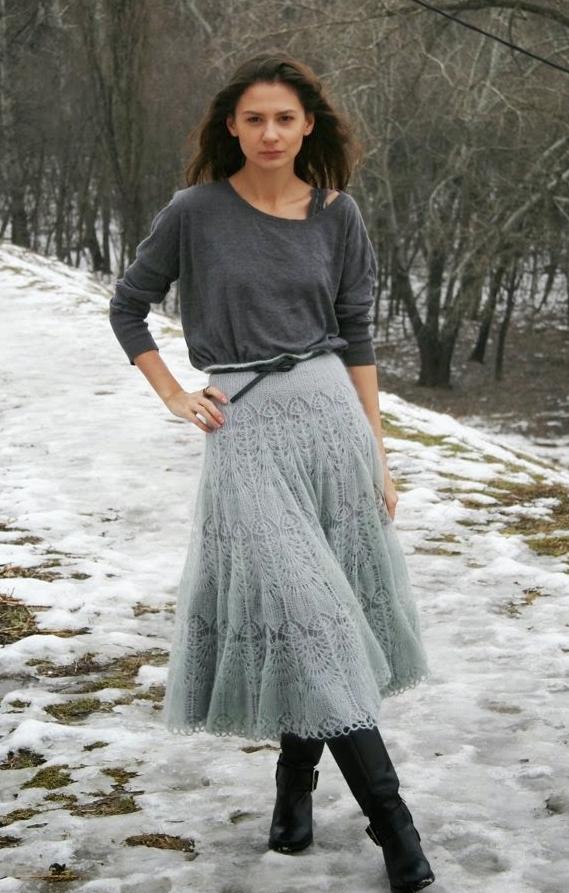
The skirt is knitted from Kauni (100 g - 400 m), with 2 stitches per 1 cm.
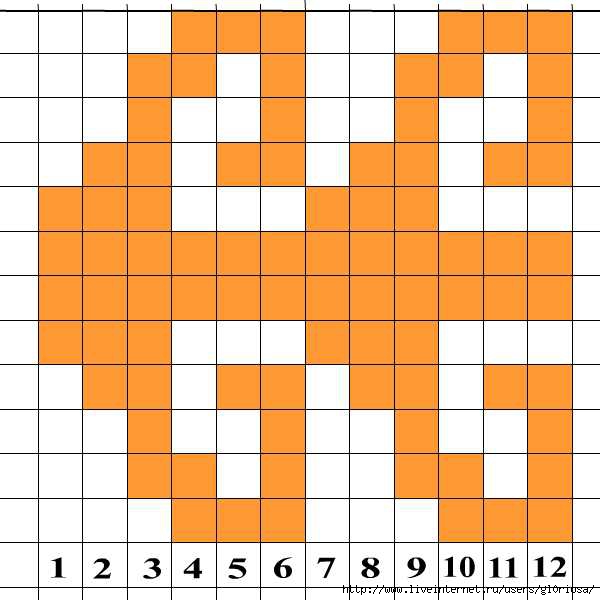
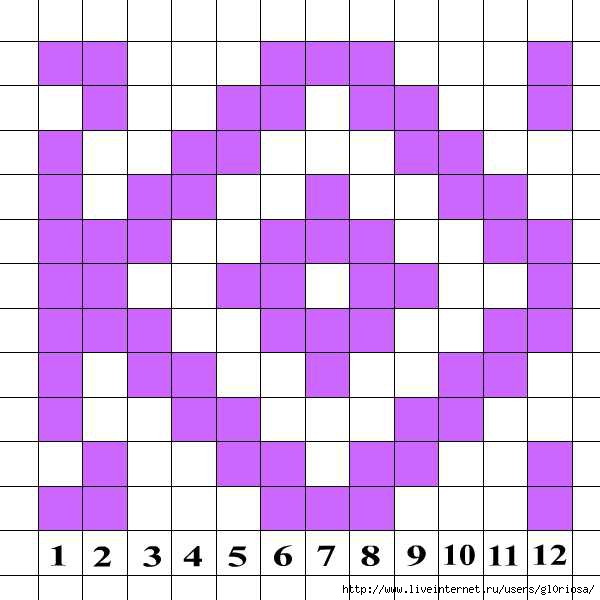
All jacquard patterns are multiples of 12 stitches, so increases were made in increments of 12 stitches in 1 row. The cast-on stitches must also be a multiple of 12 (+2 edge stitches if the knitting is not in the round, but with one seam).
1). Measure the hip circumference, add a few cm for ease, and multiply by 2 to get the number of stitches for casting on. Check if it is a multiple of 12. If not, either add or subtract the necessary number of stitches. + 2 edge stitches if needed. (I need the skirt to fit at the hips; 80 cm multiplied by 2 gives me 160, which is not divisible by 12, so I add 8 stitches +2 edges = 170 stitches for casting on).
2). Measure the hem circumference, add a few cm for ease, and multiply by 2 to get the number of stitches for the hips. Check if it is a multiple of 12. If not, either add or subtract the necessary number of stitches. (For the hips, I need (already with ease) 104 cm, multiply by 2, which gives 208 stitches. Check if divisible by 12. No. I subtract 4 stitches, getting 204 stitches (+ 2 edges).
3). The line where the highest points (i.e., the hip line) are located for most women is 18 - 20 cm below the waistline (if the skirt is at the hips, this number is less - about 14 - 15 cm).
4). Increases.
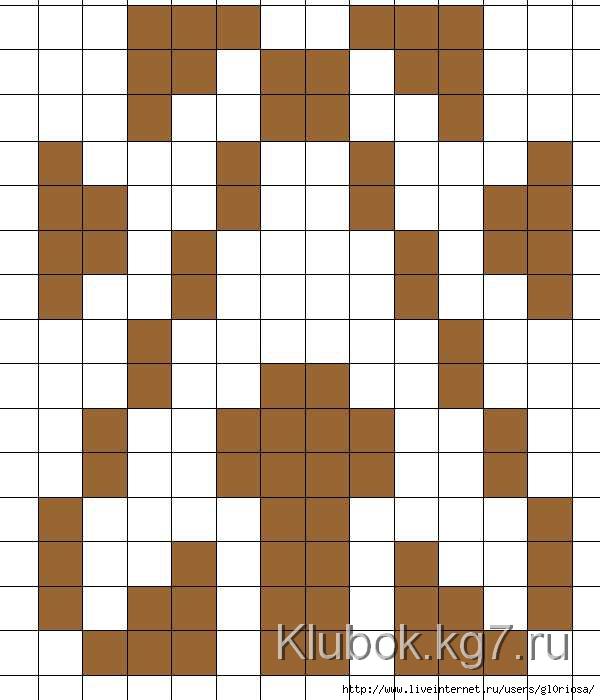
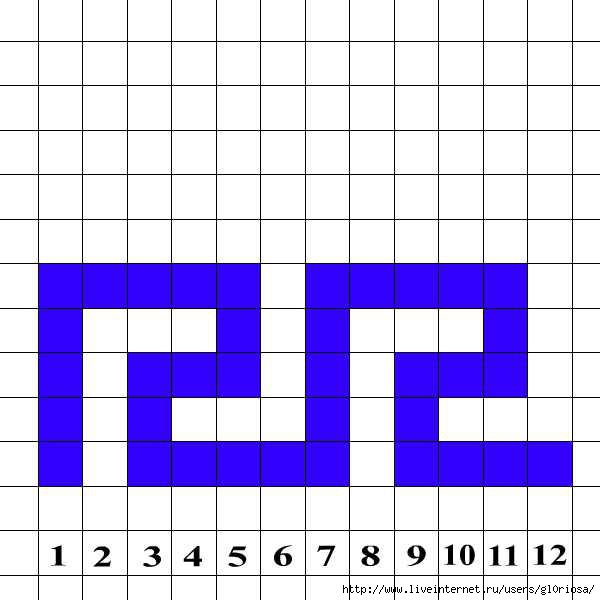
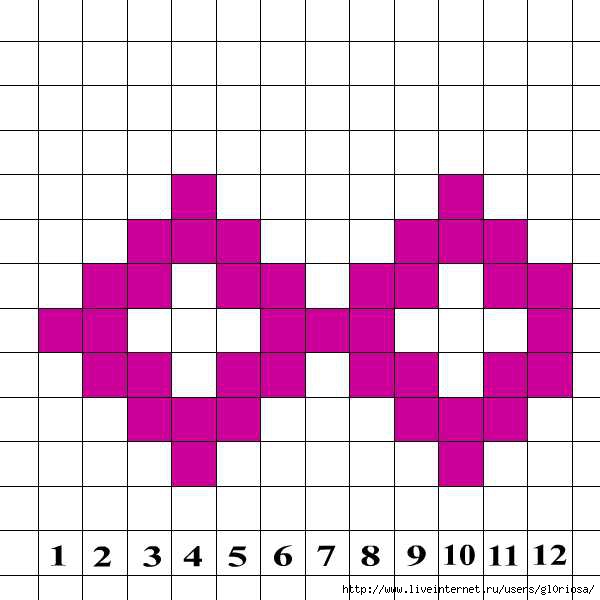
From the number of stitches at the hips, subtract the number of stitches for casting on. This gives the number of stitches needed for increases. It is also a multiple of 12 (this will happen by itself). (I have 204 - 168 = 36, which means I need to increase 12 stitches three times in 15 cm in one row. That is, every 5 cm in one row, I added 12 stitches). To find out how many stitches to increase, divide the number of cast-on stitches by 12 (I have 168 (not counting edges) : 2 = 14, so I increase 2 stitches from every 14th stitch every 5 cm, from the next 5 cm I increase 2 from every 15th stitch, and from the last 5 cm I increase 2 from every 16th stitch). For this type of knitting, it is better to choose low patterns, for example, numbers 1, 2, 4, 5. Increases should be made between patterns (after finishing a pattern, I knitted 2 or 4 rows in the background color, and that’s where the increases were made).
5) After crossing the hip line, increases can be stopped, and the skirt will be straight. But there is a risk that then the ease of movement will be small (meaning it will be difficult to lift the leg onto a step). Therefore, after about 10 cm, you can make another increase (knit 2 from every 17th stitch). And if necessary, after another 10 - 12 cm, make another increase (knit 2 from every 18th stitch).
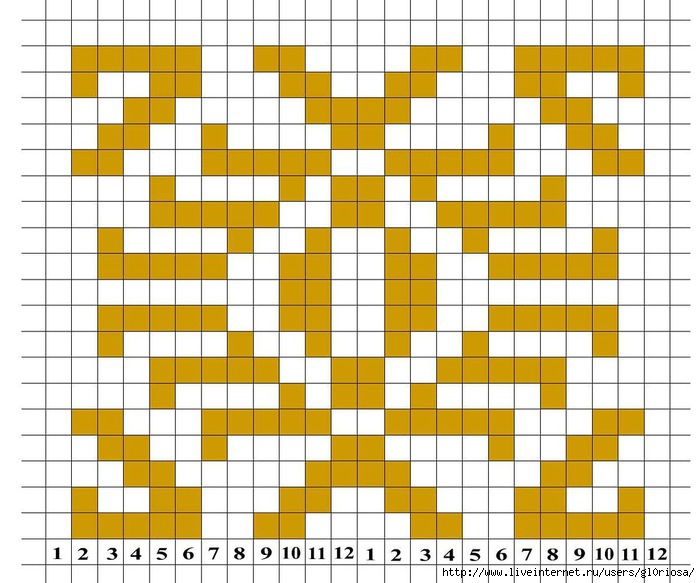
6) Pattern #6 is a multiple of 24 stitches; to knit it, check how many stitches you have on your needles and divide this number by 24. If it is a whole number, then this pattern can be started. Its height is 10 - 11 cm.
These are the charts for the jacquards from which the skirt is knitted.