



Sweater
Added: 01.04.2014 в 13:26 Views: 74374
SweaterKlubokhttp://klubok.work/1/3/4758/Klubokhttps://klubok.work/css/image/top-logo-en.png

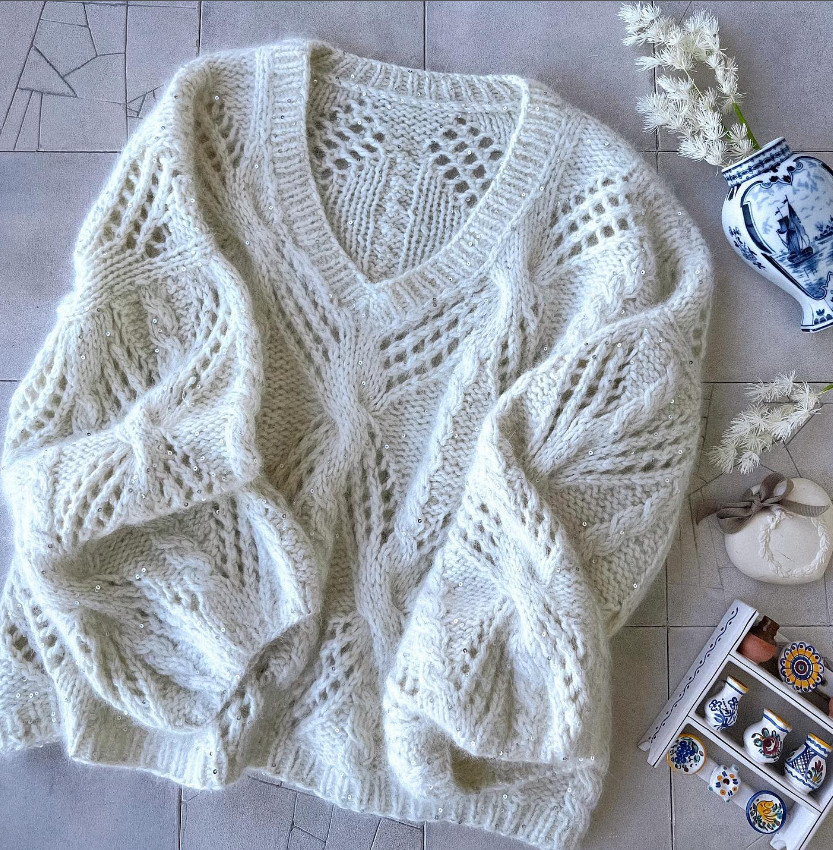
One-sided knitting. Used for knitting hats and as a decorative stripe. The number of stitches is a multiple of six plus two edge stitches. For the sample, we cast on 26 stitches and knit according to the pattern (fig. 144):
Rows 1 and 5 — knit stitches;
Row 2 and all subsequent even rows — purl stitches;
Row 3 — slip 3 stitches (1, 2, and 3) to the right needle and knit the next 3 (4, 5, and 6) as knit stitches. With the left needle (from the front side), pick up the 3 unknit stitches (1, 2, and 3), and the right needle is taken out of all 6 stitches. After that, carefully collect the 3 knit stitches behind the work, and then knit the 3 unknit knit stitches, and so on until the end of the row;
Row 7 — at the beginning, 3 knit stitches, then slip 3 stitches (1, 2, and 3) to the right needle and knit the next 3 (4, 5, and 6) as knit stitches. With the left needle (from the purl side of the work), pick up the 3 unknit stitches, and the right needle is taken out of all 6 stitches and carefully collect the 3 knit stitches in front of the needle. Knit 3 knit stitches (1, 2, and 3). At the end of the row, 3 knit stitches;
Row 9 — repeat the pattern from Row 1.
This pattern can also be knitted using an additional needle or pin.


DESCRIPTION OF KNITTING FROM Astrea
Hip circumference - I have 96 cm, I will explain using my example
Bust circumference - 88 cm
Length of the item - I will make it 70 cm
Length of the front to the waist - 42 cm.
I want the tunic not to cling to my hips, but to be loose at the bottom, so I will add 4 cm at the bottom, then the width of the front at the bottom will be = (96 : 2) + 4 = 52 cm
We calculate the number of stitches, looking at the sample with measurements:
we have 5 spokes on each side with 5 purls = 3 cm x 5 = 15 cm, 2 middle spokes with 2 purls = 2.7 cm - in total, the fabric with spokes will occupy 15*2 + 2.7 = 32.7 cm, and 19.3 cm remains for the purl smooth, rounding it - 19 cm, dividing into 2 sides - 9.5 cm each.
The density of the purl smooth (see the drawing - 12 : 5 = 2.4 stitches per 1 cm
then 9.5 cm = 22.8 or 23 stitches.
So at the bottom: 23 purl smooth, (2 knits + 5 purls) * 5, 2 knits + 2 purls + 2 knits, (5 purls + 2 knits) * 5, 23 purl smooth = 122 stitches
The remaining 20 cm are conditionally divided into 4 parts of 5 cm = 15 rows, and we will knit as follows:
15 rows of spokes with 5 purls
15 rows of spokes with 4 purls
15 rows of spokes with 3 purls
15 rows of spokes with 2 purls
Description up to the waist:
Cast on: 122 stitches, knit in ribbing for 10 rows,
then move on to the main pattern with spokes.
Rows 1-38: 23 purl smooth, (2 knits + 5 purls) * 5, 2 knits + 2 purls + 2 knits, (5 purls + 2 knits) * 5, 23 purl smooth = 122 stitches
Knit according to the pattern for a total of 38 rows (24+15)
Row 39: between the spokes, decreased by 1 stitch - continue knitting with 4 purls between the spokes
Rows 40-54: according to the pattern
Row 55: between the spokes, decreased by 1 stitch - continue knitting with 3 purls between the spokes
Rows 56-70: according to the pattern
Row 71: between the spokes, decreased by 1 stitch - continue knitting with 2 purls between the spokes
Rows 72-84: according to the pattern
Row 85: between the spokes, decreased by 1 stitch - continue knitting with 1 purl between the spokes for one more row. (a total of 86 rows before the braid)
Next starts the braid.
I knitted from the bottom, decreasing every 20 rows by 1 purl stitch, knitting them together as purls. Between the two crossed knits, I left 1 purl (the yarn is thin for the braid) and instead of 4 rows, I knitted 6, so that this purl was not completely "eaten". Also, instead of 1 purl between the spokes, when I started braiding, I left 2 purl stitches, and when the knit stripes went into crossing, I knitted from 2 to 1 purl stitch. In the braid (hidden text) the middle purl was always behind the work. At the edge of the stripes, I added the number of stitches that I knitted together to maintain the width of the front. Plus from the waist at the edge of the knitting, I added 1 stitch in every 6th row until the armhole, a total of 20 stitches, at the waist there were 88, at the armhole there were 108 stitches. In the photo from the reverse side, you can see my increases and decreases. I wanted the stripes to smoothly transition into the braids, on the model they have an angle of slope.

Collar. I cast on 36 chain stitches on 4 needles. I knitted 20 rows of pearl ribbing without decreases. Then I decreased 2 stitches in every 6th row: I knitted the first knit, then from 4 stitches I knitted 2: I slipped the purl unknit, then swapped the knit and purl (the purl was behind the work), slipped the purl back, knitted the two purls together as one purl, then knitted the 2 knits together as one knit. When there were 26 stitches left on the needles, I knitted 10 rows without decreases. Then I knitted 4 rows of knit stitches, closed the knitting. I left the thread longer to later sew the band to the neckline. From the back side (the purl side), I cast on the same number of stitches from the wraps on 4 needles and knitted 4 rows of knit stitches, closed the stitches, leaving the thread longer for sewing. I got a collar with a double band. First, I sewed the band on the front side with a slip stitch, then I sewed the band from the back side, from the back side it needs to be sewn carefully so that the seam is not visible from the front. I have pearl ribbing, and the front is turned inside the collar; when the collar is narrow, you have to knit the front of the pattern half on the front half on the purl. To avoid repeating my mistake, you need to decrease as in mittens from the sides at the beginning of the needles and at the end, not just at the beginning as I did all the time; the decreases are visible in the middle of the collar, but only those who have been knitting for a long time will notice this, while others will think it should be like that. Happy knitting.