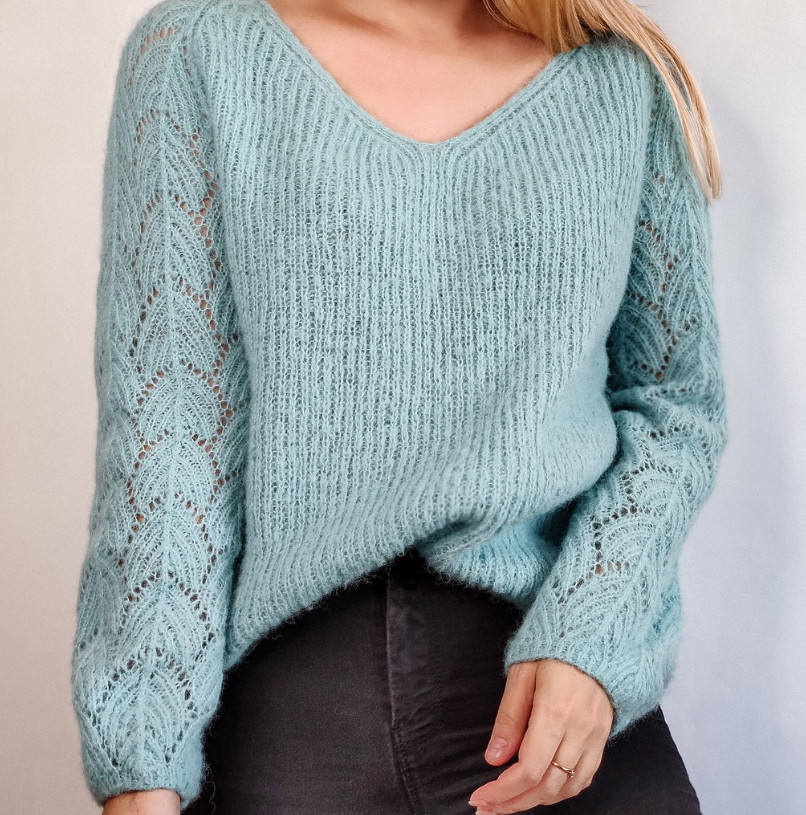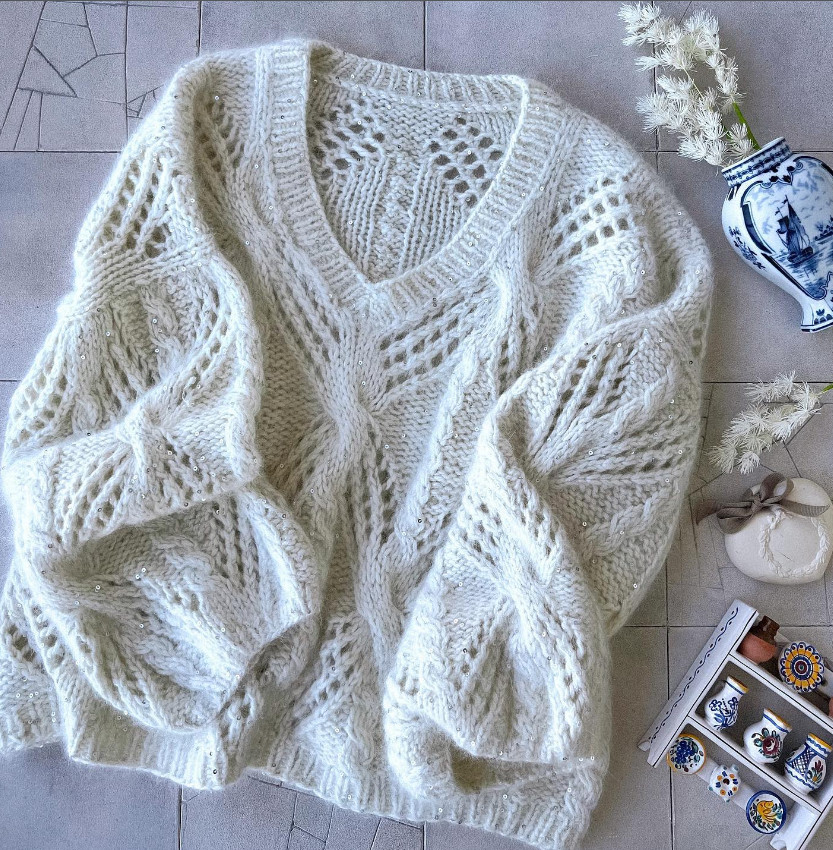




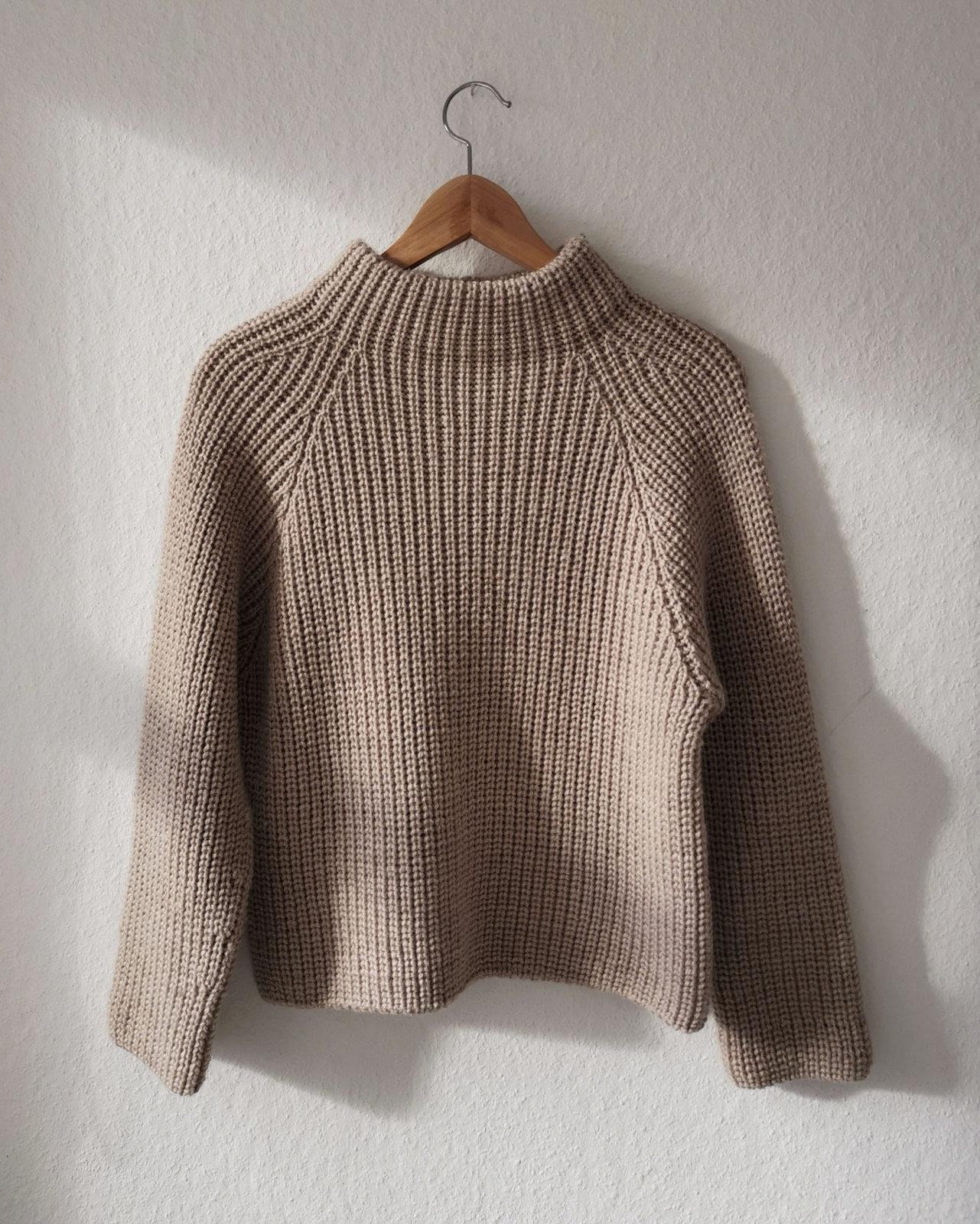
Ribbed sweater knitted with needles. Top-down raglan.
Added: 04.07.2025 в 21:22 Views: 237
Ribbed sweater knitted with needles. Top-down raglan.Klubokhttp://klubok.work/1/3/8881/Klubokhttps://klubok.work/css/image/top-logo-en.png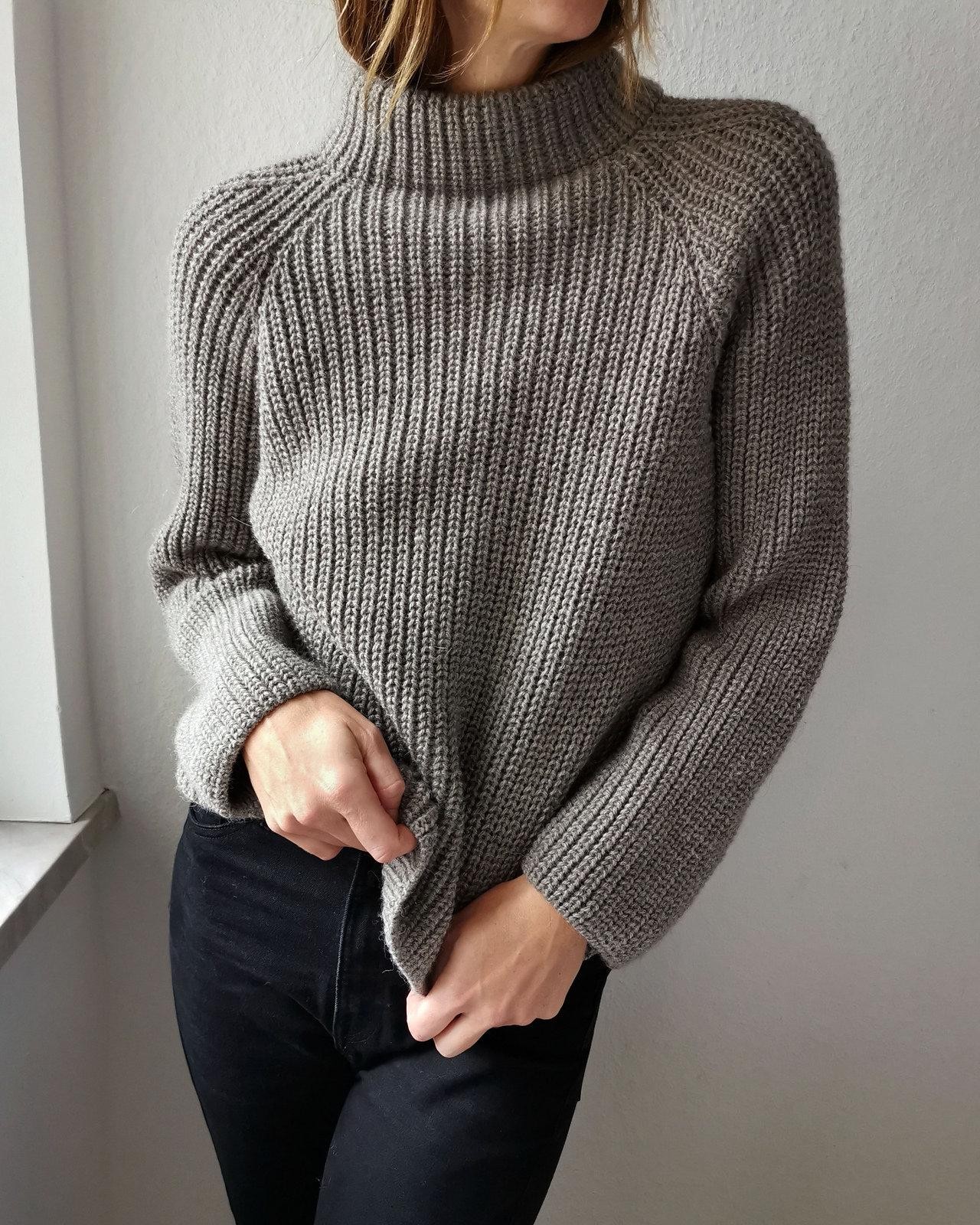
Circular needles 3 mm long 80–100 cm for
the hem.
Double-pointed needles 3 mm for the sleeve cuffs (if
the "magic loop" method is not used).
ADDITIONAL
Tapestry needle, stitch markers, crochet
hook 4.0–5.0 mm, and some scrap yarn
in a contrasting color for temporary cast on
stitches.
GAUGE
Half fisherman's rib, in rows,
with 4 mm needles: 18-19 sts x 38-40 rows = 10 x 10
cm, measured in a laid flat position, after washing, slightly
stretched.
If necessary, adjust the needle size to
achieve the correct gauge.
SPECIAL TECHNIQUES AND ABBREVIATIONS
P1P (increase leaning right): lift the yarn between 2 sts with the left
needle from back to front and knit it through the front loop.
P1Pizn (purl increase leaning right): lift the yarn between 2 sts
with the left needle from back to front and purl it through the
front loop.
P1L (increase leaning left): lift the yarn between 2 sts with the left needle
from front to back and knit it through the back loop.
P1Lizn (purl increase leaning left): lift the yarn between 2 sts
with the left needle from front to back and purl it through the
back loop.
Slip 1 st with yarn over: slip the stitch as if to purl, while also
yarning over.
Double decrease leaning right: knit 2 sts together as one (= knit st + purl
st with its yarn over). Slip the stitch back to the left
needle and yarn over the next st with the left needle from left to right. Slip the stitch back to the
right needle.
Double decrease leaning left: slip 1 st (= knit st) as knit. Knit the next
2 sts together (purl st with its yarn over +
knit st), then yarn over the slipped stitch onto this stitch.
RS: right side.
WS: wrong side.
M: marker.
PM: place marker.
SM: slip marker from left to right needle.
UM: remove marker.
NK: beginning of round.
MAIN PATTERN
Half fisherman's rib with yarn overs in the round
(even number of stitches):
Round 1: *1 knit, slip 1 st with yarn over,
repeat from * to end of round.
Round 2: *1 knit, purl the stitch together with its yarn over, repeat from * to
end of round.
Half fisherman's rib with yarn overs,
in rows (for swatch, odd number of stitches):
Row 1 (WS): 1 selvedge st, *1 purl, slip 1 st with
yarn over, repeat from *, finish with 1 purl, 1
selvedge st.
Row 2 (RS): 1 selvedge st, *1 knit, purl the
stitch together with its yarn over, repeat from *, finish with 1 knit, 1 selvedge st.
Note that the "wrong" side
of the half fisherman's rib pattern is the visible side in
this model, not the "true" side, which looks like the full pattern
of fisherman's rib, as is usually the case.
TEMPORARY CAST ON WITH CROCHET
Loosely crochet a chain of chain stitches,
using yarn in a contrasting color. Make 2 or 3
stitches more than you need to cast on.
Carefully pull the end of the yarn through the
last chain stitch, not too tightly,
because this is the yarn you will need to
pull later to unravel the chain of chain stitches.
On the back side of the chain, there are
horizontal bumps that resemble the bumps
of stockinette stitch.
Using the main yarn of the project, pick up
the number of stitches indicated in the instructions
along this row of "purl bumps". Start from
the end of the crochet chain, i.e., from the
point where the end of the yarn was loosely pulled
through the last stitch.
To unravel the temporary cast on, simply
release the end of the yarn at the end of the chain of
chain stitches, gently unravel the
chain of chain stitches and pick up the
unraveled stitches with the circular needle.
Temporarily cast on 84 (88) 88 (88) 92 (92) sts,
using a short circular needle 4 mm and
the chain of chain stitches crocheted. Here you can find a helpful
instruction on "temporary cast on":
https://www.youtube.com/watch?v=BtM9EcSp1-k
Join in the round and PM for NK. The marker should not be too "bulky", otherwise
it may create an unsightly jump when
transitioning from the end of the round to the beginning
of the round. Pins, for example, work well.
Then continue knitting half fisherman's
rib in the round as follows:
Round 1: *1 knit, slip 1 st with yarn over,
repeat from * to end of round.
Round 2: *1 knit, purl the stitch together with its yarn over, repeat from * to
end of round.
Repeat rounds 1 and 2 another 26 times, until
a total of 54 rounds have been knitted,
and the collar measures approximately 12 cm.
At the next stage, unravel the temporary
cast on as follows: release the end
of the yarn at the end of the chain of chain stitches,
gently pull on this end and pick up
the opened stitches with the circular needle. The second
circular needle does not necessarily have to be
size 4 mm, but can be smaller. This
spare circular needle is only for
picking up stitches.
In the end, there should be a total of 84 (88)
88 (88) 92 (92) sts on the second circular needle, the
same number of stitches as on
the opposite side on the 1st circular needle (Fig. 1).
Now fold the second circular needle up the
inside so that the neckband folds in half. Place
the first and second circular needles parallel
to each other (Fig. 2) and knit together the 1st stitch from the first needle and the 1st stitch from the second
needle, repeat around until there are 84 (88) 88 (88) 92 (92) sts on
the first circular needle.
Tip: "If you don't want to use a temporary cast on and knit together
both edges of the collar, you can cast on stitches the classic way, for example, using the
"long tail" cast on. After the sweater is finished, fold the collar inward and sew it with a seam through the edge. This way,
the collar will smoothly transition into the body, which also has its charm."
After completing the double collar
continue knitting half fisherman's rib in the round as follows:
Round 1: *1 knit, slip 1 st with yarn over,
repeat from * to end of round.
Round 2: *1 knit, purl the stitch together with its yarn over, repeat from * to
end of round.
Round 3: *1 knit, slip 1 st with yarn over,
repeat from * to end of round.
In the next round (round 4), PM for better orientation in the increases:
Round 4: knit 11 (13) 13 (13) 13 (13)
sts (= half of the back) in pattern, PM, 3 sts in
pattern, PM, 13 (13) 13 (13) 13 (13) sts in pattern (=
shoulder), PM, 3 sts in pattern, PM, 23 (25) 25 (25) 27
(27) sts in pattern (= front), PM, 3 sts in
pattern, PM, 13 (13) 13 (13) 13 (13) sts in pattern (=
shoulder), PM, 3 sts in pattern, PM, 12 (12) 12 (12) 14
(14) sts in pattern (= half of the back), SM (= NK).
The start of the round is in the middle of
the back.
Now start increases for the shoulders and body.
Use increases leaning left and
right, knit and purl, from the yarn overs
between 2 stitches.
Important: yarn overs create 2 yarn overs. When
increasing knit stitches, always pick up
the yarn over that is in front, and
when increasing purl stitches, always
pick up the yarn over that is in back.
Tip: "Increases require a high level of
concentration; if necessary, use
colored stitch markers.
A little hint for half fisherman's
rib: yarn overs ("slip 1 st with yarn over")
are done in all odd rounds,
and "purl the stitch together with its yarn over"
— in all even rounds.
Now reduce the distance between
the body increases as follows:
Round 1 (sleeve + body increases): knit
in pattern to M, P1L, SM, slip 1 st with yarn over,
P1P, knit in pattern to 1 st before M, P1L, slip
1 st with yarn over, SM, P1P, knit in pattern to M,
P1L, SM, slip 1 st with yarn over, P1P, knit in
pattern to 1 st before M, P1L, slip 1 st with
yarn over, SM, P1P, knit in pattern to end
of round.
(+ 8 sts = 252 (256) 256 (240) 228 (212) sts.)
Round 2 (sleeve + body increases): knit
in pattern to 1 st before M, P1Lizn, 1 knit, SM,
purl the stitch together with its yarn over, 1 knit, P1Pizn, knit in pattern to 2 sts
before M, P1Lizn, 1 knit, purl the stitch together
with its yarn over, SM, 1 knit, P1Pizn, knit in pattern to 1 st before M, P1Lizn, 1 knit,
SM, purl the stitch together with its yarn over, 1 knit, P1Pizn, knit in pattern to 2 sts
before M, P1Lizn, 1 knit, purl the stitch together
with its yarn over, SM, 1 knit, P1Pizn, knit in pattern to end of round.
(+ 8 sts = 260 (264) 264 (248) 236 (220) sts.)
Rounds 3 and 4 (without increases): knit in
pattern.
Round 5 (body increases): knit in pattern
to M, P1L, SM, knit in pattern to M, SM, P1P,
knit in pattern to M, P1L, SM, knit in pattern
to M, SM, P1P, knit in pattern to end
of round.
(+ 4 sts = 264 (268) 268 (252) 240 (224) sts.)
Round 6 (body increases): knit in pattern
to 1 st before M, P1Lizn, 1 knit, SM, knit in
pattern to M, SM, 1 knit, P1Pizn, knit in pattern
to 1 st before M, P1Lizn, 1 knit, SM, knit in
pattern to M, SM, 1 knit, P1Pizn, knit in pattern
to end of round.
(+ 4 sts = 268 (272) 272 (256) 244 (228) sts.)
Round 7 (sleeve increases): knit in
pattern to M, SM, slip 1 st with yarn over, P1P,
knit in pattern to 1 st before M, P1L, slip 1 st
with yarn over, SM, knit in pattern to M, SM, slip
1 st with yarn over, P1P, knit in pattern to 1 st
before M, P1L, slip 1 st with yarn over, SM, knit
in pattern to end of round.
(+ 4 sts = 272 (276) 276 (260) 248 (232) sts.)
Round 8 (sleeve increases): knit in
pattern to M, SM, purl the stitch together
with its yarn over, 1 knit, P1Pizn, knit in
pattern to 2 sts before M, P1Lizn, 1 knit,
purl the stitch together with its yarn over, SM, knit in pattern to M, SM,
purl the stitch together with its yarn over, 1 knit, P1Pizn, knit in pattern to 2 sts
before M, P1Lizn, 1 knit, purl the stitch together
with its yarn over, SM, knit in pattern
to end of round.
(+ 4 sts = 276 (280) 280 (264) 252 (236) sts.)
Round 9 (body increases): knit in pattern
to M, P1L, SM, knit in pattern to M, SM, P1P,
knit in pattern to M, P1L, SM, knit in pattern
to M, SM, P1P, knit in pattern to end
of round.
(+ 4 sts = 280 (284) 284 (268) 256 (240) sts.)
Round 10 (body increases): knit in pattern to 1 st before M, P1Lizn, 1 knit, SM,
knit in pattern to M, SM, 1 knit, P1Pizn, knit
in pattern to 1 st before M, P1Lizn, 1 knit, SM,
knit in pattern to M, SM, 1 knit, P1Pizn, knit in pattern
to end of round.
(+ 4 sts = 284 (288) 288 (272) 260 (244) sts.)
Rounds 11 and 12 (without increases): knit in
pattern.
Now check, on the needles 284 (288) 288 (272)
260 (244) sts, with 75 (77) 77 (73) 71 (67) sts for
the front and back, and 67 (67) 67 (63) 59
(55) sts for each sleeve.
Continue repeating rounds 1–12,
repeating them as follows for different
sizes:
Size XS:
knit rounds 1–12 a total of 2 times.
Size S:
knit rounds 1–12 a total of 2 times +
knit round 1–4 once.
Size M:
knit rounds 1–12 a total of 2 times +
knit round 1–6 once.
Size L:
knit rounds 1–12 a total of 3 times +
knit round 5–6 once.
Size XL:
knit rounds 1–12 a total of 3 times +
knit round 1–6 once + knit rounds 3–6 twice.
Size XXL:
knit rounds 1–12 a total of 4 times +
knit rounds 9–12 three times.
On the needles 324 (344) 352 (360) 380 (388) sts, with 87
(93) 97 (101) 111 (115) sts for the front and
back, and 75 (79) 79 (79) 79 (79) sts for
each sleeve.
The work measures about 20 (21) 21 (22) 23 (24)
cm, measuring from the connection of the double collar
and in a slightly stretched state.
BODY
In the next round, separate the body and
sleeves as follows:
Knit 43 (47) 49 (51) 55 (57) sts in pattern (=
half of the back), UM, slip 1 st with yarn over,
place 73 (77) 77 (77) 77 (77) sts on holder,
cast on 5 (5) 5 (9) 9 (13) new sts, slip 1 st with
yarn over, UM, knit 87 (93) 97 (101) 111
(115) sts in pattern (= front), UM, slip 1 st with yarn over, place
73 (77) 77 (77) 77 (77) sts on holder, cast on 5 (5) 5 (9) 9 (13) new sts,
slip 1 st with yarn over, UM, knit 44 (46) 48
(50) 56 (58) sts in pattern (= half of the back) to
the end of the round.
Knit half fisherman's rib in the round on all
188 (200) 208 (224) 244 (260) sts, logically incorporating
5 (5) 5 (9) 9 (13) sts for the underarm.
Continue knitting in rounds until the
work, measuring from the connection of the double
collar, measures approximately 47 (49) 49 (52) 52
(55) cm or until the desired
length is reached.
Important: the measurements given here may
seem too short at first glance.
However, this takes into account the fact that items
knitted in half fisherman's rib tend to stretch in width and length
after washing and wearing, especially in length.
The body stretches in length by approximately 3–4 cm
after washing.
Tip: "If you are unsure about the length, I
recommend placing the stitches on a spare
circular needle or a piece of scrap yarn
before closing the stitches. Then try on
the sweater after washing, decide on the
final length, and close the stitches."
When the desired length is reached,
switch to 3 mm circular needles and knit
2 more rounds of half fisherman's rib,
finishing after the 2nd round of the pattern.
Then close the stitches of the hem
"Italian style" (without
preparatory rounds). Here is
a useful guide to this method:
https://www.youtube.com/watch?v=lhJGkzgIJEY
SLEEVES
Join the yarn in the middle of the cast on
stitches of the underarm, i.e., in the 3rd (3rd) 3rd (5th)
5th (7th) st from the 5 (5) 5 (9) 9 (13) cast on
stitches of the underarm and pick up/knit a total of 78 (82) 82
(86) 86 (90) sts, using a short circular
needle 4 mm:
Pick up 3 (3) 3 (5) 5 (7) sts along the cast on edge
of the underarm, knit in pattern across the
held 73 (77) 77 (77) 77 (77) sts of the sleeve and
pick up another 2 (2) 2 (4) 4 (6) sts along the cast on
edge of the underarm. Join in the round and
PM for NK.
5 (5) 5 (9) 9 (13) sts of the underarm are logically
incorporated into the half fisherman's rib pattern. The round
starts with a purl stitch, even if the body stitches below it appear different or
not identical. Knit as follows:
Round 1: 1 purl, *1 knit, 1 purl, repeat
from * 1 (1) 1 (2) 2 (2) times, knit 73 (77) 77
(77) 77 (77) sts in pattern, **1 purl, 1 knit,
repeat from ** 1 (1) 1 (2) 2 (3) times.
Round 2: *slip 1 st with yarn over, 1 knit,
repeat from * to end of round.
Round 3: *purl the stitch together with its yarn over, 1 knit, repeat from * to
end of round.
Repeat rounds 2 and 3, simultaneously
decreasing the sleeve every 5 cm.
Decreases are done as double decreases leaning
right and left. Switch to double-pointed needles
or long circular needles and the "magic loop" method
when the number of stitches decreases.
Knit the next round with decreases
a total of 5 (5) 5 (5) 5 (6) times every 5 cm
(approximately in every 24th round):
Decrease round: purl the stitch together with its yarn over, 1 knit, purl the
stitch together with its yarn over,
double decrease leaning right, knit in
pattern to the last 5 sts of the round,
double decrease leaning left, purl the stitch together with its
yarn over, 1 knit. (= decreased 4 sts.)
After this decrease round has been completed a total of 5 (5) 5 (5) 5
(6) times, there will be 58 (62) 62 (66) 66
(66) sts remaining on the needles.
Continue knitting half fisherman's rib until the sleeve measures approximately 36 (37) 38
(39) 39 (39) cm.
Tip: "Don't despair if the sleeves seem
too short to you. Items knitted in
half fisherman's rib stretch after washing and during wearing, especially in length.
The sleeves will "grow" by about 5 cm. I
prefer to place the sleeve stitches on
a piece of scrap yarn before closing
the stitches. Only after washing the sweater do I
finish the sleeves. This way I can perfectly
adjust the length."
When the desired length is reached,
switch to 3 mm circular needles and knit
2 more rounds of half fisherman's rib,
finishing after the 2nd round of the pattern.
After finishing the last round, knit
1 more purl stitch, so that the next
round starts with a knit stitch. Then
close the cuff stitches Italian style
(without preparatory rounds), as was
done for the body hem.
FINISHING
Weave in all yarn ends. Close
any small gap in the underarm
with a few small stitches.
Gently wash the sweater and lay it
flat to dry. This will even out the stitches, and the sweater will have a better
drape. Moreover, knitted items made in the half fisherman's rib technique
show their "true" size only
after washing, i.e., they stretch a bit,
especially in length.