


Knitted sweater
Added: 16.09.2025 в 19:19 Views: 818
Knitted sweaterKlubokhttp://klubok.work/1/3/9100/Klubokhttps://klubok.work/css/image/top-logo-en.png
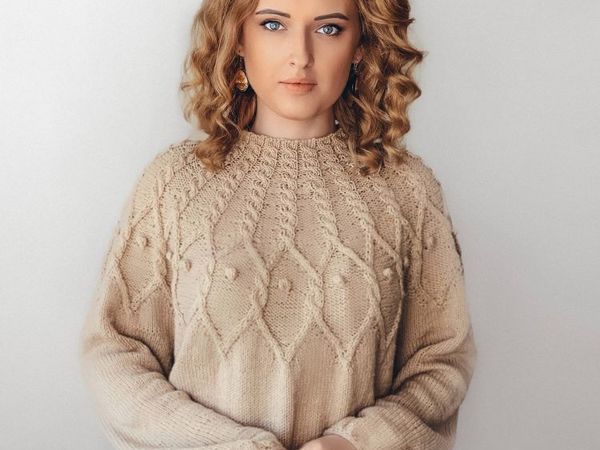
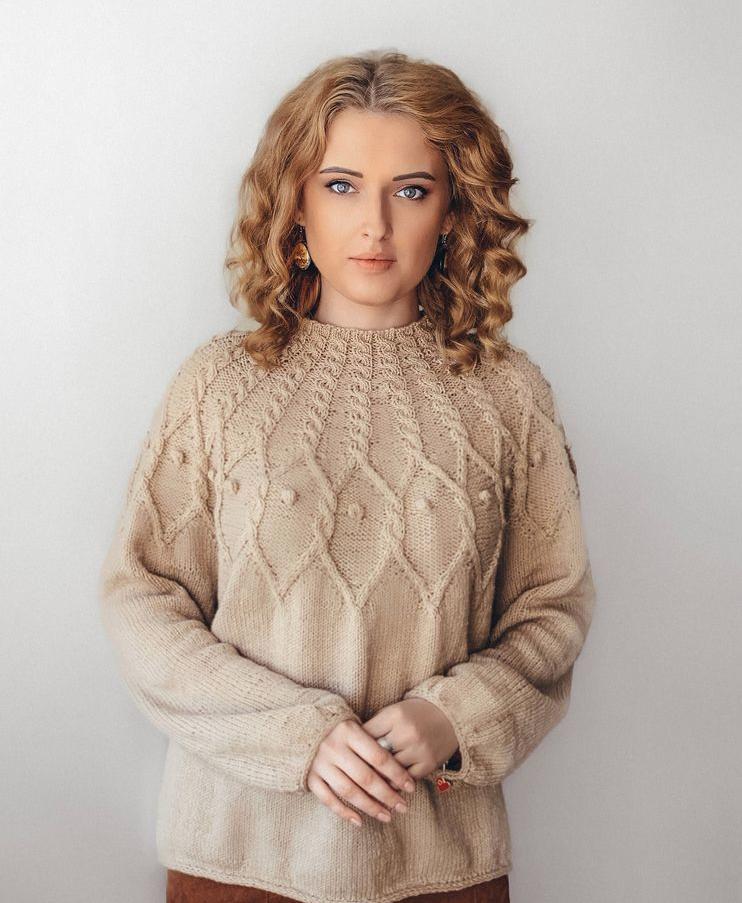
This sweater is knitted from top to bottom with a round yoke. After watching our master class and the diagram, you will be able to make any calculations for any knitting density and any size on your own. We will consider knitting this sweater in size M-L. You will see later that this pattern can be reduced or increased to fit any size.
Materials:
yarn Lanacoton Alize — 6 skeins of 50 g, 160 m long;
composition: 26% wool, 26% cotton, 48% acrylic;
color — 262 Beige;
up to 18 markers if needed, one of a different color, 2 stitch holders or waste yarn;
circular needles 2.5 mm 40 cm long for knitting the neckline, 3.0 mm or 3.5 mm 80 cm or longer, double-pointed needles 3.0 mm or 3.5 mm. You can use needles of different thicknesses that allow you to achieve the desired knitting density.
scissors;
tapestry needle (if necessary).
You can use any yarn of any composition to knit this sweater.
Knitting density of the sample:
Pattern: stockinette stitch and main pattern chart after blocking:
20 stitches*26 rows = 10 cm*10 cm, needles 3.5 mm
The "braid" pattern and the round yoke pattern chart
Beginning of the rapport — 12 stitches — 7 cm
End of the rapport (size M, L) — 32 stitches — 16 cm
Length of the round yoke with neckline and short rows — 25 cm
The table presents sizes in cm and immediately (according to the knitting density) the number of stitches (girth) or rows (length).
Name Size M-L
cm quantity
Length of the garment along the back including the short row 60 156
Head circumference* 55
Chest circumference 100 - 96 200 - 192
Length of the sleeve from the neckline 28 73
Length of the raglan line 26 68
Sleeve circumference 34 68
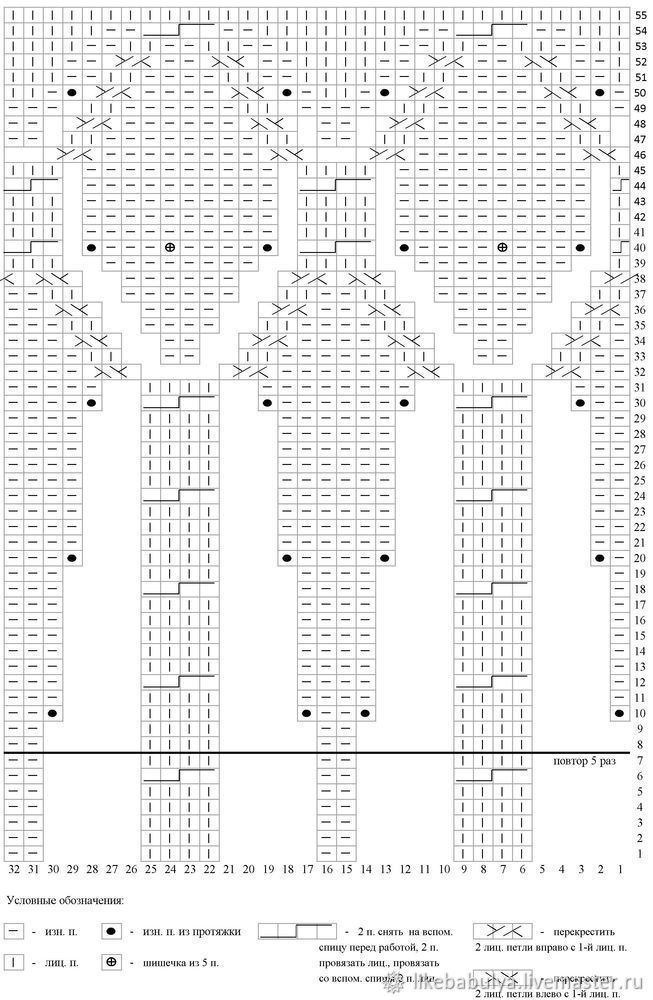
1. purl
purl
2.
knit
3.  bobble stitch from the wrap
4. bobble made of 5 stitches
5. slip 2 stitches onto a holding needle in front of the work, knit 2 stitches, then knit 2 stitches from the holding needle
6. cross 2 knit stitches to the right with 1 knit stitch
7. cross 2 knit stitches to the left with 1 knit stitch
We will consider the head circumference not based on the knitting density, but on the calculation of the rapports of the main pattern and taking into account the "braid" pattern.
The number of stitches and rows in the table is indicated based on the knitting density without a loose fit. However, as is known, the density of the sample and the density of knitting in the round do not exactly correspond.
Further, the number of stitches and rows will be adapted to the main knitting scheme.
And we ask you to try to fit the garment while knitting.
The front, back, and sleeves of the sweater are knitted from top to bottom in circular rows and then separated from the sleeves and body of the sweater (front and back). Then the sleeves and body are knitted in circular rows from top to bottom until the garment is finished, to the required length.
The short row is knitted after completing the main yoke.
Let's start knitting
Size M-L
With a head circumference of 55 cm, according to the knitting density we get = 55*2.0 stitches = 110 stitches.
The length of the round yoke without taking the neckline into account is 25 cm, and 7 cm for a high neckline with the "braid" pattern or another pattern for the neckline. You can start knitting the neckline with a "1*1 or 2*2 ribbing" and make it 5 cm or more wide. You can knit the round yoke up to 27 cm or more, continue knitting according to the pattern.
Now let's calculate the number of rapports, which depends on the chest circumference and sleeve width. We will later separate the knitting into back + front and 2 sleeves.
In our case, the chest circumference is 96-100 cm. The circumference of one sleeve is 34 cm. Since the density of the main pattern and stockinette stitch differs slightly, we will make the calculation considering the main pattern. We will leave underarms of 10 stitches on each side for a loose fit for size M and 12 stitches for size L.
1st method of calculation according to the round yoke pattern
The volume of the chest and sleeves is 164 (168) cm
End of the rapport — 32 stitches — 16 cm
Number of rapports — 164 (168) /16 = 10 (10.5) rapports
Therefore, we have 9 rapports of the main pattern — 320 stitches
Beginning of the rapport — 12 stitches*10 rapports = 120 stitches (54 cm)
2nd method of calculation based on the density of stockinette stitch
The volume of the chest and sleeves is 164 (168) cm (96 cm chest volume and 34 cm for each sleeve), considering the density of stockinette stitch*20/10 = 328 stitches
According to the main pattern - 328/32 = 10 rapports.
Therefore, we need to knit — 10 rapports.
At the beginning of the rapport, we have 12 stitches*10 rapports = 120 stitches for the neckline circumference. By preliminary calculations for a standard neckline, we need 110 stitches.
Preliminarily, we will distribute 10 rapports: 2 rapports for the sleeves (2*32 = 64 stitches:2= 32 cm), 3 rapports for the back (3*32 = 96 stitches:2= 48.0 cm) and 3 rapports for the front (3*32 = 96 stitches:2= 48 cm).
This is an approximate calculation, as we will distribute according to the number of stitches at the end of the pattern considering the underarms from the back and taking the symmetry of the rapports into account.
Neckline
Cast on circular needles of smaller size 2.5 mm — 121 stitches (+1 stitch for joining in the round is not taken into account). Join the stitches in the round by knitting the last and first stitches of the cast-on row together. In the end, we have a closed ring — place a marker (the marker should be different from the others). The marker is the middle of the back. It will help us later to knit the short row and distribute the stitches.
Knit the pattern "braid 2*2" — 4 rapports of the "braid" down, knitting "braids" — 7 cm (depending on how high the neckline will be) and start knitting the round yoke.
We begin to knit the round yoke — 10 rapports (12*10 = 120 stitches). For convenience, you can separate the rapports with a marker. However, we placed a marker of a different color when joining the neckline in the round and marked the middle of the back and the beginning of the knitting.
Short row
Option 1 — if the round yoke is 25 cm and does not continue.
After knitting the required length of the round yoke, we start knitting the short row.
On the needles, 10 rapports of 32 stitches = 320 stitches.
We will divide them as follows:
For sleeves, 65 stitches considering knitting density — 32.5 cm
For the back — 90 stitches considering knitting density — 45 cm
For the front — 100 stitches considering knitting density — 50 cm
The short row is 6 cm — it is 16 rows. For calculation, we will take the number of stitches of the two sleeves and the back 220 stitches:16 rows = approximately 14 stitches.
We will knit the short row in turning short rows, so each time we turn, we do not knit 14 stitches to the previous turn.
To form the short row, we used a twisted yarn over. You can use the traditional method of making short rows with wrapping stitches. (information below)
After 16 turning rows, we knit a setup row in the round and knit all twisted yarn overs together with the following or previous stitch. We knit one more row in stockinette or according to the pattern and proceed to distribute to the front, back, and sleeves.
Option 2 — if you knit the short row immediately after knitting the neckline, then knit as follows. We will divide the knitting according to the rapports of the neckline (12 stitches each) — for the back 3 rapports — 36 stitches, for the sleeves 2 rapports each — 24 stitches and 3 rapports for the front — 36 stitches. The short row is 6 cm — 16 rows.
For calculation, we will take the number of stitches of the two sleeves and the back 7 rapports — 84 stitches:16 rows = approximately 5 stitches.
We will knit the short row in turning short rows, so each time we turn, we do not knit 5 stitches to the previous turn, while keeping the "braid" pattern. To form the short row, we used a twisted yarn over. You can use the traditional method of making short rows with wrapping stitches.
After 16 turning rows, we knit a setup row in the round and knit all twisted yarn overs together with the following or previous stitch. We knit one more row and proceed to the main pattern. At this point, we knit the purl turning rows according to the pattern.
CHART
Front, back, and underarms
For size M, we will make underarms of 10 stitches (4.8 cm), and for size L — 12 stitches for each sleeve.
On the needles, 10 rapports of 32 stitches = 320 stitches
We will divide them as follows:
For sleeves, 65 stitches considering knitting density — 32.5 cm
For the back — 90 stitches considering knitting density — 45 cm
For the front — 100 stitches considering knitting density — 50 cm
According to the chart, we knit from the back marker:
- 22.5 cm = 45 stitches according to the pattern (half of the back), if necessary continue knitting the main pattern
- separate, not knitting 65 stitches of the sleeve onto a stitch holder or another needle
- continuing to knit on the main needle, add 5 (6) chain stitches, marker, another 5 (6) chain stitches for the underarms (the marker separates the front and back) = 10 (12) stitches
- then knit 100 stitches according to the pattern of the front part (you can also continue the main pattern)
- separate, not knitting 65 stitches of the sleeve onto another needle or stitch holder
- continuing to knit on the main needle, add 5 (6) chain stitches, marker, another 5 (6) chain stitches for the underarms (the marker separates the front and back) = 10 (12) stitches
- 45 stitches according to the pattern (half of the back).
In total, we have on separate needles (stitch holders) 65 stitches for sleeves + 10 (12) stitches for the underarm for each sleeve = 150 (154) stitches.
Considering underarms of 10 (12) stitches for each sleeve = 75 (77) stitches — for knitting density and loose fit, this is 37.5 (38.5) cm.
The front and back total 45 + 10 + 100 + 10 + 45 = 210 stitches.
Based on knitting density and loose fit, this is 105 cm of chest volume. This results in a loose fit of 9 cm.
For size L:
The front and back total 45 + 12 + 100 + 12 + 45 = 214 stitches.
Based on knitting density and loose fit, this is 107 cm of chest volume. This results in a loose fit of 7 cm.
We knit our garment in the round to the desired length — 30 cm — 90 rows.
You can finish the garment with a 1*1 ribbing, or a hollow cord, or finish it in a way that is convenient for you.
Sleeves
Sleeves can be knitted in the round or separately. Let's consider the first option.
Knit in the round
We have 65 stitches on the needles. Attach the sleeve to the main garment. In the main garment, we added 10 (16) chain stitches on each side. For further knitting, first, cast on the stitches for the underarms. To avoid gaps between the underarm stitches and the sleeve stitches, you need to knit one stitch from the wrap on either side of the underarm stitches, then knit them together in the next row.
After casting on 10 (12) underarm stitches, we end up closing in the round 75 (77) stitches. According to knitting density, this is 37.5 (38.5) cm. Continue knitting the sleeve length 33 cm — 99 rows.
Throughout the length, the width of the sleeve can be tapered by closing 2 stitches together inside the sleeve on both sides of the middle every 7-8 rows.
If you find it uncomfortable to knit small sleeves on circular needles, use double-pointed needles of the same size.
At the end of the sleeve, you can finish it with a 1*1 ribbing 4-5 cm high or in a way that is convenient for you.