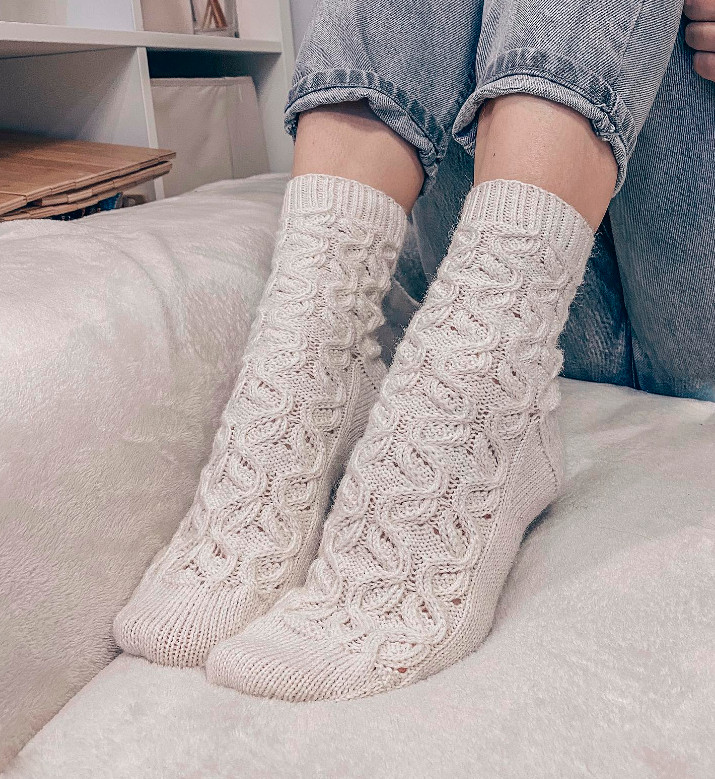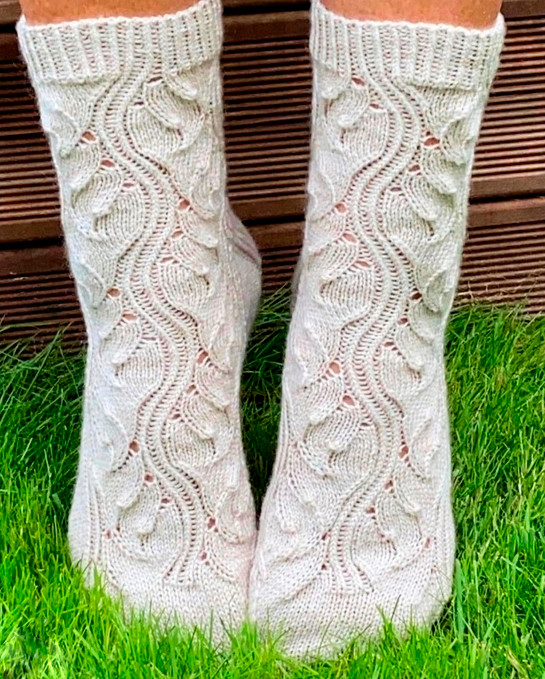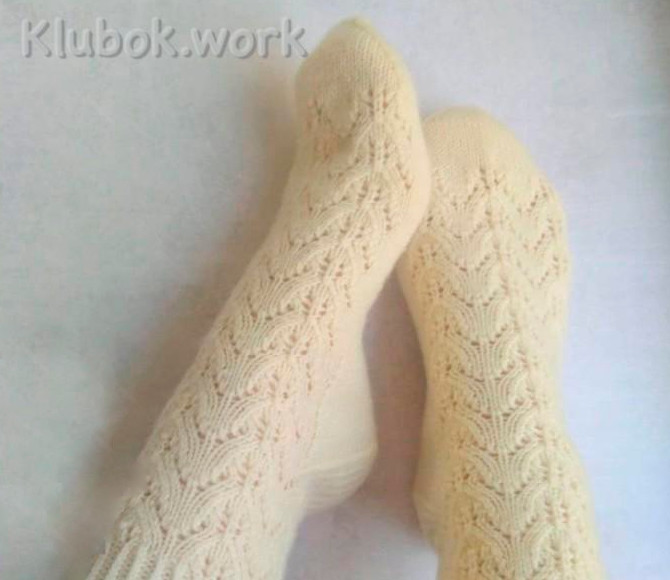




Very lazy slippers
Added: 17.09.2017 в 14:57 Views: 32960
Very lazy slippersKlubokhttp://klubok.work/1/53/7052/Klubokhttps://klubok.work/css/image/top-logo-en.png

Very lazy slippers a) they can be knitted in one evening b) they are knitted with 2 needles c) they use leftover yarn d) they are very comfortable to wear "Slippers 7 out of 7". They are knitted in 2 stages: - knit the rapport *4 rows with fans* - knit the sole, attaching to the side stitches. Slippers "classic" - with bobbles, lazy jacquard. You can also knit them in a solid color, striped, or however you like. But let's consider the classic option, especially if you have never knitted "bobbles" before. Knit the first time without looking back and trying them on: if they are too small or too big - you will surely gift them with delight, and you will quickly knit another pair for yourself. It's enough to knit it once to understand the principle. *** Description: 1. Cast on 49 stitches.
2. Knit 3-5 rows of garter stitch (in both the right and wrong rows, all stitches are knit). 3. (you can knit 2 slippers at once) This was the introduction, the entrance for the foot, ankle circumference, let's move on to the footbed. Row 1 (introducing yellow yarn): edge stitch, slip 1 stitch as knit, knit the next stitch, slip the 4th stitch as knit, knit the next 5th stitch. When slipping the stitch - yarn behind work. Knit until the 25th stitch, the middle one. From it, we will create 9 stitches: knit, yarn over, knit... slip the 26th, knit the 27th and so on to the end. Row 2: Slip the pink stitches without knitting, yarn in front of the work. Knit the yellow stitches as knit, including all 9 stitches in the center. Rows 3-4: again working with the pink yarn, knit all stitches as knit. Next step - repeat the first 4 rows four more times. Again slip the knit stitches and knit every other one, and from the center stitch, but now not the 25th, but the 29th, create 9 stitches. Wrong row: slip and knit every other one. And 2 rows with "pink", the main color - all knit. To avoid counting the center stitch each time, do this: when approaching the fan of the previous row, carefully look at which stitch is in the middle, and create from it. Here, in the photo, I specifically took it off the needle. How to calculate the size. For example, socks for my husband: 7 rapports in height, 7 fans = 25 cm (approximately, I measured in the finished state) - size 40-42. They turned out tight, but after washing and wearing they will stretch a little and be perfect. 6 rapports, 1 fan less = 23 cm, my size 39-40. In height, it turned out about 7.5-8 cm. In the pink slippers, I knitted 6 rapports, measured, 20 cm. The yarn is thinner, I knit tighter. So I will knit 7 fans in pink. How to transition to the sole and calculate it: Look at your footbed and estimate how many stitches you want to reserve for the sole. In my husband's, it's 9 cm, in the pink ones - 8. That turned out to be 19 (17 for my husband) stitches. And even if you estimate an even number, please remove 1 stitch, the sole should be odd. And the number of stitches on the sides should be even, respectively. In the center with arrows - will be the sole. On the sides - the side pieces. And what can we do here? Break the yarn, find the starting stitch of the sole, join and knit, but slippers are lazy and I don't do that. I knit the beginning of the knit row, the stitches of the first side piece. I knit the stitches of the sole and... turn the work. From now on, we will only knit 19 stitches in every row, in both right and wrong, knitting the last stitch of the sole, the 19th and the first stitch of the side piece together. Turned: 18 stitches, edge and side stitch - together. This is the principle. With each row, one of our side pieces decreases by 1 stitch. How to easily count the middle of the sole, look again at the picture. I, without counting, knit to the end of the fan, carefully watching where these 9 stitches end, then: one, two, three, four... 5+6 together, turned. I knit 18 stitches, 19+20 together. Turned. How I make the heel: I love smooth lines and curves, so my heel looks like this. I lay the work in front of me and see how many stitches I want to leave specifically for the heel. Out of 19 stitches, I selected 11. And I start to count the stitches with my fingers, as if "clicking abacus". These final 11 stitches will remain open in the last row and will connect with the open stitches of the side pieces. So 5 stitches on one side, and 5 on the other (you can leave 6 each, i.e., either 1 stitch more or less). I look further. So I need to decrease by 4 stitches from the sole on each side. I will decrease by knitting not 2 stitches together, but 3: 1 from the side piece, 2 from the sole. I count off another 4 stitches from the side pieces with my fingers. The solitaire matched, to transition to the heel, I need 9 stitches on the side pieces. I perform decreases: knit 4 knit and 4 purl rows by knitting 3 stitches together. What remains - see the photo: 11 stitches in the middle and 5 on the sides. We unwind the tail a bit and cut it, we will use it to sew the back. Since the seam will go right in the middle of the current number of stitches, we pull it through the stitches on the needle with a hook, so it sticks out in the center. We hook a stitch from the side piece, then a stitch from the sole and pull it through the first stitch. Again, we hook a stitch from the side piece and pull it through the stitch on the hook. "We link" the stitches of the first side piece and the stitches of half the heel with a hook. Then we do the same with the second side piece. In the end, there is 1 stitch left, with the tail sticking out nearby. We pull the tail through the stitch and sew the back together.