



Elastic slippers-socks
Added: 08.02.2019 в 14:12 Views: 57609
Elastic slippers-socksKlubokhttp://klubok.work/1/53/7646/Klubokhttps://klubok.work/css/image/top-logo-en.png
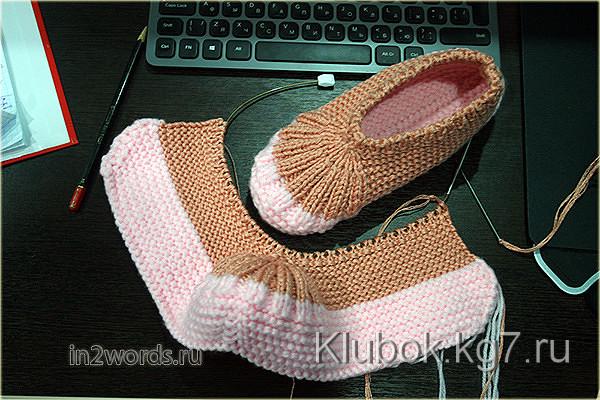
Due to the thick yarn, it is warm, soft, and knits up quickly (mainly in knit stitches). The predominant stitch in knitting this model of booties is garter stitch. The seam runs along the middle of the sole and heel and is done at the very end of the work. With proper sewing (along the edge of the cast-on row), it is almost invisible from the outside and not felt by the foot; it will be visible inside and on the heel, but looks neat. The photo and description provide calculations for approximately size 35. To increase the size of the slippers, you need to increase the starting number of stitches by multiples of two. 2 types of yarn: For the sole and a little higher, use pink acrylic Schachenmayr SMC Bravo 50 grams/133 meters in 4 strands from 1 skein. About 80-90 grams were used. For the upper part, use Iris cotton from PNK im. Kirova in small skeins of 25 grams in 7 strands. That is, approximately the same thickness of yarn or slightly thinner. The consumption was about 3.5 skeins. Needles No. 4 from ADDI with stoppers on the cables. You can use long straight needles with stoppers or a pair of circulars. The knitting will be in straight and back rows without edge stitches, but the last stitch of the row is almost always a purl to keep a neat row for sewing. The model has a total of 32 rows. It starts with 70 stitches, and increases in the middle and at the edges are made by passing stitches over the previous row's stitch, not by yarn overs. This makes it denser. If you can't do it, you can use yarn overs, but be sure to cross them when knitting, and there may be small holes in the fabric. The knitting consists of straight and back rows, specifying knit and purl rows. It is better to knit the last stitch of the rows as a purl, so the edge will be neater; this is not indicated in the rows for better perception of the entire pattern. Sole (pink color) 1st row (70 sts) knit stitches 2nd row (70 sts) 1 knit, 1 increase, 33 knit, 1 increase, 2 knit, 1 increase, 33 knit, 1 increase, 1 knit 3rd (74 sts) knit 4th (74 sts) 1 knit, 1 increase, 35 knit, 1 increase, 2 knit, 1 increase, 35 knit, 1 increase, 1 knit 5th (78 sts); knit 6th (78 sts) 1 knit, 1 increase, 37 knit, 1 increase, 2 knit, 1 increase, 37 knit, 1 increase, 1 knit 7th (82 sts) knit 8th (82 sts) 1 knit, 1 increase, 39 knit, 1 increase, 2 knit, 1 increase, 39 knit, 1 increase, 1 knit 9th (86) knit 10-12 (86) All knit. Here the sole approximately ends. Toe At the toe, stitches are first increased, and then ribbing 2x2 is combined with decreases. 13th (86) 28 knit, [shaping the toe — *2 knit, 2 purl* repeat 7 times, 2 knit], 28 knit 14th (86) 28 knit, [toe *2 purl, 2 knit* repeat 7 times, 2 purl], 28 knit. At this point, change the yarn (brown color) 15-24 (86) 28 knit, ribbing 2x2 as per pattern, 28 knit. Decreases begin. First, ribbing 2x2 is converted to 1x1. That is, in the 2x2 ribbing, 2 knit stitches are knitted together, and 2 purl stitches are knitted together. 25th (71) 28 knit, ribbing 1x1 from ribbing 2x2 (decreases), 28 knit. 26th (71) 28 knit, ribbing 1x1 as per pattern, 28 knit 27th (63) 28 knit, 2 together knit 8 times, 27 knit 28th (63) 27 knit, 8 purl, 28 knit 29th (59) 28 knit, 2 together knit repeat 4 times, 27 knit 30th (57) 27 knit, 2 together purl repeat 2 times, 28 knit 31st (57) Ribbing 1x1 32nd (57) Ribbing 1x1 as per pattern. The fabric ends up being convex in the middle. This is the toe. The beginning of the knitting is the middle of the foot and heel. The boot preparation and the finished product are shown in the photo. Assembly: First, close the stitches of the ribbing with a needle, then continue to sew the heel, then the foot, folding the bootie preparation in half. Closing with a needle is chosen for a more interesting edge appearance and better elasticity. Sew the heel a little more tightly to maintain its shape. The upper yarn is slightly thinner than the lower one so that the sole is thicker, fluffier, and softer, while the top fits the foot more snugly and is lighter. Along the edge of the sole on the sides, crochet in a crab stitch (capturing the stitches of the last row of the sole).