



Bonnet for newborn
Added: 03.10.2025 в 20:01 Views: 3756
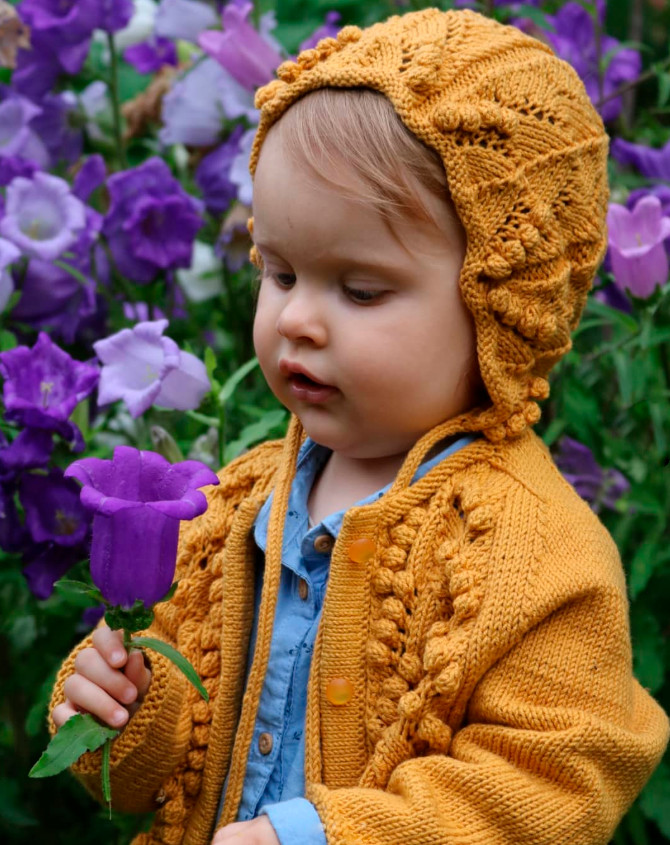
Bonnet for newbornKlubokhttp://klubok.work/23/189/9192/Klubokhttps://klubok.work/css/image/top-logo-en.pngYarn Brilliant Vita, yarn composition - 45% wool (cluster), 55% acrylic, 100 g/380m, color ultra pink (№ 5102), needles №2.5. Consumption about 90 g.
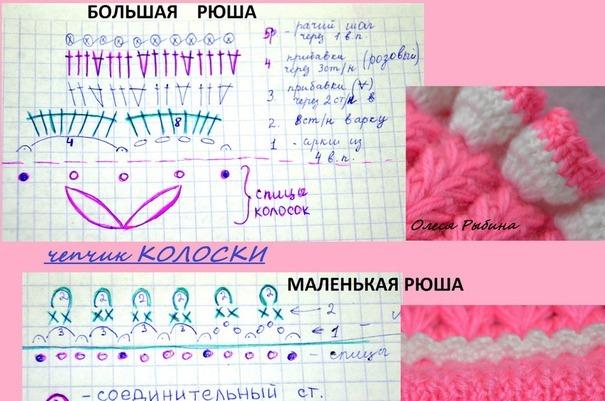
The bonnet is double, the upper part with 2 threads, the inner part with one thread. Decorated with frills (crochet)
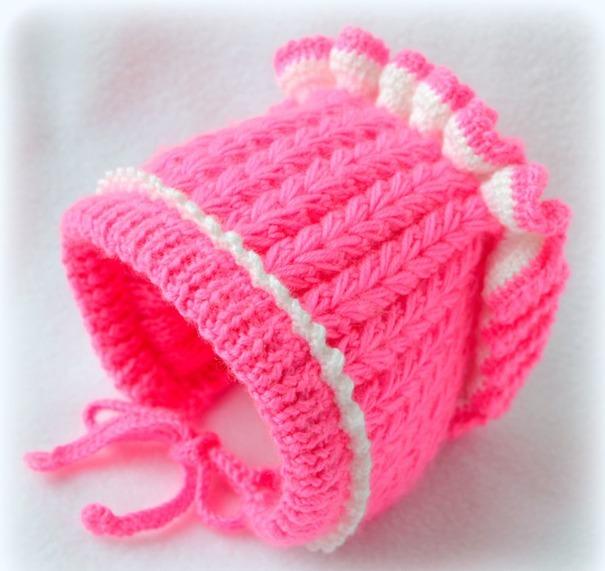
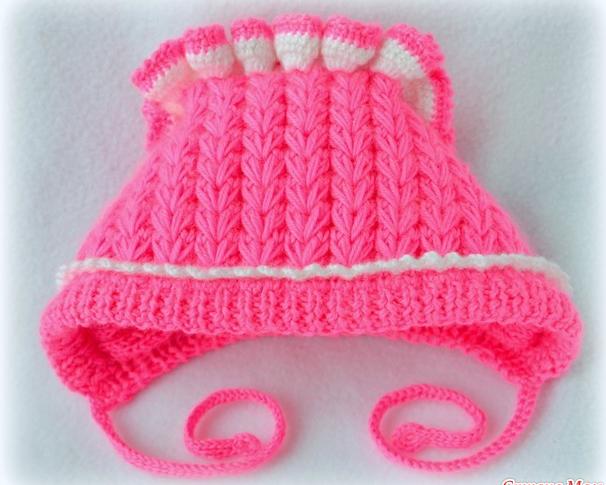
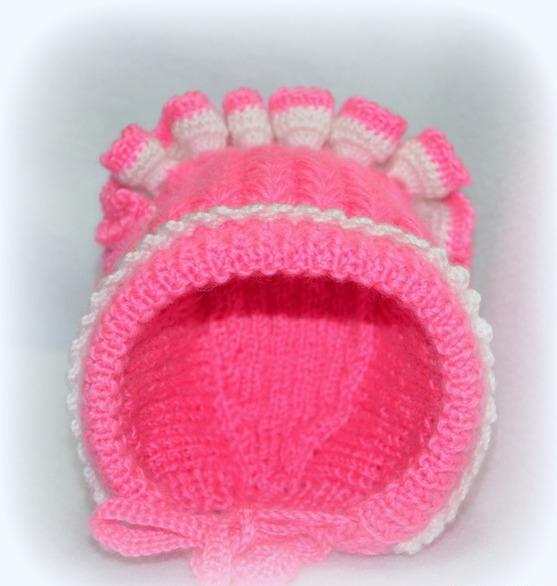
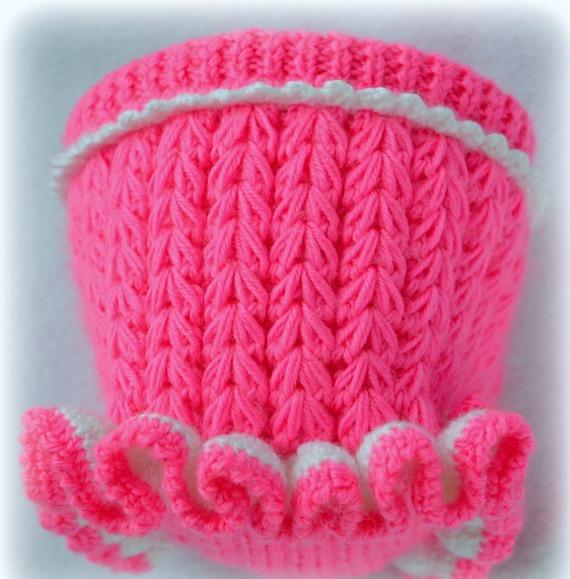
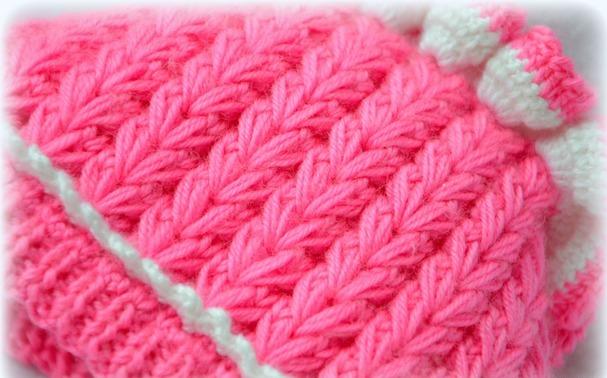
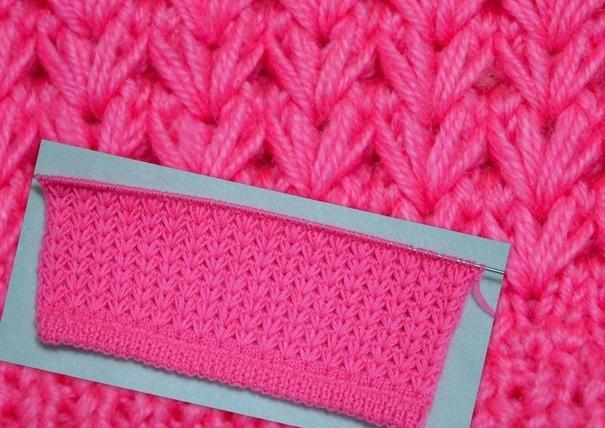
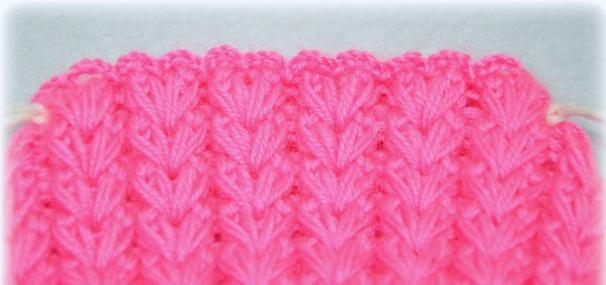
Pattern chart and frills.The pattern is voluminous
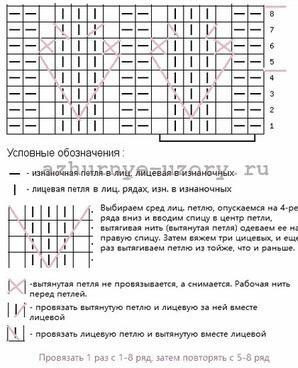
Legend:
1.— purl stitch in knit rows, knit stitch in purl rows
2. knit stitch in knit rows, purl in purl rows
3. Choose the middle knit stitch, go down 4 rows and insert the needle into the center of the stitch, pulling the thread (pulled stitch) and place it on the right needle. Then knit three knit stitches, and once again pull a stitch from the same one as before.
4. The pulled stitch is not knitted, but slipped. The working thread is in front of the stitch.
5. Knit the pulled stitch and the knit stitch behind it together as a knit
6. Knit the knit stitch and the pulled one together as a knit
Knit once from rows 1–8, then repeat from rows 5–8.
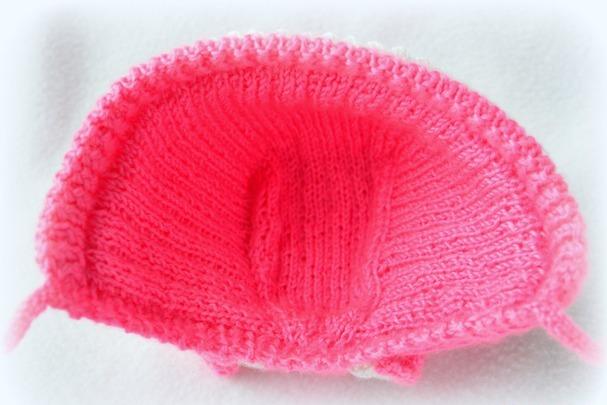
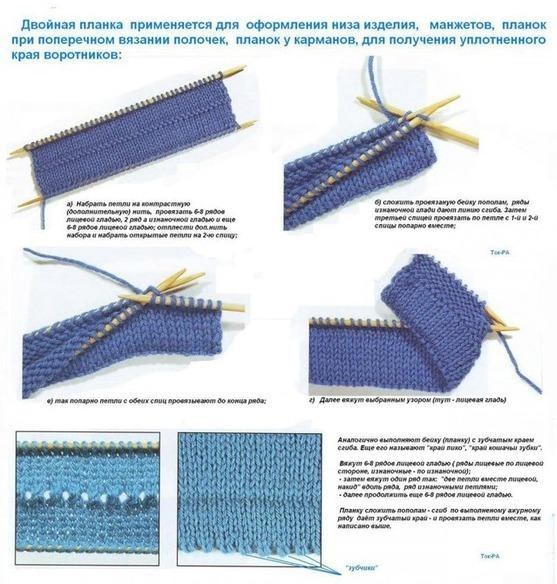
I will briefly explain how I knitted the double bonnet. First, you need to knit the ribbing twice as wide as necessary, fold it in half. In the middle for the fold, knit a row of purl stitches. Next, connect the stitches on the needle with the cast-on row. You can do it in this way.
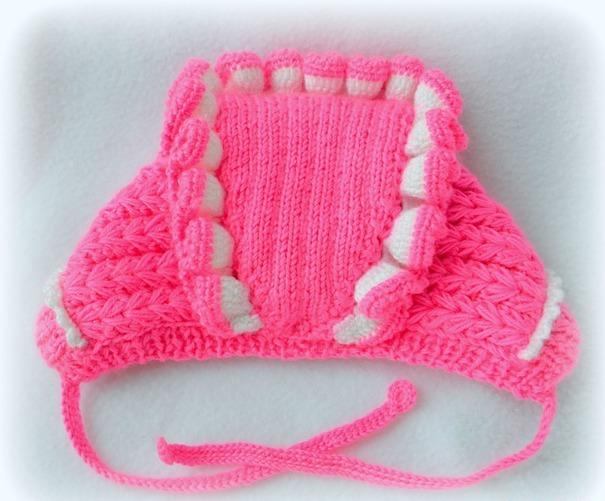
Then knit the pattern. Then form the bonnet (according to the MK). Knit the back part according to the pattern, but without "ears", resulting in a ribbing of 3/1.
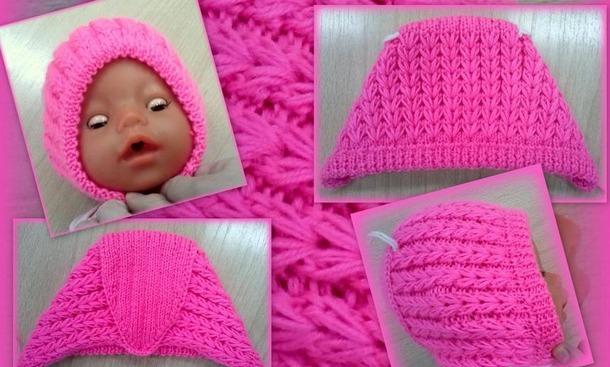
The upper part is ready. This is how it looks on a doll.
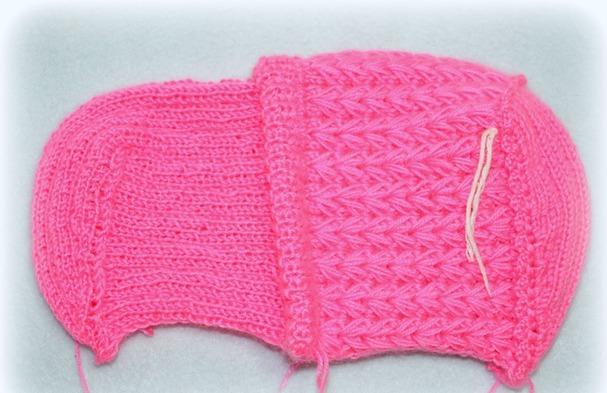
Next, with 1 thread cast on from the inner edge of the ribbing and knit the inner bonnet with ribbing 3/1.
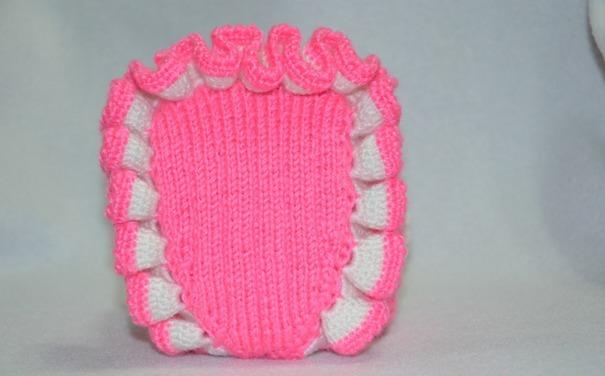
Now we knit the frills. Small
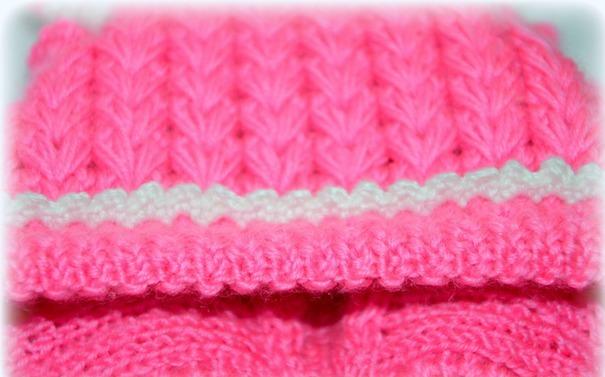
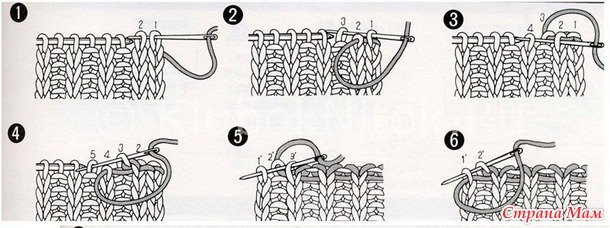
And only after this do we knit the lower ribbing (with 2 threads). Cast on for it, catching both edges - the inner bonnet and the upper one. Close the edge with a needle. Don't forget about the ties.
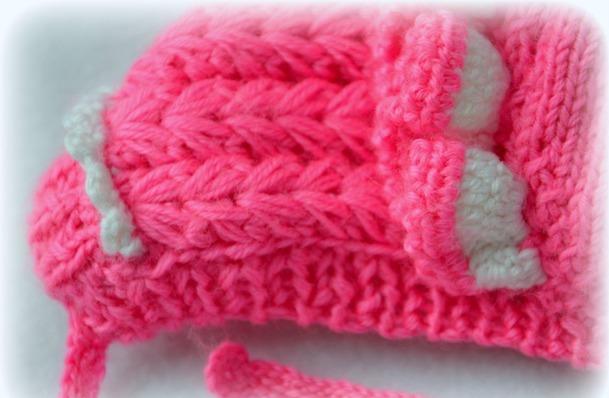
Knitting a bonnet
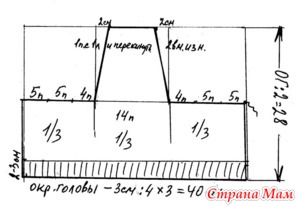
Drawing the pattern
For the bonnet, measure the circumference of the head and subtract 3 cm, divide the remainder into 4 parts, and for the width of the pattern grid, take .
For example: Head circumference = 56 cm.
(56 cm. – 3 cm.) /4 x 3 = 40 cm.
Draw a rectangle, the width of which is 40 cm, and the height of the head circumference (56:2=28 cm). Divide the height of the resulting rectangle in half and draw a horizontal line. Divide the width of the upper rectangle into 3 parts
.
At the division points, place dots through which draw vertical lines. Shorten the central part by 2-3 cm on each side. Outline the bonnet pattern.
1. Seamless knitted bonnet.
Knit according to the principle of a sock heel. Start knitting the bonnet from the widest point of the pattern. The edge can be finished as desired (points, ribbing, garter stitch). Knit a border 2-3 cm high and switch to the main pattern. After knitting the required height of the bonnet, conditionally divide the total number of stitches into 3 parts. To make the bonnet sit better on the head, increase the height of the central part by knitting short rows.
For this, divide the stitches of the side parts (1/3) into 6-8 equal sections. While knitting a row on the front side, do not knit the stitches at the end of the left needle (in our example, 1/8 part of 1/3 = 5 stitches). Turn the work with the purl side facing you. At the beginning of knitting from the working needle (left) NOKS, 1 p. s. (Thread Away From Self, slip 1 stitch). Knit a row on the purl side, not finishing 5 stitches (1/8 of 1/3). Turn the work with the front side facing you, 1 p. s., thread behind. To avoid holes at the turn, slip the first stitch, pulling the thread tightly or wrap the working thread around the first stitch on the left needle. Not finishing another 1/8 part at the end of the row, leave 10 stitches unknitted. On the left needle, 5 + 5 = 10 stitches have not been knitted. Turn the work again. Continue knitting in short rows until we reach the stitches of the central part of the bonnet (1/3).
Now knit the back part of the bonnet according to the principle of a sock heel on 5 needles. The stitches of the side parts go to the turn of the work and connect with the middle part into a whole. For this, on the front side of the work, after knitting the stitches of the central part, slip the last stitch of the central part, knit the 1st stitch of the 3rd part and transfer the slipped stitch onto the knitted one (knit 2 together). Do not knit the remaining stitches on the left needle, but immediately turn the work with the purl side facing you, NOKS, 1 p. s. Knit the stitches of the central part, and knit both the last stitch of the middle part and the 1st stitch of the side part together purlwise, leaving the remaining stitches on the left needle unknitted. Turn the work with the front side facing you, 1 p. s. - thread behind.
Knit only the middle part, knitting 2 purl stitches at the end on the front side each time, and on the purl side – 2 purl stitches.
When only 1/3 of the stitches (middle) remain on the needle, reduce the number of stitches on the needle by half, knitting the entire row in 2 purl stitches.
Cut the thread, cast on the necessary number of stitches for the ties, then cast on stitches along the braids of the side part of the bonnet, knit the stitches of the central part, cast on stitches along the other braid and add chain stitches for the other tie. Knit 2-3 rows and close all stitches.
2. Sewn bonnet
After knitting the wide part of the bonnet, conditionally divide the number of stitches on the needle into 3 parts. Close the first part, knit the 2nd and 3rd, turn the work and close the stitches of the 1/3 part. Knit only the middle part to the desired height, making decreases on both sides according to the triangle calculation. For this, divide the height of the triangle by the number of stitches that need to be decreased over this height (1 cm – 3 stitches, 1 cm – 4 rows, then multiply 4 rows by 14 cm = 56 rows). You need to decrease 7 stitches. Thus, divide 56 rows by 7 p. = 8, that is, in every 8th row knit the last 2 stitches together on both the front and purl sides.
Sew the side parts to the central part, and then proceed as in the seamless knitted bonnet.