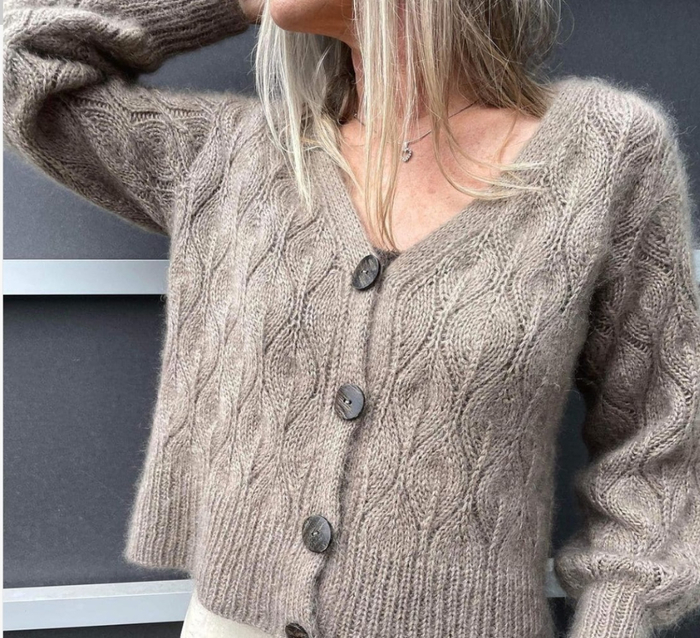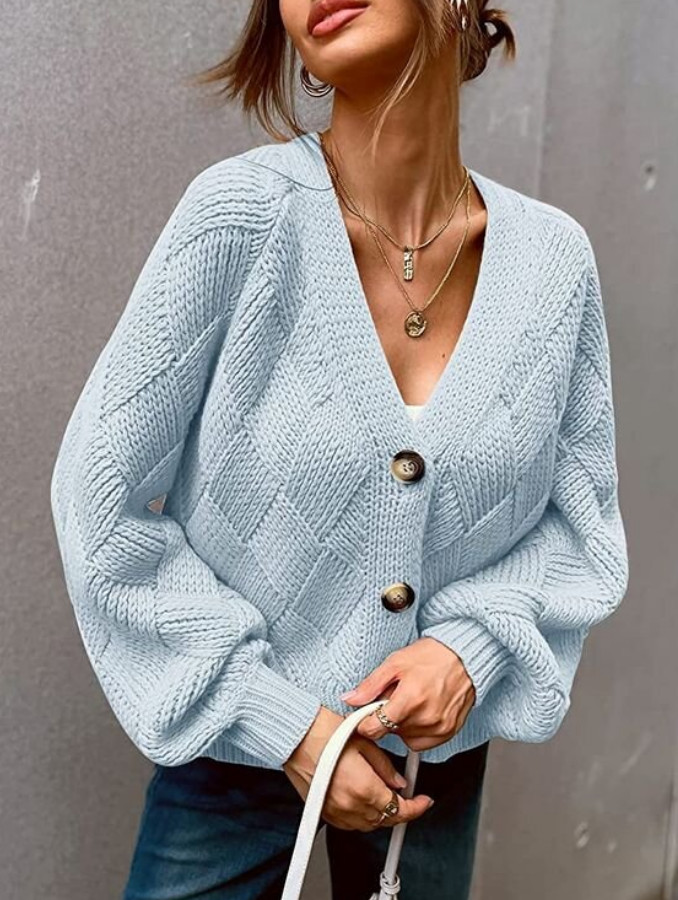




Sand cardigan with short sleeves
Added: 18.09.2025 в 16:05 Views: 299
Sand cardigan with short sleevesKlubokhttp://klubok.work/1/2/9119/Klubokhttps://klubok.work/css/image/top-logo-en.pngSmooth yarn and light natural tones are best suited for expressive patterns. And our charming cardigan made of select cotton is just what you need for spring!

Sizes: 36/38 (40) 42/44
You will need: yarn (100% cotton; 180 m/50 g) — 350 (450) 500 g sand; needles No. 3; circular needles No. 3; 5 buttons (size 12 mm).
Pattern 1: ribbing (odd number of stitches). After the initial row start with 1 purl row.
Purl rows: selvedge, alternately 1 knit, 1 twisted purl, finish with 1 knit, selvedge.
Knit rows: knit the stitches according to the pattern, while twisted purls are knitted as twisted knits.
Pattern 2: purl stitch = knit rows — purl stitches, purl rows - knit stitches.
Pattern 3: lacy pattern (number of stitches multiple of 30 (32) 34 + 7 + 2 selvedge) = knit according to the chart. It provides the rapport for size 1. The highlighted colored cells for size 2 should be doubled, for size 3 tripled, i.e., here perform 1 or 2 additional stitches in pattern 2. The chart shows knit and purl rows. Start with 1 selvedge, repeat the rapport continuously, finish with the first 7 stitches of the rapport and 1 selvedge.
Repeat rows 1-24 continuously.
Pattern 4: garter stitch = knit and purl rows — knit stitches.
Knitting density: patterns 3 and 2 on average — 28 sts x 37 rows = 10 x 10 cm; pattern 4 (= border) — 5 sts = 2 cm.
Pattern chart:


 1 knit stitch: knit row – knit stitch, purl row – purl stitch

1 purl stitch: knit row – purl stitch, purl row – knit stitch
 purl
purl
U = 1 yarn over
< 1 twisted knit
> 1 twisted purl
2 stitches knit together
2 stitches knit together leaning left (1 stitch slipped as knit, 1 knit, then pull it through the slipped stitch)
2 stitches knit together purl
2> 2 stitches knit together twisted purl

3 stitches knit together by yarn over (1 stitch slipped as knit, 2 stitches knit together, then pull it through the slipped stitch)
3 stitches knit together
5 - 5 purls
5 stitches knit together by yarn over (3 stitches slipped together as knit, 2 stitches knit together, then pull it through the slipped stitches)


⟙ = insert needle 3 rows below, grab and pull out 1 stitch, 1 yarn over, 1 knit, 1 yarn over, reinsert needle 3 rows below, grab and pull out 1 stitch (= 5 sts)
⟞ = leave the next 5 stitches on a holder in front of work, wrap working yarn twice around stitches on the holder, without pulling too tightly, then knit the stitches from the holder as follows: knit 2 stitches together, 1 yarn over, 1 purl, 1 yarn over, knit 2 stitches together leaning left
■ = see instructions for pattern 3
Work description:
Back: cast on 129 (137) 145 stitches and for the border knit 2 cm with pattern 1, starting with 1 purl row and finishing with 1 purl row on purls.
Continue working with pattern 3. After 39 cm = 144 rows from the border, bind off for armholes on both sides 1 x 7 sts = 115(123) 131 sts.
Attention: the bound-off edges of 7 sts will subsequently form the entire width of the armhole for the front and back.
After 55 cm = 204 rows (56.5 cm = 210 rows) 58.5 cm = 216 rows from the border, bind off for shoulder slope on both sides 1 x 5 sts, then in every 2nd row bind off 4 x 6 (7) 8 sts. Simultaneously with the 1st shoulder decrease bind off the middle 47 sts for the neckline and finish both sides separately.
After 58.5 cm = 216 rows (60 cm = 222 rows) 62 cm = 228 rows from the border, bind off the remaining 5 sts for the shoulders.
Left front: cast on 67 (71) 75 stitches and for the front border + lower border in the 1st purl row distribute the stitches as follows: 5 sts for pattern 4 (= border), 61 (65) 69 sts for pattern 1, selvedge.
After 6 rows from the initial row, knit in the next purl row 5 knits, 61 (65) 69 purls and the selvedge. Height of the lower border: 2 cm = a total of 7 rows.
Continue working as follows: selvedge, 60 (64) 68 sts for pattern 3, for this execute the last 23 (25) 27 sts of the chart once, then execute the rapport once and the first 7 sts of the chart once, finish with 1 stitch in pattern 2 and 5 stitches in pattern 4 (= border).
Attention: do not perform the armhole!
After 48.5 cm = 180 rows (50 cm = 186 rows) 52 cm = 192 rows from the border, bind off for the neckline on the left edge 1 x 33 sts = 34 (38) 42 sts.
Perform the shoulder slope on the right edge as on the back. At the height of the back, bind off the remaining 5 sts of the shoulder.
Right front: knit the same as the left front, but mirrored and with 5 buttonholes. To do this, in the 1st purl row from the initial row knit the selvedge, 61 (65) 69 sts for pattern 1 and 5 sts for pattern 4. After the border distribute the stitches as follows: 5 sts for pattern 4, 1 stitch for pattern 2, 60 (64) 68 sts for pattern 3, for this execute the rapport 2 times, finish with 1 selvedge.
For the 1st buttonhole in the 38th (36th) 34th row of the border (= knit row) knit 2 knits, make 1 yarn over, knit 2 stitches together and 1 knit. The yarn over in the next purl row should be knitted as knit. The next 4 buttonholes should be made with an interval of 34 (36) 38 rows.
Sleeves: cast on 81 (85) 89 stitches for each sleeve and knit the border as on the back, while in the last purl row, evenly distributed, add 4 (6) 8 sts = 85 (91) 97 sts.
Continue working with pattern 3, starting with 1 selvedge and the last 23 (25) 27 sts of the chart, execute the rapport 2 times, finish with 1 selvedge.
For the sleeve slope add 1 stitch on both sides after 16 cm = 60 rows from the border, then in every 8th row add 3 x 1 stitch and knit with pattern 2 = 93 (99) 105 sts. For a low sleeve cap, after 23 cm = 86 rows from the border, bind off 1 x 4 sts on both sides, then in every 2nd row bind off 4 x 4 sts.
After 26 cm = 96 rows from the border, bind off the remaining 53 (59) 65 sts.
Assembly: perform shoulder seams. For the neckline trim, cast on 177 stitches on circular needles along the neckline edge and knit 4 rows with pattern 1, starting with 1 purl row. Then bind off all stitches as purls.
Perform side seams up to the bound-off edges of the armholes. Perform sleeve seams and set in the sleeves, positioning the sleeve seam in the middle of the bound-off edge of the armhole and gently stretching the curved edges if necessary during setting in. Sew on the buttons.